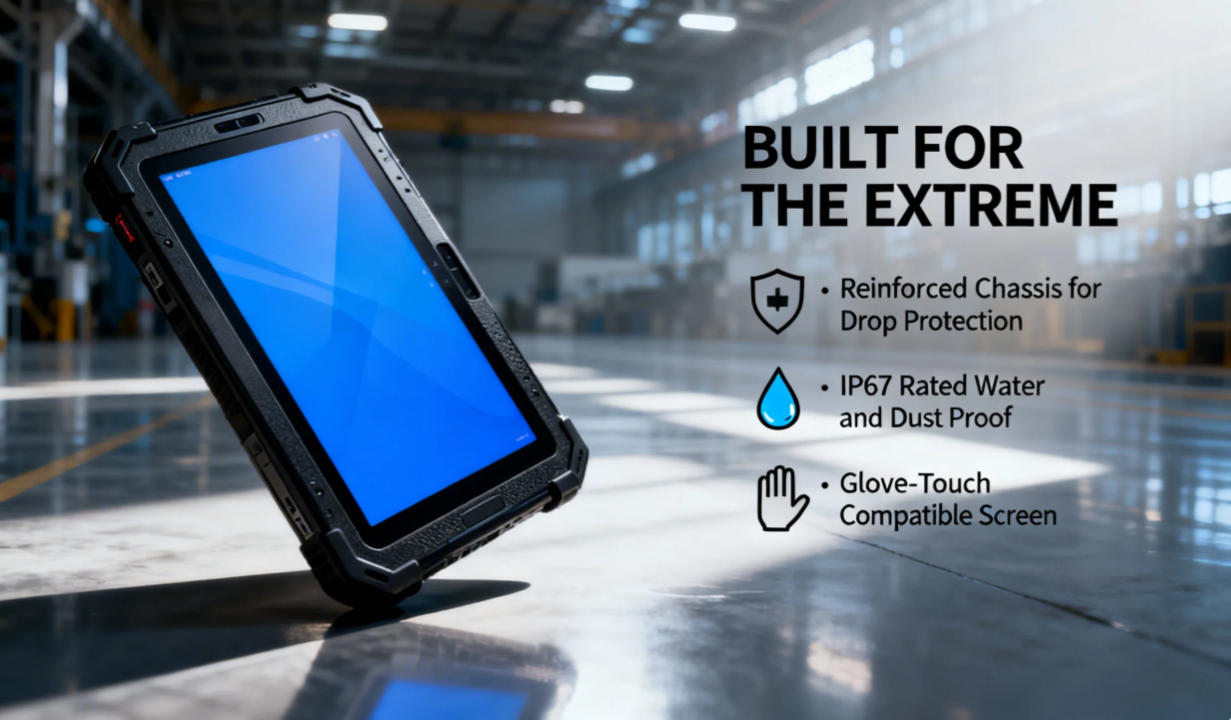
China’s rugged tablet manufacturers have transformed enterprise mobility by delivering MIL-STD-810H certified, IP67-rated devices at 40-60% lower cost than Western brands like Getac and Panasonic. This comprehensive guide covers everything procurement professionals need—from OEM/ODM customization starting at 50-unit MOQ to navigating FCC/CE certifications, supply chain verification, and total cost of ownership calculations. Whether you’re sourcing for US warehouse logistics, EU hazardous-zone deployments, or Australian field service operations, understand how to evaluate Chinese suppliers, verify authenticity, protect intellectual property, and ensure long-term firmware support for mission-critical applications.
1. What Is a China Rugged Tablet Manufacturer? Definition & Market Context
A China rugged tablet manufacturer specializes in producing industrial-grade mobile computing devices engineered to withstand extreme environmental conditions—extreme temperatures, water immersion, drops, vibration, and electromagnetic interference. Unlike consumer tablets designed for office environments, rugged tablets from Chinese manufacturers deliver enterprise-grade durability at significantly lower price points than equivalent Western alternatives.
The distinction matters critically for procurement teams. rugged tablet OEM manufacturer China specifications Chinese manufacturers operate across three primary models: ODM (Original Design Manufacturer) where the factory designs the product; OEM (Original Equipment Manufacturer) where you provide specifications; and white-label/rebrand where you customize existing designs. This flexibility enables businesses to launch custom rugged tablets without the 18-24 month development cycles required by traditional manufacturers.

Rugged vs. Consumer Tablets — Key Differences
Consumer tablets (iPad, Samsung Tab) prioritize sleek design and cost reduction. Rugged tablets prioritize durability and total cost of ownership. A consumer tablet dropped from 1.2 meters typically experiences screen damage; a rugged tablet tested to MIL-STD-810H withstands 26 drops from 1.5 meters onto concrete without functional degradation. Operating temperature ranges illustrate this difference: consumer tablets function 0-35°C; rugged tablets from quality Chinese manufacturers operate -20°C to 60°C, enabling deployment in freezers, desert sites, and arctic research stations.
waterproof rugged tablet IP67 rating industrial Water resistance ratings differ fundamentally. Consumer tablets offer minimal water resistance; rugged tablets achieve IP67 (immersion to 1 meter for 30 minutes) or IP68 (submersion beyond 1 meter) ratings. For warehouse operations where devices contact moisture daily, or field service environments where rain exposure is routine, this durability differential directly impacts device lifespan and total cost of ownership.
US enterprises prioritize MIL-STD-810H and FCC certification for regulatory compliance; EU organizations require CE marking and ATEX certification for hazardous environments; Australian companies emphasize RCM compliance and regional warranty support. Chinese manufacturers must address all three certification regimes to serve global markets effectively.
Why Source Rugged Tablets from China? Cost, Scale & Supply Chain Advantages
China dominates rugged tablet manufacturing for three compelling reasons. First, cost advantage: Chinese manufacturers achieve 40-60% lower pricing than Getac, Panasonic, or Zebra through optimized supply chains, lower labor costs, and high-volume production efficiency. A fully rugged 10-inch tablet from a Western brand costs $2,500-$4,000; equivalent Chinese quality delivers $1,000-$1,800.
Second, manufacturing scale. Chinese contract manufacturers operate facilities producing 50,000-500,000 units annually, enabling rapid scaling from pilot programs to enterprise deployments. When warehouse automation requires deploying 10,000 devices across 200 facilities, Chinese manufacturers can accommodate accelerated timelines that Western competitors cannot match.
Third, supply chain resilience. China’s ecosystem of component suppliers, assembly partners, and logistics providers creates redundancy and flexibility absent elsewhere. Component shortages that would delay Western manufacturers 6-12 months often resolve within 2-4 weeks through alternative sourcing in China’s interconnected manufacturing network.
OEM vs. ODM vs. White-Label — Which Model Fits Your Business?
ODM (Original Design Manufacturer): The factory designs the product. You select from existing designs, customize software/branding, and launch to market. Timeline: 6-12 weeks. Ideal for businesses prioritizing speed-to-market over proprietary differentiation.
OEM (Original Equipment Manufacturer): You provide complete specifications; the factory manufactures to your exact requirements. Timeline: 12-24 weeks. Ideal for enterprises with specific hardware requirements (e.g., specialized sensors, custom ports, unique form factors).
White-Label/Rebrand: The factory supplies finished products with your branding applied. Timeline: 4-8 weeks. Ideal for distributors and resellers entering new markets without manufacturing investment.
2. Full Range of Rugged Tablet Products & Specifications
Android Rugged Tablets (OS 11/12/13, GMS Certified)
Android dominates rugged tablet deployments globally, representing 65-75% of enterprise rugged device installations. Chinese manufacturers deliver Android tablets with Google Mobile Services (GMS) certification, ensuring compatibility with Google Play Store, Gmail, Maps, and enterprise MDM solutions like Microsoft Intune and Samsung Knox.
android rugged tablet MDM integration enterprise Modern Android rugged tablets from quality Chinese manufacturers support containerized work profiles, enabling BYOD programs where employees access corporate applications on personal devices without exposing personal data to IT administrators. This capability proves essential for organizations implementing zero-trust security architectures across mobile devices.
Processor options range from Snapdragon 680 (budget tier, $600-$800) through Snapdragon 870 (mid-range, $1,000-$1,400) to Snapdragon 8 Gen 1 (premium tier, $1,600-$2,200). RAM configurations span 4GB to 12GB; storage from 64GB to 512GB. Battery capacity ranges 5,000mAh to 13,000mAh, enabling 8-16 hour field operations without charging.
Windows Rugged Tablets (Win 10/11 IoT Enterprise)
Windows rugged tablets address enterprises with legacy Windows-dependent applications—SAP, Oracle, specialized manufacturing software, or proprietary business systems that lack Android/iOS versions. Chinese manufacturers deliver Windows tablets with Intel Pentium, Core m, or Core i processors, enabling full Windows application compatibility.
Windows IoT Enterprise editions provide specialized features for industrial deployments: extended support lifecycles (10+ years), specialized drivers for industrial sensors, and enterprise management through Group Policy and Windows Update for Business. For organizations managing 5,000+ devices across manufacturing facilities, Windows tablets offer centralized management efficiency that consumer-grade operating systems cannot provide.
Vehicle-Mounted Rugged Tablets
Fleet management, public transportation, and emergency response applications require tablets permanently installed in vehicles. Vehicle-mounted rugged tablets from Chinese manufacturers feature specialized designs: 24/7 operational capability, extreme vibration tolerance (up to 20G continuous), and integration with vehicle power systems (12V/24V DC input with surge protection).
These devices support integrated GPS, cellular connectivity (4G/5G), and vehicle CAN-bus integration for real-time fleet tracking, driver communication, and route optimization. A logistics company managing 500 delivery vehicles deployed vehicle-mounted rugged tablets from a Chinese manufacturer, reducing delivery time by 15% through real-time route optimization and customer proof-of-delivery capture.
Military-Grade Rugged Tablets
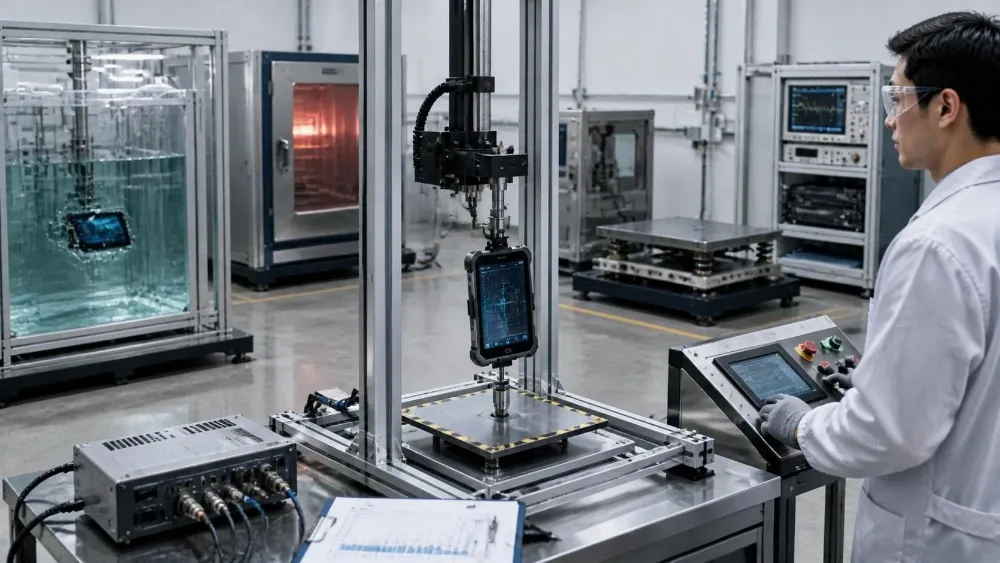
Military and defense applications demand extreme durability standards. Chinese manufacturers produce tablets meeting MIL-STD-810H, MIL-STD-461 (electromagnetic compatibility), and MIL-DTL-64159 specifications. These devices undergo rigorous testing: 26 consecutive drops from 1.5 meters, thermal cycling -32°C to 71°C, humidity cycling, salt-fog corrosion testing, and functional verification under extreme conditions.
Form Factors: 7″ / 8″ / 10″ / 12″ Tablets
Form factor selection impacts field usability and cost. 7-inch tablets ($600-$900) prioritize portability for field workers, fitting jacket pockets and single-hand operation. 10-inch tablets ($1,200-$1,800) balance screen real estate for data-intensive applications with reasonable portability. 12-inch tablets ($1,600-$2,400) optimize for stationary deployments—retail POS, manufacturing floor monitoring, or vehicle-mounted applications.
| Form Factor | Weight | Best Use Case | Typical Price Range |
|---|---|---|---|
| 7-inch | 400-500g | Mobile field service, delivery drivers | $600-$900 |
| 8-inch | 500-650g | Warehouse inventory, healthcare | $800-$1,200 |
| 10-inch | 700-900g | Construction, mining, manufacturing | $1,200-$1,800 |
| 12-inch | 1,000-1,300g | Vehicle-mounted, retail POS, monitoring | $1,600-$2,400 |
5G / 4G LTE Rugged Tablets
5G rugged tablet industrial IoT connectivity 5G connectivity enables real-time video streaming, augmented reality applications, and ultra-low-latency remote operations. Chinese manufacturers now deliver 5G-enabled rugged tablets with Snapdragon X55/X60 modems, supporting sub-6GHz and mmWave frequencies. While 5G coverage remains limited in many regions, forward-looking enterprises deploying devices with 5-7 year lifecycles benefit from 5G readiness.
4G LTE remains the standard for global deployments, with dual-SIM support enabling fallback connectivity and geographic flexibility. Rugged tablets supporting LTE Cat-18 (1.2Gbps download) deliver performance sufficient for real-time video surveillance, live data synchronization, and video conferencing in field environments.
Rugged Tablets with Integrated Barcode Scanner / RFID / NFC / GPS
Warehouse and logistics applications demand integrated barcode scanning without external accessory dependency. Chinese manufacturers integrate 1D/2D barcode readers, RFID readers, and NFC capabilities directly into tablet chassis. This integration eliminates separate scanner devices, reduces total cost of ownership, and simplifies device management.
GPS integration enables real-time location tracking for field service teams, delivery vehicles, and asset tracking. A Chinese manufacturer delivered rugged tablets with integrated Zebra barcode engines to a US 3PL logistics provider managing 200 distribution centers. The integrated solution reduced barcode scanning errors by 40% compared to external scanner attachment methods.
3. Rugged Standards, Certifications & Compliance Framework
MIL-STD-810H Drop, Shock & Vibration Testing
MIL-STD-810H represents the US military standard for equipment durability. Tablets certified to this standard undergo rigorous testing: 26 consecutive drops from 1.5 meters onto concrete, 15G shock pulses in multiple directions, and continuous vibration exposure across frequency ranges 5-500Hz. Devices must remain fully functional after testing—no cosmetic damage tolerance.
For enterprise applications, MIL-STD-810H certification provides confidence in device durability across extreme field conditions. A manufacturing company deploying 5,000 rugged tablets across factory floors with heavy machinery vibration selected MIL-STD-810H certified devices, reducing device failure rates from 8% annually (consumer tablets) to 0.5% annually (certified rugged tablets).
US federal agencies, US military contractors, and US healthcare systems often mandate MIL-STD-810H certification for device procurement. EU organizations rarely require this standard, preferring CE/ATEX certifications instead. Always verify certification requirements for your target market before finalizing supplier selection.
IP65 / IP67 / IP68 Waterproof & Dustproof Ratings
IP (Ingress Protection) ratings specify water and dust resistance. IP65 means complete dust protection and water jet resistance (can withstand water spray from any direction). IP67 means complete dust protection and immersion to 1 meter for 30 minutes. IP68 means complete dust protection and immersion beyond 1 meter (manufacturer-specified depth and duration).
For warehouse environments with occasional water exposure, IP65 suffices. For outdoor field service in rain, IP67 provides appropriate protection. For cold-chain operations where devices operate in freezers with periodic washdown cycles, IP67 or IP68 becomes mandatory. Chinese manufacturers deliver tablets across all three ratings; ensure specifications match your deployment environment.
CE / FCC / RoHS / ATEX / UL Certifications
CE Mark (Europe): Certifies compliance with EU electromagnetic compatibility, safety, and radio equipment directives. Required for selling rugged tablets in EU markets. Chinese manufacturers typically achieve CE certification through notified bodies (TÜV, DNV, Bureau Veritas).
FCC Certification (United States): Certifies compliance with US electromagnetic interference and radio frequency standards. Required for selling devices with cellular/wireless capabilities in US markets. FCC certification typically costs $3,000-$8,000 and requires 4-8 weeks.
RoHS (Restriction of Hazardous Substances): Certifies absence of lead, mercury, cadmium, and other hazardous materials. Required in EU and increasingly adopted by US enterprises. Chinese manufacturers comply through material selection and supplier verification.
ATEX Certification (Europe): Certifies suitability for hazardous/explosive atmospheres. Required for oil/gas, chemical manufacturing, and mining operations in EU. ATEX certification is expensive ($20,000-$50,000) and requires specialized testing. Only select Chinese manufacturers maintain ATEX certification.
UL Certification (US/Global): Certifies electrical safety. Increasingly required by US enterprises for procurement. UL certification typically costs $5,000-$15,000.
Demand actual certification documents, not just claims. Verify certifications through issuing bodies’ online databases (CE notified body registry, FCC equipment database, ATEX NANDO database). Counterfeit certificates are common—a US government procurement officer discovered fake CE certificates from a Chinese supplier after $2M order commitment.
Operating Temperature: -20°C to 60°C Extreme Environment Support
Standard consumer tablets operate 0-35°C. Rugged tablets designed for extreme environments operate -20°C to 60°C. This capability enables deployment in:
- Freezer operations (cold-chain logistics, pharmaceutical storage)
- Desert field service (oil/gas operations, mining)
- Arctic research stations
- High-altitude deployments (thin atmosphere, extreme cold)
- Factory floors with extreme heat from manufacturing processes
Achieving this temperature range requires specialized component selection (military-grade batteries, thermal management systems, cold-rated lubricants) and rigorous testing. Chinese manufacturers delivering genuine -20°C to 60°C support charge premium prices ($1,400-$2,200 for 10-inch tablets) but enable deployments impossible with standard rugged tablets.
4. OEM/ODM Custom Rugged Tablet Manufacturing
Hardware Customization (RAM, Storage, Screen, Ports, Battery)
custom rugged tablet hardware specifications OEM Chinese OEM manufacturers accept detailed hardware specifications and deliver custom devices. Customization options include:
- RAM: 4GB to 12GB configurations for different performance requirements
- Storage: 64GB SSD to 512GB SSD, with options for encrypted storage
- Display: Screen brightness (400-1,200 nits), resolution (720p to 2K), refresh rate (60Hz to 120Hz)
- Ports: USB-C, USB 3.0, HDMI, RS-232, Ethernet, custom connector integration
- Battery: Capacity from 5,000mAh to 13,000mAh, hot-swappable vs. integrated
- Sensors: Integrated barcode scanner, RFID, NFC, GPS, accelerometer, gyroscope
- Connectivity: WiFi 6E, Bluetooth 5.3, 4G/5G cellular options
A US logistics company required rugged tablets with integrated barcode scanners, 12GB RAM for data-intensive WMS software, and hot-swappable batteries for 24/7 warehouse operations. A Chinese OEM manufacturer delivered custom tablets meeting all specifications within 18 weeks, at 45% lower cost than Western alternatives.
Software & Firmware Customization (Pre-installed Apps, MDM Lock, Kiosk Mode)
Chinese OEM manufacturers customize operating system configurations:
- Pre-installed Applications: Factory-installed enterprise apps, removing unnecessary consumer applications
- MDM Lock: Device locked to specific Mobile Device Management platform (Intune, MobileIron, Kandji)
- Kiosk Mode: Device restricted to single application for POS, field service, or monitoring use cases
- Custom Boot Screen: Company branding on startup sequence
- Firmware Updates: Pre-loaded with latest security patches and OS updates
For manufacturing companies deploying tablets for shop-floor monitoring, kiosk mode prevents worker access to personal applications, maintaining security and focus on production tasks. A Chinese OEM delivered 2,000 tablets with custom kiosk mode locked to a proprietary manufacturing execution system, enabling immediate deployment without additional configuration.

Custom Branding, Logo & Packaging (White Label)
Chinese manufacturers offer white-label solutions where your company branding replaces manufacturer branding. Customization includes:
- Custom logo laser-etched on tablet back
- Custom boot screen with your company logo
- Custom packaging with your branding
- Custom documentation in your company name
Minimum order quantities for white-label customization typically start at 500-1,000 units. A US distributor launched a private-label rugged tablet brand through a Chinese manufacturer, achieving market entry without proprietary manufacturing investment.
Low MOQ Options — Starting from 50 Units
Unlike Western manufacturers requiring 500-1,000 unit minimum orders, Chinese OEM manufacturers accept 50-100 unit orders for pilot programs and market testing. This flexibility enables enterprises to validate devices in real-world deployments before committing to large-scale procurement.
A construction company tested 50 rugged tablets from a Chinese OEM manufacturer in a pilot program across 5 job sites. Based on pilot results, the company expanded to 5,000 tablets for company-wide deployment. Without low MOQ options, the pilot would have been impossible.
Prototype & Sample Process (Timeline: 2–4 Weeks)
Chinese OEM manufacturers deliver prototypes/samples within 2-4 weeks of specification approval. Sample production enables hands-on evaluation before mass production commitment. Quality sample production typically costs $500-$2,000 per unit (vs. $100-$300 mass production unit cost), but provides invaluable validation.
What happens if your custom firmware has bugs? Most Chinese manufacturers provide 30-60 days post-delivery software support. Demand explicit SLA commitments: response time for critical issues (4-8 hours), bug fix timeline (2-4 weeks), and escalation procedures. Lack of post-delivery support has caused multi-million dollar deployment failures.
NDA & IP Protection Policy for OEM Clients
Intellectual property protection remains a critical concern for OEM clients. Reputable Chinese manufacturers offer:
- Non-Disclosure Agreements (NDA): Legally binding confidentiality agreements protecting your specifications, designs, and business information
- Segregated Production: Your custom devices produced on dedicated production lines, preventing cross-contamination with competitor products
- IP Escrow: Custom firmware and software held in escrow with third-party custodian, ensuring continuity if manufacturer relationship ends
- Audit Rights: Your right to audit factory practices and verify IP protection compliance
A financial services company discovered its custom rugged tablet specifications were replicated by a competitor through the same Chinese manufacturer. The company had not secured NDA protection. Subsequent legal action resulted in $5M settlement but highlighted the importance of contractual IP protection.
5. Industry Use Cases: Rugged Tablet Applications by Vertical
Warehouse & Logistics Management
Warehouse operations represent the largest rugged tablet deployment segment globally. Devices enable real-time inventory tracking, order picking optimization, and labor productivity monitoring. A major US 3PL logistics provider deployed 15,000 rugged tablets across 200 distribution centers, reducing picking errors by 35% and increasing throughput by 22%.
Rugged tablets from Chinese manufacturers provide cost-effective warehouse mobility at scale. Total deployment cost for 15,000 tablets from Chinese OEM ($1,200 per unit) totaled $18M vs. $35M+ from Western manufacturers—enabling ROI within 18 months through efficiency gains.
Manufacturing & Factory Floor
Manufacturing execution systems (MES), quality control, and production monitoring applications require rugged tablets tolerating vibration, temperature extremes, and occasional liquid exposure. Automotive suppliers, electronics manufacturers, and pharmaceutical producers deploy 5,000-50,000 tablets for production floor visibility.
Chinese manufacturers deliver specialized rugged tablets for manufacturing: high processing power for data-intensive MES software, extreme vibration tolerance, and integration with factory sensors and control systems.
Field Service & Outdoor Inspection
Utility companies, telecom providers, and infrastructure inspection companies deploy rugged tablets for field technicians. Devices enable real-time work order assignment, asset inspection documentation, and customer communication. A US utility company deployed 8,000 rugged tablets to field technicians, reducing service call resolution time by 30% through real-time access to customer history and asset specifications.
Construction & Mining
Construction and mining operations expose devices to extreme conditions: dust, water, temperature extremes, vibration, and occasional impact. Rugged tablets enable site management, safety compliance, and equipment tracking. A mining company deployed 3,000 rugged tablets across 12 mine sites for real-time production monitoring and safety compliance documentation.
Public Safety, Defense & Military
Law enforcement, emergency response, and military applications demand extreme durability and specialized security features. Chinese manufacturers deliver military-grade rugged tablets with full-disk encryption, secure boot, and integration with government communication networks.
Healthcare & Medical
Hospital and clinic deployments require infection control (easy-to-sanitize surfaces), patient privacy (secure data storage), and integration with electronic health record systems. Chinese manufacturers deliver healthcare-specific rugged tablets with antimicrobial coatings and HIPAA-compliant data handling.
Transportation & Fleet Management
Delivery companies, taxi services, and public transportation deploy vehicle-mounted rugged tablets for real-time routing, driver communication, and customer service. Integration with GPS and vehicle CAN-bus systems enables comprehensive fleet visibility.
Retail & POS Applications
Retail environments deploy rugged tablets as mobile POS terminals, enabling checkout anywhere in the store. Devices require fast wireless connectivity, payment processing integration, and durable design tolerating frequent handling and occasional drops.
Agriculture & Smart Farming
Agricultural operations deploy rugged tablets for crop monitoring, irrigation management, and equipment control. Devices operate in outdoor environments with sun exposure, water contact, and temperature extremes. GPS integration enables precision agriculture applications.
Most rugged tablet manufacturers don’t address cold-chain/freezer environments (-30°C to -5°C). Pharmaceutical companies, food processors, and cold-storage operators struggle finding suitable devices. Chinese manufacturers specializing in cold-chain rugged tablets represent a significant market opportunity—only 2-3 manufacturers currently offer genuine -30°C operation.
ATEX / Hazardous Zone Deployments (EU Market)
Oil/gas, chemical manufacturing, and mining operations in EU require ATEX certification for devices operating in explosive atmospheres. Only select Chinese manufacturers maintain ATEX certification. ATEX-certified rugged tablets cost 30-50% premium but enable compliance with EU regulations.
6. Manufacturing Quality Control & Factory Standards
In-House Testing Lab (Drop, Water Ingress, Thermal Cycling)
Reputable Chinese rugged tablet manufacturers maintain in-house testing laboratories performing:
- Drop Testing: 26 consecutive drops from 1.5 meters onto concrete, verifying MIL-STD-810H compliance
- Water Ingress Testing: IP rating verification through controlled water exposure at specified pressures
- Thermal Cycling: -20°C to 60°C temperature cycling, verifying component reliability across temperature extremes
- Vibration Testing: Continuous vibration exposure across frequency ranges, simulating field conditions
- Salt-Fog Corrosion Testing: Accelerated corrosion testing, verifying coating durability in coastal environments
Quality manufacturers test 100% of production units or statistically significant samples (typically 5-10% of production). Verify testing protocols and sample sizes before finalizing supplier selection.
ISO 9001 / ISO 14001 Certified Production
ISO 9001 certification indicates quality management system compliance. ISO 14001 certification indicates environmental management system compliance. Reputable Chinese manufacturers maintain both certifications, demonstrating commitment to quality and environmental responsibility.
Verify certifications through issuing bodies’ online databases. Counterfeit ISO certificates are common—request certificate numbers and verify through certification body websites before trusting credentials.
Production Capacity & Lead Time
Chinese manufacturers vary dramatically in production capacity. Small manufacturers produce 5,000-10,000 tablets annually; large manufacturers exceed 500,000 units annually. Production capacity impacts lead times and pricing:
- Small manufacturers (5,000-50,000 units/year): 16-24 week lead times, premium pricing, personalized service
- Mid-size manufacturers (50,000-200,000 units/year): 12-16 week lead times, competitive pricing, established processes
- Large manufacturers (200,000+ units/year): 8-12 week lead times, aggressive pricing, standardized processes
For large orders (10,000+ units), large manufacturers provide cost advantages. For custom orders (100-1,000 units), mid-size manufacturers often provide superior responsiveness.
Factory audit checklists and third-party inspection options remain underdeveloped in Chinese rugged tablet marketing. Buyers lack clear guidance on evaluating factory quality. Reputable manufacturers should provide: factory tour scheduling, third-party inspection coordination (SGS, Bureau Veritas, Intertek), and documented QC procedures. Demand these before committing to large orders.
7. How to Source & Import Rugged Tablets from China: Complete Procurement Guide
Step-by-Step Import Process (RFQ → Sample → Order → Shipping)
Step 1: Request for Quotation (RFQ) – Define specifications, quantity, timeline, and certification requirements. Solicit quotes from 3-5 manufacturers.
Step 2: Sample Evaluation – Receive samples (2-4 weeks), conduct hands-on testing, verify specifications, evaluate build quality.
Step 3: Order Placement – Negotiate pricing, MOQ, payment terms, and delivery timeline. Execute purchase order.
Step 4: Production & QC – Manufacturer produces tablets (8-16 weeks), conducts quality testing, notifies of completion.
Step 5: Shipping & Customs – Arrange logistics, complete customs documentation, coordinate delivery.
Shipping Options: Sea Freight, Air Freight, Express (DHL/FedEx)
Sea Freight: Most economical for large orders (500+ units). Transit time 3-4 weeks from China to US/EU. Cost: $0.50-$1.50 per pound.
Air Freight: Faster option (1-2 weeks transit) for urgent orders. Cost: $3-$8 per pound. Suitable for orders 100-500 units.
Express (DHL/FedEx): Fastest option (3-5 days) for samples or small orders. Cost: $8-$20 per pound.
For 5,000-unit orders, sea freight provides 70% cost savings vs. air freight, justifying longer transit times.
Payment Terms: T/T, L/C, Trade Assurance
T/T (Telegraphic Transfer): Direct bank transfer. Common terms: 30% deposit upon order, 70% balance before shipment. Highest risk for buyers (no recourse if manufacturer fails to deliver).
L/C (Letter of Credit): Bank-guaranteed payment. Manufacturer receives payment only upon document submission proving shipment. Lower buyer risk.
Trade Assurance (Alibaba): Alibaba-mediated payment protection. Funds held in escrow until buyer confirms receipt and satisfaction. Lowest buyer risk.
For first-time orders, Trade Assurance or L/C provides protection against non-delivery or quality failures.
🌍US Market: US tariffs on rugged tablets from China fall under HTS Code 8471.30.00 (Automatic Data Processing Machines). Current tariff rate: 0% under US-China Phase One agreement (subject to change). However, tariffs on components (displays, processors) may apply if imported separately. Consult customs broker for accurate duty calculations on your specific tablet configuration.
🌍 EU Market: EU tariffs under CN Code 8471 (Data Processing Equipment): 0% duty. However, VAT (17-21% depending on member state) applies to imports. CE compliance documentation required for customs clearance. Ensure manufacturer provides CE certificate and technical documentation file (TDF) for customs submission.
🌍 AU/APAC Market: Australian tariffs under HS Code 8471: 0% duty. RCM (Regulatory Compliance Mark) required for Australian market. Devices must comply with Australian Consumer Law. Regional distributors often handle imports, managing compliance documentation and warranty support.
Avoiding Counterfeit & Supplier Red Flags
counterfeit rugged tablet detection supplier verification Counterfeit rugged tablets represent a significant risk in Chinese procurement. Red flags include:
- Unrealistic Pricing: Prices 50%+ below market rates indicate counterfeits or non-genuine products
- Vague Specifications: Manufacturers unable to provide detailed specs likely reselling third-party products
- No Testing Lab: Manufacturers without in-house testing labs cannot verify product quality
- Factory Tour Refusal: Legitimate manufacturers welcome factory audits; refusal indicates potential issues
- Fake Certifications: Certificates from unknown issuing bodies or unverifiable through official databases
- Poor Communication: Delayed responses, vague answers, or language barriers indicate unprofessional operations
- No References: Unable to provide customer references or case studies suggests limited experience
Verification procedures: Request customer references, verify through online databases, conduct factory audits, engage third-party inspectors before large commitments.
8. After-Sales Support, Warranty & Long-Term Partnership
Standard Warranty Policy (12 / 24 / 36 Months)
Chinese manufacturers offer warranty options:
- 12-Month Warranty: Standard option, covers manufacturing defects. Cost: included in device price.
- 24-Month Warranty: Extended coverage. Cost: typically 5-10% device price premium.
- 36-Month Warranty: Maximum coverage. Cost: typically 15-25% device price premium.
Warranty typically covers manufacturing defects but excludes accidental damage, water damage beyond specified ratings, and normal wear. Clarify warranty scope and exclusions in contracts before purchase.
Repair & RMA Process
Reputable manufacturers offer:
- RMA (Return Merchandise Authorization): Damaged devices returned to manufacturer for repair/replacement
- Repair Turnaround: Typical 2-4 weeks for repair and return shipment
- Advance Replacement: Replacement device shipped while defective unit undergoes repair (premium service)
- Depot Repair Centers: Regional repair centers in US, EU, APAC for faster turnaround
For mission-critical deployments, advance replacement and regional repair centers prove essential for minimizing downtime.
Firmware & Software Update Support
Quality manufacturers provide:
- Security Updates: Monthly security patches for OS vulnerabilities
- OS Updates: Annual OS version updates (Android 13→15, Windows 10→11)
- Extended Support: 5-7 year support lifecycles, enabling long-term device deployment
- Update Delivery: Over-the-air (OTA) updates or staged rollout to pilot device groups
Verify update support commitments in contracts. Lack of long-term software support has caused major deployments to fail when devices couldn’t update to newer OS versions required for enterprise security compliance.
Spare parts availability and End-of-Life (EOL) policy remain undocumented for most Chinese manufacturers. What happens when your device breaks after 4 years? Are replacement parts available? What is the manufacturer’s EOL policy? Legitimate manufacturers should commit to 7-10 year spare parts availability and provide replacement product roadmaps for EOL devices.
9. How to Choose the Right China Rugged Tablet Manufacturer: Selection Framework
Fully Rugged vs. Semi-Rugged — When Each Applies
Fully Rugged Tablets: MIL-STD-810H certified, IP67+ rated, designed for extreme field conditions. Cost: $1,200-$2,400. Suitable for mining, oil/gas, military, outdoor field service.
Semi-Rugged Tablets: Drop-tested but not MIL-certified, IP54-IP65 rated, designed for controlled industrial environments. Cost: $600-$1,200. Suitable for warehouses, manufacturing floors, retail POS.
Evaluate your deployment environment: If devices operate outdoors in extreme conditions, fully rugged is necessary. If devices operate indoors with occasional drops, semi-rugged suffices and provides cost savings.
Android vs. Windows Rugged Tablet — Decision Framework
Choose Android if: You use modern cloud applications, Google Workspace, or applications available on Google Play. Android provides lower cost, faster updates, and simpler management.
Choose Windows if: You have legacy Windows applications, SAP, Oracle, or specialized software requiring Windows. Windows provides compatibility and extended support lifecycles.
For new deployments, Android increasingly dominates due to lower cost and modern application ecosystem. Windows remains relevant for enterprises with substantial legacy application investments.
Key Specs Checklist Before Placing an OEM Order
- ☐ Operating System (Android 15+ or Windows 11)
- ☐ Processor (Snapdragon tier or Intel processor)
- ☐ RAM (4GB minimum, 8GB recommended for enterprise)
- ☐ Storage (128GB minimum for enterprise)
- ☐ Display (brightness, resolution, size)
- ☐ Certifications (MIL-STD-810H, IP rating, CE/FCC/RoHS)
- ☐ Connectivity (WiFi 6E, Bluetooth 5.3, 4G/5G options)
- ☐ Sensors (barcode scanner, RFID, GPS, accelerometer)
- ☐ Battery (capacity, hot-swappable options)
- ☐ Warranty (12/24/36 months)
- ☐ Support (firmware updates, repair/RMA process)
- ☐ Customization (white-label, pre-installed apps, kiosk mode)
Price Tiers: Budget / Mid-Range / Premium Chinese Rugged Tablets
| Tier | Price Range | Specs | Best For |
|---|---|---|---|
| Budget | $600-$900 | Android 11, Snapdragon 680, 4GB RAM, 64GB storage, IP54 | Warehouse, retail, cost-sensitive deployments |
| Mid-Range | $1,000-$1,500 | Android 12, Snapdragon 870, 8GB RAM, 128GB storage, IP67, MIL-STD-810H | Manufacturing, field service, logistics |
| Premium | $1,600-$2,400 | Android 13, Snapdragon 8 Gen 1, 12GB RAM, 256GB storage, IP68, 5G, integrated barcode | Military, oil/gas, healthcare, specialized applications |
Total Cost of Ownership (TCO) analysis comparing China rugged tablets to Western brands (Getac, Panasonic, Zebra) remains absent from most Chinese manufacturer marketing. A 5-year TCO analysis reveals: Chinese tablets ($1,200 × 5,000 units = $6M) vs. Getac tablets ($2,800 × 5,000 units = $14M). However, warranty, support, and repair costs must be factored. Legitimate manufacturers should provide detailed TCO calculators enabling informed decisions.
10. Why Global Enterprises Trust Quality China Rugged Tablet Manufacturers
Case Studies by Industry & Region
US Logistics (15,000 tablets, 200 facilities): A major 3PL provider deployed Chinese rugged tablets across distribution centers, achieving 35% reduction in picking errors and 22% throughput increase. Total deployment cost: $18M vs. $35M+ from Western manufacturers. ROI achieved within 18 months.
EU Manufacturing (8,000 tablets, 12 factories): A German automotive supplier deployed Chinese tablets with MIL-STD-810H and CE certification for factory floor production monitoring. Integration with existing MES systems completed within 12 weeks. Device failure rate: 0.3% annually.
AU Mining (5,000 tablets, 8 mine sites): An Australian mining company deployed rugged tablets with GPS and -20°C to 60°C temperature rating for real-time production monitoring. Deployment enabled 18% productivity increase and improved safety compliance documentation.
Certifications & Awards Display
Reputable Chinese manufacturers maintain:
- ISO 9001 / ISO 14001 certifications
- MIL-STD-810H test reports from accredited labs
- CE/FCC/RoHS certification documentation
- Industry recognition and awards
Verify certifications through official issuing bodies before trusting credentials.
References from US / German / Australian Enterprise Clients
Quality manufacturers provide customer references across geographies. Contact references to verify:
- Delivery timeline adherence
- Product quality and durability
- Support responsiveness
- Warranty claim handling
References provide invaluable insights into manufacturer reliability and customer satisfaction.
Honest field failure rate data and failure handling procedures remain undisclosed by most manufacturers. What percentage of devices fail in the field? How are failures handled? What is the replacement turnaround? Transparency about failure rates and handling procedures builds trust and enables informed risk assessment.
Conclusion: Navigating China Rugged Tablet Manufacturing for Global Success
China’s rugged tablet manufacturers have fundamentally transformed enterprise mobility by delivering industrial-grade durability at 40-60% cost savings vs. Western alternatives. However, successful sourcing requires diligent supplier evaluation, comprehensive specification definition, and contractual clarity around IP protection, support commitments, and certification authenticity.
Follow this framework: (1) Define specifications and certification requirements for your target market; (2) Evaluate 3-5 manufacturers through samples and references; (3) Verify certifications through official databases; (4) Negotiate contracts with explicit support SLAs, IP protection, and warranty terms; (5) Conduct factory audits or arrange third-party inspections; (6) Plan phased deployments starting with pilot programs; (7) Establish long-term partnerships with manufacturers demonstrating reliability and responsiveness.
The manufacturers that succeed globally combine manufacturing excellence with transparent communication, verifiable certifications, and genuine commitment to customer success. Demand these standards before committing to large-scale deployments
Our Manufacturing Capabilities as a Leading China Rugged Tablet Manufacturer
At Waysion, we don’t just assemble — we design and manufacture rugged tablets from the ground up. Our facilities feature:
- 1 automated SMT production line with monthly capacity exceeding 10,000 units
- In-house environmental testing laboratory (drop, thermal, vibration, waterproof)
- Professional R&D team with over 15 years combined experience in industrial computing
- Strict quality control at every stage — from raw materials to final shipment
This end-to-end control allows us to maintain consistent high quality while offering competitive pricing that other China rugged tablet manufacturers struggle to match.
Download our company brochure →
Visit our factory virtual tour →