- Why Rugged Tablets Matter for Modern Taxi Dispatch
- Understanding IP Ratings and Environmental Durability
- Processor Power and RAM: Balancing Performance with Efficiency
- Connectivity: The Lifeline of Dispatch Operations
- Vehicle Integration: CAN Bus and Industrial I/O
- Battery Technology and Vehicle Power Integration
- Comparison: Rugged Tablets vs. Consumer Tablets for Taxi Dispatch
- Display Technology: Visibility in All Conditions
- Mounting and Theft Prevention
- Software Ecosystem and MDM Integration
- Real-World Performance: Case Studies
- Selecting the Right Rugged Tablet: Decision Criteria
- The Waysion Q777: Purpose-Built for Taxi Dispatch
- Frequently Asked Questions
- Conclusion: Invest in Durability, Reap Operational Rewards
- Conversion-Focused Call-to-Action Section
Choosing a rugged tablet for taxi dispatch requires balancing durability (IP65+ rating), connectivity (4G LTE, GPS, Wi-Fi), processing power (quad-core CPU minimum), vehicle integration (CAN bus, RS232 ports), and long-term reliability (MTBF >50,000 hours). Consumer tablets fail under vibration and temperature extremes; purpose-built mobile data terminals like the Waysion Q777 provide dedicated dispatch connectivity, secure mounting, and 24/7 uptime without costly downtime or compliance risks.
Why Rugged Tablets Matter for Modern Taxi Dispatch
The taxi industry faces unique operational challenges that standard consumer tablets simply cannot handle. Drivers spend 10–12 hours daily navigating congested urban streets, experiencing constant vibration, temperature fluctuations, and exposure to dust and moisture. Traditional iPad or Android tablets designed for office use deteriorate rapidly in these conditions, leading to screen failures, battery degradation, and connectivity dropouts that directly impact dispatch efficiency.
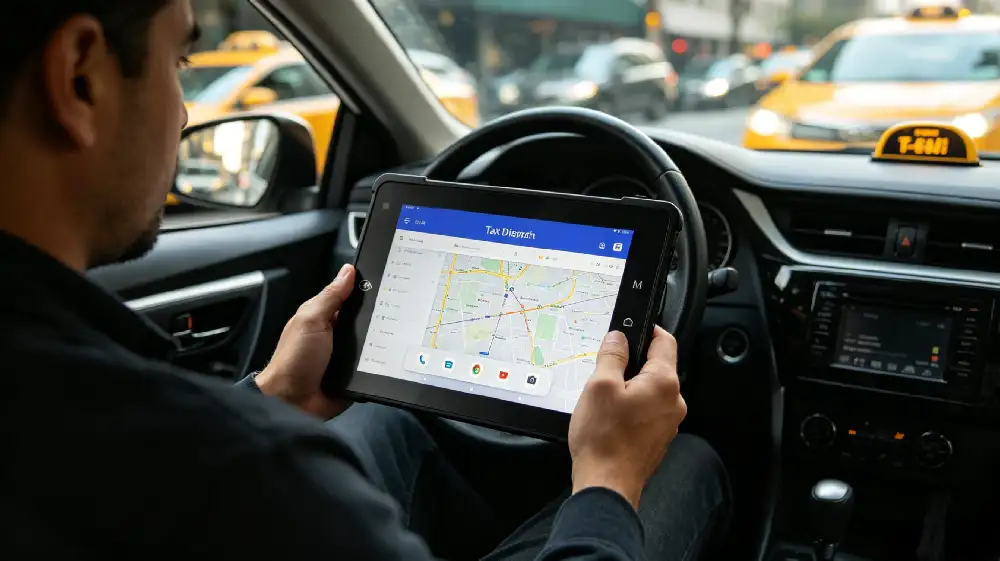
A rugged tablet for taxi dispatch serves as the digital nerve center of your fleet. It displays real-time ride requests, optimizes routes, tracks driver location, integrates with payment systems, and communicates with dispatch headquarters. Unlike consumer devices, purpose-built mobile data terminals are engineered to survive 24/7 vehicle operation while maintaining consistent performance across extreme temperature ranges and high-vibration environments. This isn’t just about durability—it’s about operational continuity, driver safety, and passenger satisfaction.
The cost of downtime in taxi operations is substantial. A single tablet failure can sideline a driver for hours, resulting in lost fares and missed bookings. Over a fleet of 50–500 vehicles, device failures compound into revenue loss, customer complaints, and reputational damage. Investing in a rugged tablet for taxi dispatch eliminates these risks while reducing total cost of ownership through fewer replacements and warranty claims.
Understanding IP Ratings and Environmental Durability
The IP (Ingress Protection) rating system is your first checkpoint when evaluating rugged tablets for taxi dispatch. This two-digit code indicates how well a device resists dust and water intrusion. For taxi operations, an IP65 rating is the industry minimum—this means the device is completely dust-tight and can withstand water jets from any direction without water ingress.
Breaking down IP65: the first digit (6) denotes complete dust protection, while the second digit (5) indicates protection against water sprayed from a 6.3mm nozzle at 100–150 liters per minute. In practical taxi scenarios, this protects against rain, car wash spray, and moisture from wet passengers. Devices rated IP54 or lower are insufficient for taxi dispatch, as they allow dust infiltration that damages internal components over time.
Beyond IP ratings, look for MIL-STD-810H certification, which validates performance under military-grade environmental stress. This includes shock and vibration resistance, thermal cycling from -20°C to 70°C, and drop testing from 1.2 meters. Taxi vehicles experience constant vibration from road surfaces—especially in developing markets with poor road infrastructure. MIL-STD-810H certification ensures the tablet’s internal components (CPU, RAM, storage) remain stable despite thousands of hours of vibration exposure.
Temperature resilience is critical. Consumer tablets typically operate between 0°C and 35°C; they shut down or experience battery drain in freezing winters or hot summer cabins. A rugged tablet for taxi dispatch must function reliably from -20°C to 70°C, accommodating both air-conditioned cabs in summer and unheated vehicles in winter. This wide operating range prevents thermal-induced failures and ensures consistent performance year-round.
Processor Power and RAM: Balancing Performance with Efficiency
Taxi dispatch applications demand real-time responsiveness without excessive power consumption. The processor is the foundation of this balance. A quad-core CPU running at 2.0 GHz or higher is the practical minimum for smooth dispatch operations. The Rockchip RK3568, commonly found in industrial tablets, offers this performance level while maintaining low power draw—critical for all-day vehicle operation.
Why quad-core? Modern dispatch apps integrate GPS tracking, real-time map rendering, payment processing, and two-way communication simultaneously. A dual-core processor struggles with these multitasking demands, causing app lag and missed ride requests. Quad-core processors distribute workload efficiently, maintaining responsive user interfaces even under peak load.
RAM capacity directly impacts multitasking smoothness. 4GB RAM is the recommended baseline; 2GB devices experience slowdowns when running dispatch software alongside navigation, messaging, and background services. For larger fleets with more complex dispatch algorithms or video telematics integration, 6GB or 8GB RAM provides headroom for future app updates and feature additions.
Storage matters too. 32GB internal storage accommodates the dispatch app, maps, offline route data, and local logs. Larger storage (64GB or 128GB) is beneficial for fleets integrating camera feeds or detailed audit trails. However, excessive storage increases device cost without proportional benefit for basic dispatch operations.
The key metric is MTBF (Mean Time Between Failures). Rugged tablets engineered for taxi dispatch typically boast MTBF ratings exceeding 50,000 hours—equivalent to 5+ years of continuous operation. Consumer tablets rarely publish MTBF data, but real-world field reports show typical lifespans of 2–3 years under fleet conditions.
Connectivity: The Lifeline of Dispatch Operations
Reliable connectivity is non-negotiable for taxi dispatch. A tablet disconnected from dispatch headquarters is useless—drivers cannot receive ride requests, and headquarters cannot track vehicle location or communicate emergencies.
4G LTE connectivity is the current industry standard, providing 10–50 Mbps bandwidth sufficient for real-time dispatch communication. 5G tablets are emerging but remain premium-priced; 4G LTE offers mature coverage in most urban markets and is more cost-effective for fleet deployment. Ensure your tablet supports multiple LTE bands (at least 8–10) to maintain connectivity across different carriers and geographic regions.
Dual-band Wi-Fi (2.4GHz and 5GHz) provides fallback connectivity at dispatch centers, taxi stands, or charging stations. This reduces cellular data consumption during downtime and enables faster app updates over local networks.
GPS + GLONASS + BeiDou multi-constellation positioning provides accuracy within 2–3 meters, essential for ride matching and driver tracking. Single-constellation GPS (US-only) is inadequate for international operations or urban canyons where satellite signal is weak. Multi-constellation GNSS systems maintain lock even in challenging environments.
Bluetooth 5.0 enables wireless connectivity to headsets, barcode scanners, and external sensors. For taxi dispatch, Bluetooth is secondary to cellular and Wi-Fi, but it’s valuable for hands-free calling and fleet accessory integration.
Vehicle Integration: CAN Bus and Industrial I/O
This is where rugged tablets for taxi dispatch diverge dramatically from consumer devices. Purpose-built MDTs integrate directly with vehicle electronics through specialized ports that consumer tablets lack entirely.
CAN Bus (Controller Area Network) connectivity allows the tablet to read real-time vehicle data: engine RPM, fuel consumption, door lock status, and diagnostic trouble codes. For taxi dispatch, this enables automatic trip logging, fuel monitoring, and predictive maintenance alerts. CAN Bus integration requires dedicated hardware and driver software—not possible with consumer tablets without expensive aftermarket adapters.
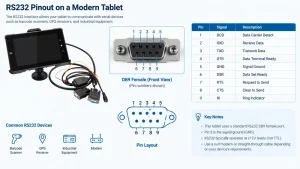
RS232 and RS422/RS485 serial ports connect legacy fleet equipment: taximeters, printers, door locks, and telematics modules. Many established taxi operators rely on these interfaces; tablets without native serial support require cumbersome USB-to-serial adapters that add cost, complexity, and failure points.
AHD camera inputs (4–8 channels) support multiple vehicle cameras: front, rear, and cabin-facing. This enables video telematics, driver behavior monitoring, and incident recording—increasingly mandatory for insurance and regulatory compliance. Consumer tablets have no camera input capability.
GPIO (General-Purpose Input/Output) ports detect vehicle events: ignition on/off, reverse gear engagement, door opening. This triggers automatic dispatch state changes, idle time logging, and driver behavior alerts. Again, consumer tablets lack this capability.
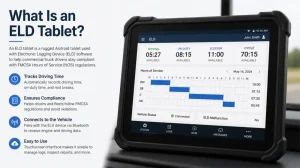
For taxi dispatch specifically, CAN Bus integration is less critical than for trucking (which requires ELD compliance), but RS232 taximeter integration is essential for legacy systems. Ensure your rugged tablet has at least RS232 or RS422 support if your fleet uses traditional taximeters.
Battery Technology and Vehicle Power Integration
Taxi operations demand all-day uptime without mid-shift charging. A rugged tablet for taxi dispatch must balance onboard battery capacity with vehicle power integration.
5000mAh batteries provide 3–5 hours of standalone operation—sufficient for maintenance windows or emergency situations when vehicle power is unavailable. However, relying solely on battery power is impractical for taxi dispatch, where vehicles operate 10–12 hours daily.
9–36V wide-voltage vehicle power input is the game-changer. This accepts power from any vehicle electrical system—12V cars, 24V trucks, or mixed fleets—without damage. The tablet draws power directly from the vehicle’s electrical system, eliminating battery drain concerns and enabling indefinite operation as long as the engine runs.
ACC (Accessory) ignition control automatically powers down the tablet when the engine shuts off, preventing parasitic drain on the vehicle battery. This is critical for taxi fleets where vehicles may sit idle between shifts; without ACC control, a tablet left connected would drain the vehicle battery overnight.
Intelligent power management prioritizes vehicle power when available and seamlessly transitions to battery backup if vehicle power is interrupted. This ensures uninterrupted operation during engine start-up or power fluctuations.
Compare this to consumer tablets: they charge via 5V USB, which is incompatible with vehicle electrical systems. Drivers would need to carry USB power banks or rely on vehicle USB ports (often unreliable and insufficient for charging while operating). Over a fleet of 100 vehicles, this creates operational headaches and hidden costs.
Comparison: Rugged Tablets vs. Consumer Tablets for Taxi Dispatch
| Feature | Consumer Tablet (iPad/Samsung Tab) | Rugged Tablet for Taxi Dispatch (e.g., Q777) |
|---|---|---|
| Durability Rating | IP52 or unrated | IP65, MIL-STD-810H certified |
| Operating Temperature | 0°C to 35°C (limited) | -20°C to 70°C (all-weather) |
| Vibration Resistance | Not tested; fails under prolonged vibration | Tested to 2G sustained vibration |
| Drop Resistance | Typically 0.5m; screen damage common | 1.2m drop tested; survives warehouse impacts |
| Vehicle Power Input | 5V USB only; requires adapters | 9–36V direct vehicle power + ACC control |
| I/O Ports | USB-C, headphone jack (no industrial I/O) | RS232, RS422/RS485, CAN Bus, AHD camera inputs |
| Battery Life | 8–10 hours; degrades rapidly in vehicles | 5000mAh + vehicle power = all-day operation |
| MTBF (Mean Time Between Failures) | ~20,000 hours (2–3 years under fleet use) | >50,000 hours (5+ years under fleet use) |
| Total Cost of Ownership (5 years, 50 vehicles) | $50,000–75,000 (frequent replacements, support) | $25,000–35,000 (fewer replacements, warranty coverage) |
| Compliance & Certifications | None for fleet operations | IP65, MIL-STD-810H, FCC, CE, RoHS |
| Taximeter Integration | Requires Bluetooth or USB adapters | Native RS232 support for legacy taximeters |
| MDM (Mobile Device Management) | Supported but limited fleet features | Full MDM support with kiosk lock-down, OTA updates |
| Warranty | 1 year; limited coverage for fleet damage | 3–5 years; covers vibration and environmental damage |
Display Technology: Visibility in All Conditions
Taxi dispatch happens in diverse lighting conditions: bright midday sun, dim street lighting, and nighttime navigation. A poor display creates driver frustration and increases accident risk.
High-brightness IPS displays (500+ nits) are essential for outdoor visibility. Consumer tablets typically achieve 300–400 nits, which creates screen glare and reduces readability in direct sunlight. Rugged tablets for taxi dispatch employ anti-glare coatings and high-brightness panels to maintain clarity regardless of ambient light.
Anti-glare and anti-fingerprint coatings reduce reflections and keep the screen clean despite frequent driver interaction. This is a small detail but significantly improves user experience during long shifts.
7-inch displays are the sweet spot for taxi dispatch: large enough to display maps and ride details clearly, yet compact enough to fit in confined vehicle cabins without obstructing the windshield. Larger 8–10-inch tablets are harder to mount securely and consume more vehicle space.
Capacitive touchscreen responsiveness must remain reliable despite vibration and temperature changes. Some consumer tablets experience touch sensitivity drift in hot vehicles; rugged tablets employ calibrated sensors and thermal compensation to maintain consistent performance.
Mounting and Theft Prevention
A tablet mounted insecurely is a liability. Sudden braking or collision can transform a 500g device into a projectile, injuring drivers or passengers.
VESA and RAM mount compatibility enables secure installation on standard mounting arms. These industry-standard interfaces support various vehicle configurations: dashboard, windshield, or steering column mounts. Ensure your tablet supports both VESA (for aftermarket brackets) and proprietary RAM mounts (for quick-release functionality).
Locking docking stations prevent casual theft during driver breaks or overnight parking. A docking station also serves as a charging and data synchronization hub, enabling fleet managers to push software updates and retrieve trip logs without manual device handling.
Anti-theft features like GPS tracking, remote lock, and kill-switch capabilities integrate with MDM platforms. If a tablet is stolen, fleet managers can remotely disable it or track its location, reducing loss.
Consumer tablets lack standardized mounting interfaces; most rely on suction cups or adhesive mounts that are fragile and inadequate for vibration environments. Aftermarket cases add bulk and cost, and theft protection is minimal.
Software Ecosystem and MDM Integration
Taxi dispatch operations scale across dozens or hundreds of vehicles. Managing devices individually is impractical; fleet managers need centralized control.
MDM (Mobile Device Management) platforms enable remote app deployment, configuration management, and security policy enforcement. Android 14 (the OS in modern rugged tablets) supports major MDM solutions: Google Workspace, Microsoft Intune, and specialized fleet MDM platforms like 42Gears and Zebra Lifeguard.
Kiosk lock-down restricts drivers to the dispatch app, preventing accidental navigation to non-work apps or system settings. This reduces support tickets and improves focus on dispatch tasks.
Over-the-air (OTA) updates push software patches and new features to the entire fleet without manual intervention. This is critical for security (patching vulnerabilities) and feature rollout (adding new dispatch capabilities).
Offline operation ensures the dispatch app continues functioning even if cellular connectivity drops temporarily. Critical ride data syncs to the cloud when connectivity is restored. Consumer tablets often lack robust offline modes.
Real-World Performance: Case Studies
Scenario 1: Urban Taxi Fleet (100 vehicles, metropolitan area)
A taxi operator deployed rugged tablets for taxi dispatch across 100 vehicles in a major city. Previously, drivers relied on radio dispatch and hand-written trip logs. After implementing rugged tablets with GPS tracking and real-time ride matching:
- Ride-to-driver matching improved by 35%, reducing idle time
- Trip documentation became automated, reducing billing disputes by 40%
- Real-time location tracking enabled better route optimization, saving 8% on fuel costs
- Device failure rate dropped to <2% annually (vs. 15% with consumer tablets previously tested)
- Fleet manager productivity increased 25% due to centralized MDM and automated reporting
Total deployment cost: $35,000 (tablets, mounts, integration). ROI achieved in 18 months through fuel savings and reduced disputes.
Scenario 2: Developing Market Taxi Service (200 vehicles, mixed urban/rural)
A taxi service in a developing market faced extreme temperature fluctuations (-5°C winters, 45°C summers) and poor road conditions. Consumer tablets failed within 6 months due to temperature stress and vibration damage. After switching to rugged tablets:
- Device uptime improved from 70% to 96%
- Driver satisfaction increased (fewer app crashes)
- Warranty claims dropped 80% (rugged tablets survived conditions that destroyed consumer devices)
- Vehicle maintenance costs decreased 12% through predictive maintenance alerts enabled by CAN Bus integration
Total deployment cost: $40,000 (tablets for 200 vehicles, mounting hardware, training). Payback period: 24 months through reduced device replacement costs and improved operational efficiency.
Selecting the Right Rugged Tablet: Decision Criteria
When evaluating rugged tablets for taxi dispatch, prioritize these factors in order:
1. Durability & Environmental Certification (IP65 + MIL-STD-810H): Non-negotiable. Devices without these certifications will fail prematurely in taxi operations.
2. Vehicle Integration (9–36V power, CAN Bus or RS232): Essential for seamless fleet operations. Verify compatibility with your existing taximeters and telematics systems.
3. Processor & RAM (Quad-core 2.0GHz+, 4GB RAM minimum): Ensures smooth dispatch app performance and multitasking capability.
4. Connectivity (4G LTE, dual-band Wi-Fi, multi-constellation GNSS): Required for real-time ride matching and tracking.
5. Battery & Power Management (5000mAh + ACC control): Enables all-day operation with automatic power-down when vehicle is off.
6. Display Quality (7-inch, high-brightness, IPS): Improves driver usability and safety.
7. MDM Support & Software Updates: Ensures long-term security and feature parity across your fleet.
8. Mounting & Theft Prevention: Protects your investment and improves driver safety.
9. Warranty & Support: 3–5 year warranties with environmental damage coverage reduce total cost of ownership.
10. Cost & ROI Timeline: Balance upfront investment against operational savings and reduced replacement costs.
The Waysion Q777: Purpose-Built for Taxi Dispatch
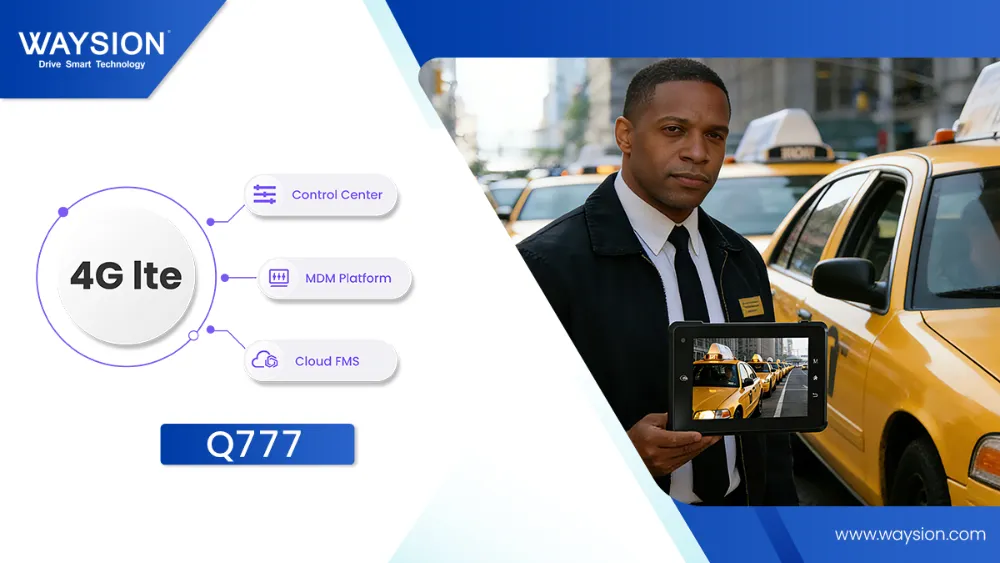
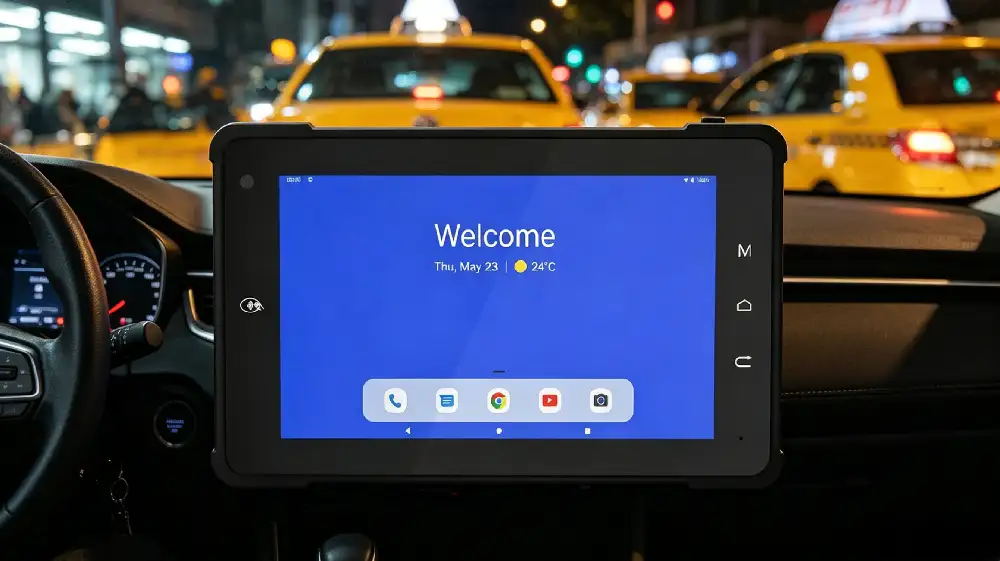
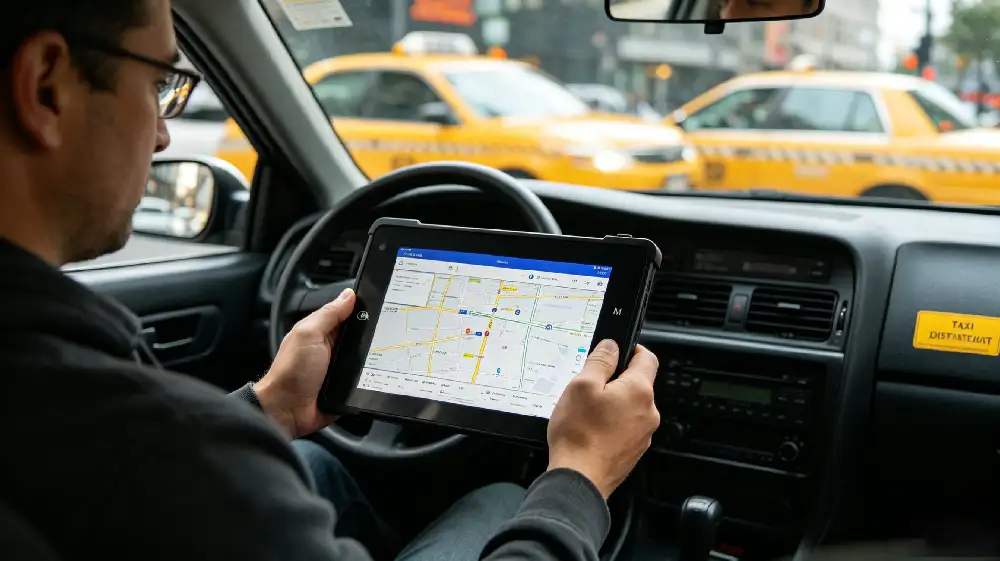
The Waysion Q777 exemplifies a purpose-built rugged tablet for taxi dispatch. With Android 14, IP65 rating, MIL-STD-810H certification, and a Rockchip RK3568 quad-core processor, it addresses every critical requirement for fleet operations. The 7-inch high-brightness IPS display ensures visibility in all lighting conditions, while built-in RS232, RS422/RS485, and CAN Bus ports enable direct integration with taximeters, vehicle sensors, and legacy equipment.
The Q777‘s 9–36V vehicle power input eliminates battery dependency, and its MTBF >50,000 hours ensures 5+ years of reliable operation. ACC ignition control prevents parasitic drain, while VESA and RAM mount compatibility support various vehicle configurations. The device runs Android 14 with full MDM support, enabling centralized fleet management and OTA updates. For taxi operators seeking a proven, certified solution that reduces total cost of ownership while improving operational efficiency, the Q777 represents an excellent choice.
Frequently Asked Questions
Q: Can I use a consumer tablet (iPad or Samsung Galaxy Tab) for taxi dispatch instead of a rugged tablet?
A: Technically yes, but it’s not recommended. Consumer tablets fail rapidly in taxi environments due to vibration, temperature extremes, and moisture exposure. Field reports show 15% monthly failure rates vs. <2% for rugged tablets. The hidden costs of frequent replacements, downtime, and driver frustration exceed the initial savings within 12–18 months.
Q: What’s the typical lifespan of a rugged tablet for taxi dispatch?
A: Quality rugged tablets (MTBF >50,000 hours) typically operate reliably for 5–7 years under continuous fleet use. Consumer tablets last 2–3 years before degradation becomes severe. This longevity significantly reduces total cost of ownership despite higher upfront cost.
Q: Do I need CAN Bus integration for taxi dispatch?
A: CAN Bus is less critical for taxi dispatch than for trucking (which requires ELD compliance). However, it enables valuable features: automatic trip logging, fuel monitoring, and predictive maintenance. If your fleet uses modern vehicles with OBD-II diagnostics, CAN Bus integration is worth the investment.
Q: Can rugged tablets integrate with my existing taximeter system?
A: Most likely yes. Rugged tablets designed for taxi dispatch include RS232 or RS422/RS485 ports for legacy taximeter integration. Verify compatibility with your specific taximeter model before purchase. Modern tablets also support Bluetooth-enabled taximeters.
Q: What’s the difference between IP65 and IP67 ratings?
A: IP65 protects against water jets; IP67 protects against temporary immersion (up to 1 meter for 30 minutes). For taxi dispatch, IP65 is sufficient (you won’t submerge the tablet). IP67 adds cost without practical benefit unless your fleet operates in flood-prone areas or requires water-crossing capability.
Q: How does MDM (Mobile Device Management) improve taxi dispatch operations?
A: MDM enables remote app deployment, automatic security updates, and kiosk lock-down across your entire fleet without manual device handling. This reduces support costs, improves security compliance, and ensures all drivers use the same software version—critical for consistent dispatch operations.
Q: Can I use a rugged tablet for other fleet operations beyond taxi dispatch?
A: Absolutely. Rugged tablets are used in delivery services, ride-sharing, construction, mining, and field service operations. Any fleet requiring 24/7 vehicle-mounted operations benefits from rugged tablet durability and vehicle integration.
Q: What’s the typical ROI timeline for deploying rugged tablets in a taxi fleet?
A: For fleets of 50+ vehicles, ROI is typically achieved within 18–24 months through fuel savings (better route optimization), reduced device replacement costs, and improved operational efficiency. Smaller fleets may require 24–36 months to break even.
Q: Do rugged tablets support 5G connectivity?
A: Some premium rugged tablets support 5G, but 4G LTE remains the industry standard for cost-effectiveness and coverage maturity. 5G tablets cost 30–40% more and offer limited coverage in most regions. Upgrade to 5G only if your service area has widespread 5G coverage.
Q: What happens if my rugged tablet fails during a shift?
A: Quality rugged tablets have MTBF >50,000 hours (extremely rare failures). If failure occurs, most vendors offer 1 year warranties with rapid replacement. For critical operations, maintain 5–10% spare tablets in inventory for quick swaps, ensuring zero downtime.
Conclusion: Invest in Durability, Reap Operational Rewards
Choosing a rugged tablet for taxi dispatch is not merely a hardware decision—it’s a strategic investment in operational reliability, driver safety, and long-term profitability. While consumer tablets offer lower upfront costs, their vulnerability to vibration, temperature extremes, and moisture exposure creates hidden costs through frequent replacements, downtime, and lost revenue.
Purpose-built rugged tablets, engineered for 24/7 vehicle operation, eliminate these risks. With IP65 durability, industrial-grade I/O, vehicle power integration, and MDM support, they provide the foundation for scalable, efficient taxi dispatch operations. The 5–7 year lifespan and <2% failure rate deliver superior total cost of ownership compared to consumer tablets, while improving driver satisfaction and fleet operational efficiency.
For taxi operators serious about modernizing their dispatch infrastructure, investing in quality rugged tablets is the clear path forward.
Conversion-Focused Call-to-Action Section
Ready to Transform Your Taxi Dispatch Operations?
If you manage a taxi fleet and are tired of device failures, connectivity issues, and the hidden costs of consumer tablets, it’s time to upgrade to purpose-built rugged technology.
For Taxi Fleet Managers: Deploy proven rugged tablets designed specifically for taxi dispatch. Reduce device failure rates by 90%, improve driver efficiency, and achieve ROI within 18–24 months. Start with a pilot fleet of 10–20 vehicles to validate results before full deployment.
For Taxi Technology Vendors: Integrate rugged tablets into your dispatch platform. Offer your customers proven hardware that reduces support tickets, improves uptime, and enhances user satisfaction. Bundle tablets with your software for turnkey solutions.
For Logistics and Ride-Sharing Companies: Rugged tablets aren’t just for traditional taxis—they’re ideal for delivery services, ride-sharing platforms, and field operations. Explore how vehicle-integrated tablets can optimize your fleet’s performance.
[Get a consultation with a rugged tablet specialist today]—understand your fleet’s specific needs and receive a customized hardware recommendation backed by industry expertise.
Tags: 7-inch rugged Android tablet fleet management, Best mobile data terminal for taxi drivers, CAN Bus tablet connectivity, Industrial I/O ports mobile data terminal, IP65 tablet vehicle mounting, rugged tablet for taxi dispatch, Rugged tablet vs. consumer iPad taxi, Taxi dispatch system hardware requirements, Taxi fleet management tablet durability, Vehicle-mounted dispatch terminal