Rugged Tablet PCs vs. Regular Tablets: Built for Work, Weather, Vehicles and Continuous Operations
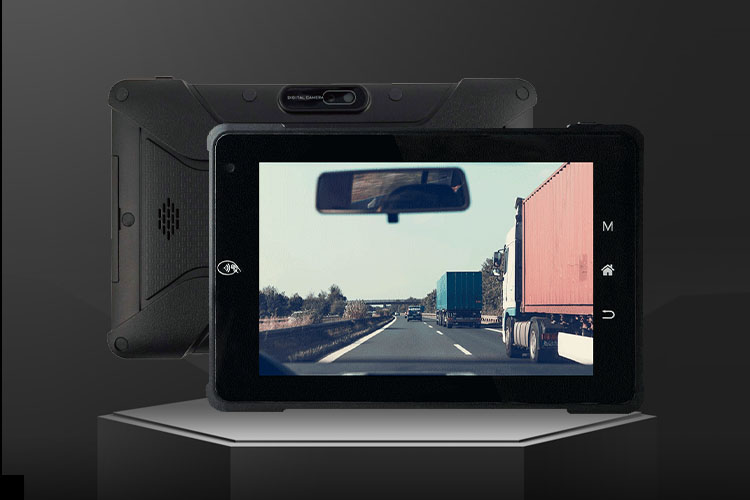
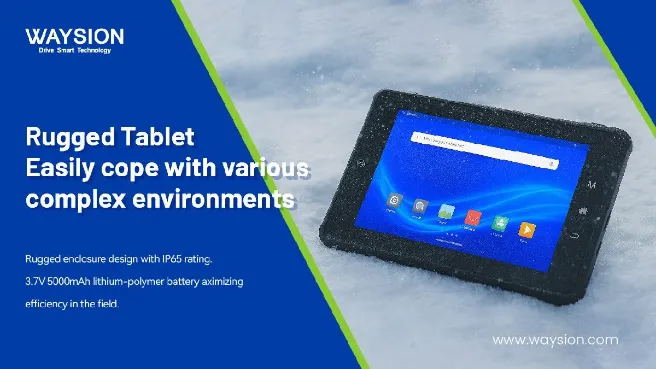
A rugged tablet PC is not simply a consumer tablet in a protective case. It is an engineered mobile computer designed for dust, vibration, rain, extreme temperatures, vehicle power systems, industrial I/O and mission-critical workflows.
Explore Rugged Vehicle Tablets →The short answer
Rugged tablet PCs differ from regular tablets in durability, environmental sealing, expandability, vehicle integration and total cost of ownership. A consumer tablet is optimized for entertainment, browsing and light office work; a rugged tablet is designed to remain operational around dust, rain, shock, vibration, temperature extremes, continuous fleet use and industrial connectivity requirements.
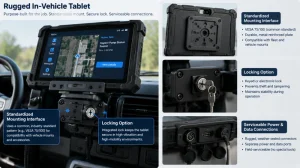
The industries that benefit most are transportation and fleet management, logistics and warehousing, construction, mining, public safety, utilities, manufacturing, agriculture, oil and gas, and field service. For vehicle-mounted deployments, a purpose-built rugged in-vehicle tablet can combine IP-rated sealing, wide-voltage vehicle power, CAN Bus, GNSS, LTE connectivity and industrial interfaces in one integrated platform.
What Is a Rugged Tablet PC?
A rugged tablet PC—also called an industrial tablet, rugged Android tablet, vehicle-mounted tablet or mobile data terminal (MDT)—is a mobile computing device engineered for harsh operating conditions. It typically combines a sealed enclosure, reinforced display and chassis, wide-temperature components, vehicle-grade power input, wireless connectivity and industrial interfaces.
In practical terms, ruggedization is not one feature. It is a system-level design approach covering ingress protection, mechanical shock and vibration resistance, thermal performance, display visibility, power stability, connectivity, mounting and long-term serviceability.
Sealed Against Dust and Water
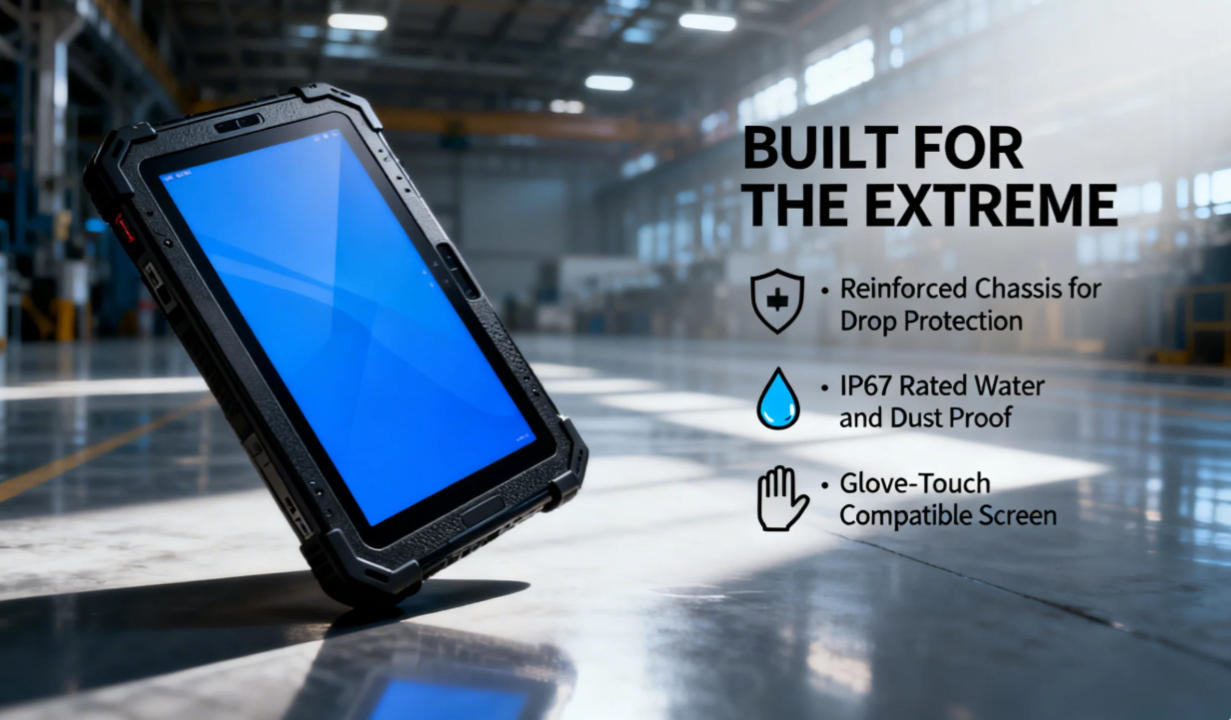
IP65 and IP67-rated rugged tablets use sealed enclosures to limit dust ingress and resist water jets or temporary immersion, depending on the rating.
Shock and Vibration Ready
Reinforced structures, dampening and controlled testing help the device withstand drops, road vibration, machinery movement and repeated handling.
Vehicle and Industrial I/O
CAN Bus, RS232/RS485, GPIO, Ethernet, camera inputs, ignition sensing and 9–36V DC power make rugged tablets suitable for fleet and machinery deployments.
Rugged Tablet vs. Regular Tablet: The Real Differences
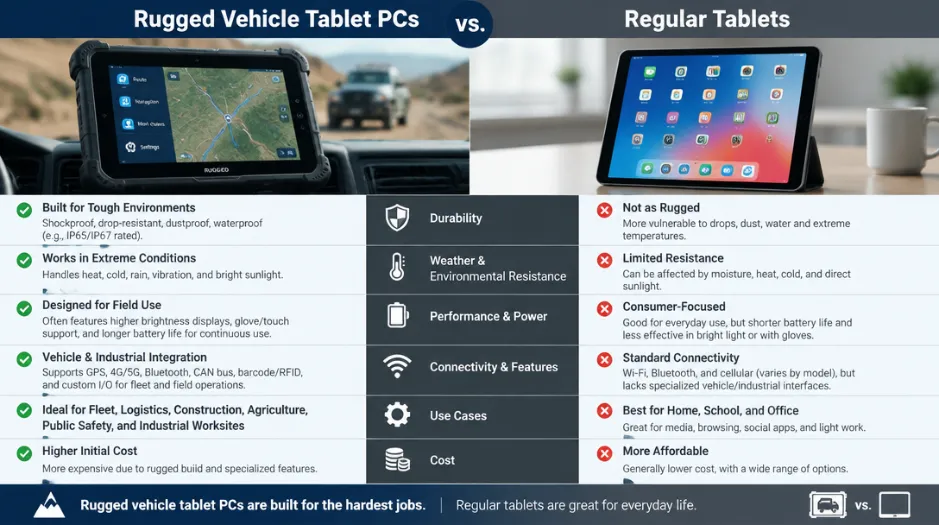
The difference is not merely “a tougher case.” Consumer tablets prioritize thinness, display area, battery life and mass-market cost. Rugged tablets prioritize uptime, environmental resilience, integration and predictable operation in professional environments.
| Capability | Regular consumer tablet | Rugged tablet PC |
|---|---|---|
| Primary design goal | Portability, media, browsing and general productivity | Reliable operation in harsh, mobile and industrial conditions |
| Enclosure and durability | Usually aluminum, glass and plastic; protective accessories are optional | Reinforced enclosure, sealed ports, impact-resistant design and vibration tolerance |
| Ingress protection | Often limited or unspecified for dust and water exposure | Commonly IP65, IP67 or equivalent sealing under the IEC 60529 IP Code |
| Environmental testing | General consumer quality testing | May be evaluated against MIL-STD-810H-style environmental test methods for shock, vibration, temperature and other stresses |
| Display | Optimized for indoor viewing and media | Often sunlight-readable, anti-glare and operable with gloves or in wet conditions |
| Power input | Consumer USB charging | Vehicle power architectures such as 9–36V DC input, ignition control and surge protection |
| Connectivity and I/O | Wi-Fi, Bluetooth, USB-C and optional cellular | LTE/4G, GNSS, Wi-Fi, CAN Bus/J1939, RS232/RS485, GPIO, Ethernet and camera inputs |
| Deployment model | Handheld personal device | Handheld, docked, vehicle-mounted or fixed industrial terminal |
| Best-fit use | Home, office, travel and entertainment | Fleet, logistics, construction, mining, utilities, public safety and field service |
Important distinction: “rugged” is not a single universal certification. Buyers should verify the exact IP rating, temperature range, drop specification, vibration profile, mounting method, operating system support and interface set—not just a marketing label.
IP Ratings: What IP65 and IP67 Actually Mean
The IP Code, defined in IEC 60529, classifies the protection an enclosure provides against solids and liquids. The first digit addresses protection against solid objects and dust; the second addresses liquid ingress.
IP65 means the enclosure is dust-protected and can withstand water jets from any direction. IP67 means the enclosure is dust-tight and protected against temporary immersion in up to one meter of water for 30 minutes, under the standard test conditions.
Dust Protection and Water Jets
Well suited to construction sites, warehouses, delivery vehicles, agricultural machinery and outdoor field-service environments.
Dust-Tight and Temporary Immersion
A stronger sealing level for washdown-prone areas, heavy rain, mud, mining environments and applications with higher exposure risk.
Environmental Test Methods
MIL-STD-810H provides environmental engineering considerations and laboratory test methods; it does not itself impose a universal pass/fail specification.
Why MIL-STD-810H Matters in Vehicle Tablets
MIL-STD-810H is a U.S. Department of Defense test-method standard for environmental engineering considerations and laboratory testing. It helps manufacturers tailor testing to real service conditions, including vibration, shock, thermal cycling, humidity, altitude, sand, dust and solar exposure.
For a rugged vehicle tablet, the meaningful question is not simply whether a product mentions MIL-STD-810H. It is which methods were applied, under what conditions, and whether the test profile reflects the customer’s actual vehicle, road surface, mounting position and duty cycle.
Waysion’s vehicle tablets are designed around these requirements, with models such as the Q777 and V7S specifying IP65 protection, 9–36V wide-voltage input, CAN Bus/J1939 integration and MIL-STD-810H-oriented environmental design.
Hardware Features That Separate Rugged Tablets
A professional rugged tablet is a platform, not only a screen. Its value comes from the combination of durability, connectivity, vehicle integration and software readiness.
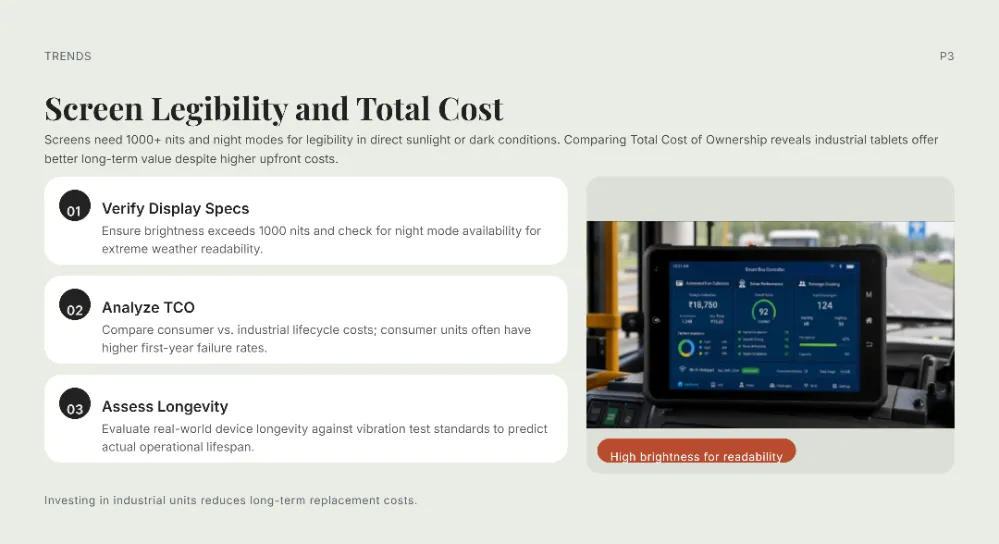
Sunlight-Readable Screens
High-brightness panels, anti-glare treatment and glove-friendly touch operation support outdoor inspection, dispatch and navigation.
LTE, Wi-Fi and GNSS
Cellular data, Wi-Fi, Bluetooth, GPS/GNSS and optional RTK positioning support real-time dispatch, tracking, navigation and telematics.
9–36V Wide-Voltage Input
Wide-voltage input, ignition detection and power management help tablets operate reliably across trucks, buses, forklifts and industrial vehicles.
CAN Bus and J1939
CAN Bus and SAE J1939 support allow the tablet to interact with vehicle data, diagnostics, driver workflows and telematics systems.
Local AI Processing
NPU acceleration can support on-device vision, driver-assistance workflows, inspection models and low-latency edge computing.
Docks, RAM Mounts and VESA
Vehicle docks, secure mounting, external antennas and cable management turn a tablet into a stable in-cab computing terminal.
Industries That Benefit Most From Rugged Tablets
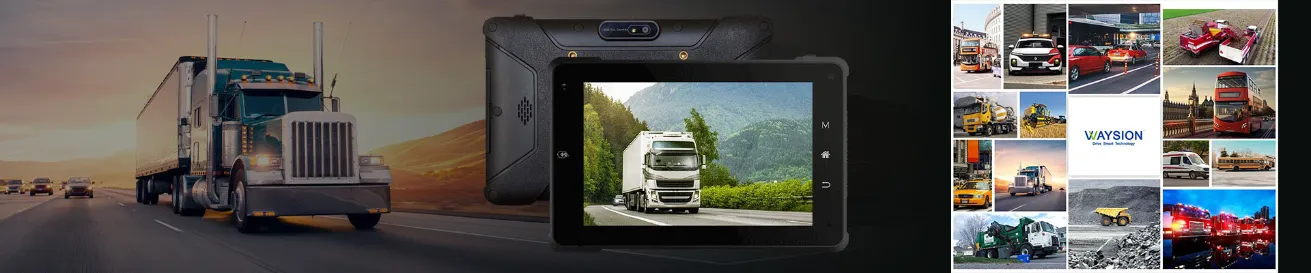
Rugged tablets deliver the greatest return where device failure creates downtime, safety risk, missed evidence, delayed dispatch or lost operational data. Market research also identifies mining, construction, logistics, transportation and defense as key environments where resistance to drops, dust, water and extreme temperatures is necessary.
Trucking, Bus and Taxi Fleets
Rugged vehicle tablets support electronic logging, dispatch, navigation, driver identification, proof of delivery, telematics and CAN-based vehicle diagnostics.
Warehousing and Last-Mile Delivery
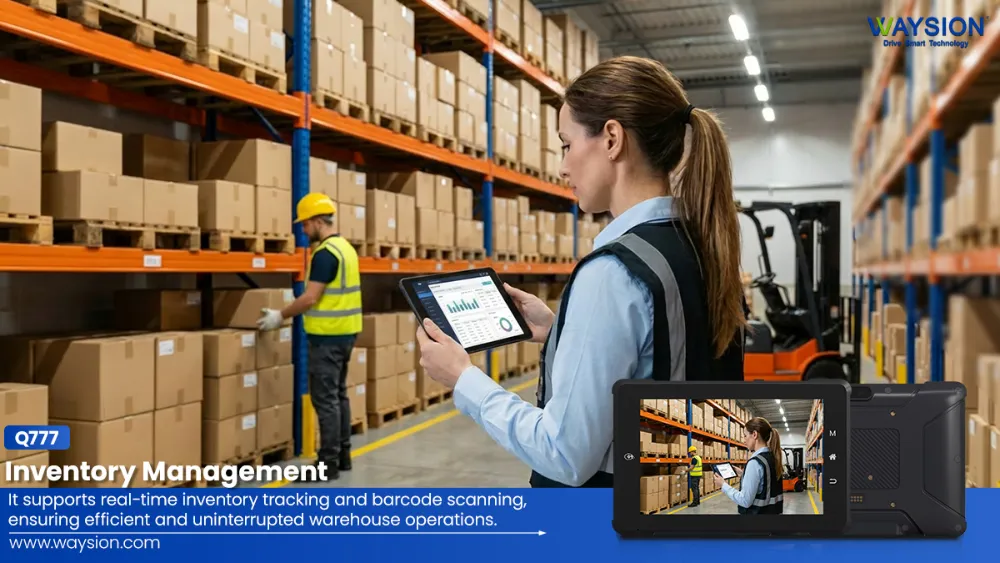
Barcode scanning, route guidance, signature capture, inventory updates and delivery confirmation require durable devices that survive constant handling.
Site Management and Equipment Control
Site supervisors use rugged tablets for drawings, safety checklists, equipment telemetry, progress reporting and machine-interface workflows.
Mining Vehicles and Open-Pit Operations
Dust, vibration, temperature extremes and remote connectivity make sealed, vehicle-ready tablets especially valuable for mining fleets.
Police, Fire and Emergency Response
Mobile data terminals support dispatch, navigation, records access, incident reporting and communications in high-pressure field conditions.
Grid, Water and Energy Field Service
Technicians need reliable access to asset records, work orders, maps, photos and diagnostics across remote and weather-exposed sites.
Factory Floor and Quality Control
Rugged tablets support production tracking, quality inspection, maintenance, inventory visibility and machine-side data collection.
Precision Farming and Machinery
GNSS positioning, CAN integration, camera input and dust/water resistance support guidance, equipment monitoring and field data capture.
The best rugged tablet is not the one with the highest headline specification. It is the one that remains dependable through the exact vibration, temperature, connectivity, mounting and workflow conditions of your operation.
Waysion industrial mobility perspectiveWhy Rugged Tablets Reduce Hidden Operating Costs
A consumer tablet may appear less expensive at purchase, but field failures can create costs beyond replacement hardware: lost shifts, repeated provisioning, data exposure, vehicle downtime, technician delays and inconsistent workflows. Rugged tablet adoption is therefore often a total cost of ownership (TCO) decision rather than a simple device-price comparison.
The global rugged tablet market was valued at approximately USD 1.197 billion in 2025 and is projected to reach USD 1.951 billion by 2034, according to IMARC Group—reflecting sustained demand from sectors that depend on durable mobile computing.
Procurement checklist: define the real environment first—temperature range, vibration source, water exposure, mounting constraints, cellular coverage, battery strategy, peripheral needs and required vehicle interfaces. Then match the tablet specification to those conditions.
Waysion Rugged Vehicle Tablet Options
For organizations deploying tablets in trucks, buses, forklifts, construction machinery, agricultural equipment or mining vehicles, Waysion provides purpose-built Android and Linux-compatible rugged vehicle terminals rather than adapted consumer hardware.
Mars 876
8-inch flagship AI vehicle terminal- 8-inch rugged Android 15 vehicle tablet
- IP65 rugged design for demanding vehicle environments
- RK3576 platform with 6 TOPS edge-AI capability
- CAN Bus, four AHD camera inputs, LTE, GNSS and industrial I/O
Q777
7-inch fleet MDT and ELD platform- 7-inch IP65 Android 14 vehicle-mounted tablet
- Dual CAN 2.0B with J1939 support
- 9–36V DC wide-voltage vehicle input
- Designed for trucking, ELD workflows, diagnostics and driver safety
V7S
Compact 7-inch vehicle terminal- Compact 7-inch IP65 Android vehicle computer
- Dual CAN Bus J1939 and 9–36V wide-voltage input
- MIL-STD-810H-oriented environmental design
- Suitable for tight in-cab and mobile-workforce installations
How to Choose the Right Rugged Tablet
Selecting a rugged tablet for harsh environments should begin with the deployment scenario, not the processor benchmark. A mining truck, refrigerated warehouse, municipal bus and utility service van impose very different demands on the same category of hardware.
Map the Physical Environment
Document dust, rain, washdown, vibration, drop height, temperature extremes, sunlight and cleaning chemicals before comparing models.
Define Vehicle Integration
Confirm ignition behavior, voltage range, CAN/J1939 needs, mounting interface, antenna placement, camera inputs and docking requirements.
Validate Connectivity
Test LTE, Wi-Fi, GNSS accuracy and antenna performance in the actual routes, buildings, yards and underground or remote areas where the device will operate.
Plan Software and Lifecycle
Review OS version, MDM support, security updates, peripheral drivers, spare-part availability and long-term supply commitments.
Frequently Asked Questions
Are rugged tablets worth the higher price?
For occasional indoor use, probably not. For fleets, construction, mining, field service, public safety and manufacturing, rugged tablets can reduce downtime, replacement frequency and workflow disruption—making total cost of ownership more important than upfront device price.
Is IP67 always better than IP65?
IP67 provides dust-tight protection and temporary immersion protection, while IP65 protects against dust and water jets. The better choice depends on the actual exposure: frequent washdown, mud or immersion risk may justify IP67; many vehicle and field applications are well served by validated IP65 designs.
Can a regular tablet be made rugged with a case?
A protective case can improve drop resistance, but it does not necessarily provide certified sealing, vehicle-grade power conditioning, CAN Bus integration, industrial I/O, controlled thermal performance or a stable mounting ecosystem. For professional deployments, those gaps often matter more than the case itself.
What is the best rugged tablet for fleet management?
The best fleet tablet is one that matches the vehicle platform and software workflow. For fleets requiring CAN Bus/J1939, wide-voltage input, LTE, GNSS and a compact in-cab form factor, Waysion’s Q777 and V7S are purpose-built vehicle MDT options; the Mars 876 adds an 8-inch format and edge-AI capability.
Do rugged tablets support Android and Linux?
Many industrial rugged tablets support Android, while selected models also offer Linux configurations. Waysion’s product range includes Android and Linux options across selected 7-inch, 8-inch and 10-inch rugged tablet platforms.
Editorial note: Rugged-tablet claims should always be reviewed against the manufacturer’s latest datasheet and the applicable test report. IP ratings are defined by IEC 60529, while MIL-STD-810H is an environmental test-method framework rather than a single universal certification.