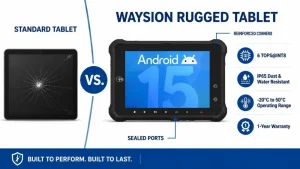
Fleet ELD Hardware Manufacturer: Build the Right Platform Behind the Logbook
For ELD providers, telematics integrators, and commercial fleets, the hardware decision reaches beyond the driver’s screen. It determines how engine data reaches the application, how the terminal behaves through ignition cycles, and who supports the system after deployment.
A fleet ELD hardware manufacturer supplies the physical platform used within an electronic logging solution. The critical distinction is responsibility: a rugged Android tablet, CAN interface, or engine gateway is not automatically a complete, registered ELD. Evaluate the hardware and the provider’s ELD solution separately, then validate them together.
What does an ELD need from its hardware?
FMCSA explains that an electronic logging device synchronizes with the commercial vehicle’s engine to capture engine power status, vehicle motion status, miles driven, and engine hours. Its ELD functions guidance also identifies automatically recorded elements such as date, time, location, and driver, vehicle, and carrier identification. Source: FMCSA ELD Functions.
This makes the data path a procurement priority. A driver-facing tablet may receive engine information from an external gateway, or a purpose-designed terminal may support an integrated vehicle interface. In either arrangement, the provider must establish that the complete implementation meets the applicable ELD requirements.
“FMCSA-approved hardware” is the wrong buying shortcut
FMCSA’s official ELD portal describes its listed devices as registered with the agency and self-certified by their providers as compliant with the ELD rule. Procurement language should preserve that distinction: provider self-certification and registration are not the same as independent government approval of every hardware component. Source: FMCSA official ELD portal.
Verify the ELD solution
- Identify the provider and exact registered device or solution.
- Check its current status on the official FMCSA list.
- Confirm the supported hardware, gateway, firmware, and application versions.
- Document who handles provider obligations and compliance-related changes.
Verify the hardware platform
- Obtain the current datasheet and hardware revision.
- Validate the vehicle interface and Android integration.
- Confirm power, mounting, environmental, and connectivity requirements.
- Agree on updates, repairs, replacement stock, and component-change notices.
How Waysion fits
Waysion’s rugged vehicle tablets can be evaluated as hardware platforms for ELD integration projects. This guide does not assert that an individual Waysion tablet, by itself, is an FMCSA-registered ELD or universally compatible with every ELD application.
Choose the architecture before choosing the tablet
When comparing an OEM ELD hardware manufacturer or an Android ELD tablet supplier, first decide where engine data acquisition, processing, storage, and driver interaction will occur. Otherwise, two quotations may describe substantially different systems.
| Approach | What to define | What to test |
|---|---|---|
| Tablet plus external gateway | Gateway ownership, vehicle harness, tablet connection, local storage responsibilities, and approved software versions. | Reconnection, device pairing, driver changes, gateway replacement, and recovery when the tablet is unavailable. |
| Terminal with integrated vehicle I/O | CAN interface, protocol stack, Android SDK, engine parameter access, isolation, and permitted bus behavior. | Required engine signals on representative vehicles, ignition transitions, application access, and error handling. |
| Custom OEM assembly | Firmware ownership, enclosure and harness changes, engineering charges, validation scope, and production acceptance criteria. | The final combined hardware and software baseline—not separate demonstrations of individual components. |
A CAN Bus port does not establish that the required vehicle information is available to the ELD application. Specify whether the project needs raw CAN access, J1939 support, decoded parameters, or a separate gateway API. Ask the integration team to demonstrate the required signals on the intended vehicles.
Six questions that reveal an integration-ready hardware supplier
| Decision area | Question to ask | Evidence to request |
|---|---|---|
| Vehicle power | How does the terminal behave during engine cranking, ignition-off, and unexpected power loss? | Input specification, protection reports, ACC behavior, standby current, and pilot test results. |
| Android integration | Can our application reliably access the required interfaces and recover after restart? | SDK documentation, sample code, permissions, firmware baseline, and application test results. |
| Connectivity | Which cellular bands, antennas, and connection methods are included? | Exact modem configuration, regional suitability, pairing procedure, and reconnection tests. |
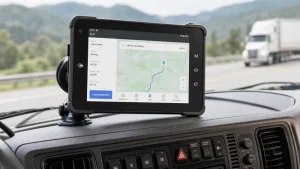
| Cab usability | Can drivers use the intended interface at the installed distance and orientation? | Cab mock-up, mounting drawing, brightness specification, cable routing, and operator feedback. |
| Environmental validation | Which operating conditions apply to the supplied terminal, dock, and cables? | Configuration-specific ingress, temperature, shock, and vibration evidence. |
| Lifecycle support | Who maintains firmware and supports replacement units during the project? | Written support dates, update process, repair terms, spare-parts plan, and change-notification policy. |
Avoid unverified comparisons such as “consumer tablets fail within weeks” or “rugged hardware cuts downtime by a fixed percentage.” Build the business case from your pilot results, installation costs, repair history, and supplier quotations.
Waysion hardware options for fleet ELD integration
Waysion’s published range includes compact Android vehicle terminals and larger platforms with industrial interfaces. These examples provide a starting point for hardware selection; the ELD provider must approve the final application and vehicle-data configuration.
Waysion V7S
Evaluate the V7S when a project calls for a dedicated Android driver terminal with vehicle communication interfaces.
- Manufacturer-listed Android 14 and Rockchip RK3568 platform.
- 7-inch display and IP65 enclosure rating.
- Published CAN Bus and serial interface support.
- Published 9–36V DC input and ACC ignition-control functionality.
Confirm the ordered CAN configuration, protocol support, SDK, regional connectivity, accessories, and electrical validation.
Waysion Q777
Consider the Q777 for a fleet integration brief that prioritizes a compact Android tablet, docking design, and vehicle-oriented I/O.
- Manufacturer-listed Android 14 operating system.
- Rockchip RK3568 processor.
- IP65 enclosure rating.
- Published ACC input and serial interface options.
Specify engine-data acquisition separately. Do not infer a complete ELD implementation from the tablet’s fleet positioning.
Specifications above summarize Waysion’s linked product pages. Request the current signed-off datasheet and configuration list before ordering. No universal ELD application compatibility, compliance status, or quantified reliability benefit is claimed.
Test the transitions—not only a successful engine-data demo
A useful pilot should show what happens when normal operation is interrupted. Define expected outcomes with the ELD provider, then collect evidence from the actual hardware, firmware, application, harness, and vehicle combination.
Hardware and communications checks
- Repeated ignition cycles and representative cranking conditions.
- Gateway or cable disconnection and documented reconnection behavior.
- Network loss, coverage changes, and application restart.
- Dock retention, cable strain relief, and installed display visibility.
Provider-led ELD checks
- Engine-data continuity and correct vehicle association.
- Driver authentication, changes, and supported workflows.
- Record preservation and diagnostic or malfunction handling.
- Required inspection display and data-transfer functionality.
What to include in an OEM ELD hardware RFQ
Describe the fleet and deployment region
Include vehicle makes and model years, engine interfaces, cabin layouts, operating countries, expected quantities, and installation constraints.
Name the ELD provider and application baseline
Specify supported Android versions, the proposed gateway, required APIs, connectivity, device management, and who owns system-level compliance validation.
Separate standard features from custom engineering
Request itemized pricing for tablets, docks, mounts, harnesses, antennas, firmware work, branding, tooling, and testing. Confirm minimum order quantities and engineering charges.
Agree on acceptance and lifecycle support
Define pilot criteria, production hardware revision, firmware build, update responsibilities, repair process, spare stock, and component change notifications before a volume order.
Fleet ELD hardware manufacturer FAQ
Is a rugged Android tablet an electronic logging device?
Not automatically. It can serve as the driver-facing component of an ELD system. The complete solution must provide the required engine synchronization and ELD functions, and its provider must self-certify and register the ELD with FMCSA.
Can a tablet with CAN Bus replace an ELD gateway?
Only if the intended system architecture, software, vehicle interface, and complete ELD implementation support that design. CAN hardware alone does not establish protocol decoding, required records, or ELD compliance.
How do I choose a rugged Android tablet for ELD integration?
Start with the ELD provider’s supported configurations. Then evaluate engine-data access, power behavior, Android compatibility, mounting, connectivity, environmental evidence, and lifecycle support. Validate the complete configuration in representative vehicles.
Does private-label branding make an OEM tablet ELD compliant?
No. Branding, boot logos, and application preinstallation are customization features. They do not replace system-level technical compliance, provider self-certification, or FMCSA registration.
What should I verify before ordering fleet ELD hardware in bulk?
Verify the ELD solution’s current registration status, provider-approved hardware and software, successful pilot results, final configuration, full installed cost, and written support commitments.
Give the manufacturer a system brief—not just a screen size
A productive Waysion evaluation starts with your ELD application, engine-data architecture, vehicle list, installation requirements, and expected volume. Use that information to select a platform, identify engineering work, and define a production-intent sample that the hardware team and ELD provider can validate together.
Scope note: This article addresses hardware selection for U.S. fleet ELD integration. It is not a legal opinion, an ELD registration claim, or a substitute for the applicable requirements and provider validation. Regulatory statements reference FMCSA; product descriptions reference Waysion’s published specifications.
Tags: custom Android ELD hardware solutions, fleet ELD hardware manufacturer, OEM ELD hardware supplier for fleets, rugged Android tablet for ELD integration, vehicle mounted Android tablet with CAN Bus