Intelligent Vehicle
Telematics Terminal:
Beyond the GPS Dot.
A practical guide to rugged in-vehicle computing, CAN bus integration, edge intelligence, and the deployment decisions that connect vehicle data with useful work.
An intelligent vehicle telematics terminal is an onboard computing endpoint that connects vehicle information, positioning, communications, and operational software. In a screen-equipped configuration, a rugged vehicle tablet also gives the driver an interface for dispatch, inspection, navigation, or other authorized workflows. NHTSA describes telematics as the integration of telecommunications and informatics for intelligent vehicle applications, including fleet management. Source: NHTSA vehicle cybersecurity guidance.
One vehicle. Several computing roles.
A GPS tracker, a telematics control unit, and a rugged mobile data terminal can cooperate without being the same device.
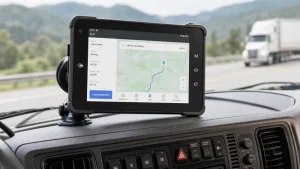
For procurement, define the role before choosing the enclosure. A location-tracking endpoint primarily answers where an asset is. A vehicle data gateway connects onboard networks and external systems. A screen-equipped mobile data terminal adds a human-machine interface: the place where a driver receives a job, completes a vehicle inspection, or acknowledges an operational message.
These roles may be combined in one rugged Android vehicle tablet or divided between a dedicated gateway and a separate display. WAYSION’s Mars 876 and Q777 illustrate the screen-equipped approach, with published vehicle interfaces and application-oriented Android platforms.
The useful design question is not “Which device has the most features?” It is “Which functions must remain available in the cab, which belong in a gateway, and which can depend on the cloud?”
CAN bus is a connection. Integration is the work.
For a CAN bus telematics terminal, a connector is only the beginning of vehicle data compatibility.
SAE J1939 provides a standardized architecture for electronic systems to communicate in vehicle applications, including trucks, construction equipment, and agricultural machinery. Its scope makes it highly relevant to heavy-duty fleet telematics, but a product description that says “CAN supported” does not by itself establish which J1939 messages, diagnostic functions, or proprietary signals your application can use. Source: SAE J1939 recommended practice.
| Integration layer | Question to resolve | Evidence to request |
|---|---|---|
| Electrical connection | Does the supplied harness match the vehicle and approved connection point? | Pinout, installation instructions, termination requirements, and grounding plan. |
| Protocol and signals | Which messages are supported on the actual fleet models? | Supported protocol documentation, signal map, and representative vehicle logs. |
| Software access | Can the fleet application read and interpret the required data? | SDK or API documentation, decoded sample data, and an integration demonstration. |
| Operational safety | Can the required workflow remain read-only? | Documented permissions, gateway boundaries, and installation risk assessment. |
Ruggedness is not one number.
Specify the environment, the installation, and the test conditions—not just an industrial-looking housing.
What IP65 actually tells you
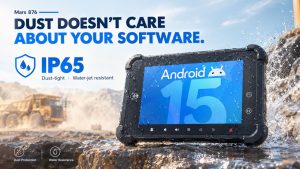
IEC 60529 classifies enclosure protection against solids and liquids. In IP65, the “6” indicates a dust-tight enclosure and the “5” indicates protection against water jets. It does not establish immersion suitability, vibration endurance, electrical transient immunity, or explosive-atmosphere approval. IEC explanation of IP ratings; IEC IP65 reference guide.
For a rugged vehicle-mounted tablet, ask whether the stated protection applies with the intended cables installed, whether unused ports require covers, and what cleaning methods are allowed. Confirm those conditions against the exact configuration being purchased.
Intelligence starts with dependable local behavior.
Edge AI is an option. Reliable data handling is a requirement to define.
WAYSION lists a 6 TOPS INT8 neural processing unit for the Mars 876. That is a hardware capability, not a verified frame rate, detection accuracy, or guarantee that a particular driver-monitoring model will run successfully. An edge AI vehicle terminal should be evaluated using the intended model, camera inputs, software stack, and thermal conditions.
Specify what survives an outage.
- Which jobs, maps, or inspection forms remain available offline?
- How much data can be queued before storage limits are reached?
- How are timestamps, retries, and duplicate events handled?
- What happens after an unexpected power loss?
Measure the deployed workload.
- End-to-end latency, including capture and preprocessing.
- Performance with the actual number of camera streams.
- False alerts and missed events under representative conditions.
- Sustained performance alongside navigation and fleet applications.
These are recommended acceptance-test categories, not published performance results for either WAYSION product.
A connected cab needs a security boundary.
Connectivity expands operational reach. It also creates interfaces that need explicit protection.
“Manufacturers should treat all networks and systems external to a vehicle’s wireless interfaces as untrusted.”
Excerpt from recommendation T.14, NHTSA, Cybersecurity Best Practices for the Safety of Modern Vehicles, 2022 .
NHTSA’s guidance is voluntary and non-binding; it is not a terminal certification program. Its recommendations nevertheless provide a useful engineering reference for separating connected systems, assessing software vulnerabilities, and preserving the integrity of over-the-air updates. NHTSA guidance announcement.
-
Control device identity
Define enrollment, credentials, account ownership, and the process for retiring or replacing a terminal.
-
Constrain application access
Agree on required permissions, approved software, driver-facing restrictions, and administrative roles.
-
Document update ownership
Request the patch policy, supported software versions, update verification process, and recovery plan.
-
Minimize exposed data
Define access and retention rules for location history, driver identifiers, diagnostic records, and video.
An ELD-capable tablet is not an ELD approval.
Separate the hardware platform from the complete electronic logging device solution.
In the United States, FMCSA maintains a list of registered ELDs that providers self-certify as meeting the rule’s technical specifications. FMCSA states that it does not endorse electronic logging devices. Selecting an Android tablet, adding a CAN connection, or installing an hours-of-service application does not by itself establish that the resulting system is a registered, compliant ELD. FMCSA ELD program and registration information; FMCSA self-certification and non-endorsement notice.
Two hardware starting points. Different project priorities.
Use these published specifications to begin a technical conversation, not to skip a vehicle-specific pilot.
WAYSION Mars 876
An option to evaluate when a project combines an in-cab display, multiple vehicle interfaces, and local AI workloads.
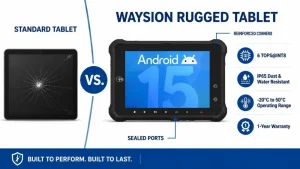
- Android 15 with Rockchip RK3576 processing.
- 8-inch 1200 × 1920 display; 700 nits listed, with 1000 nits optional.
- 6 TOPS INT8 NPU and support for up to four AHD camera inputs.
- CAN, GPIO, RS232, and additional interfaces depending on configuration.
- Published IP65 rating and 9–36V DC input.
WAYSION Q777
An option to evaluate when installation space, docking, and vehicle-connected driver workflows shape the specification.
- 7-inch vehicle-mounted Android 14 platform.
- Rockchip RK3568 processor.
- Published IP65 enclosure rating.
- CAN integration and AHD camera input support.
- Docking design with cellular, Wi-Fi, Bluetooth, and GNSS options to confirm for the ordered configuration.
Product evidence: the manufacturer pages linked above. Optional features, harnesses, accessories, radio configurations, software support, and certifications should be confirmed in the project quotation. Hardware capability does not establish application performance or regulatory compliance.
Buy the validated workflow—not the longest specification sheet.
A useful pilot converts assumptions into evidence before a fleet-wide installation.
- Define the job: dispatch, inspection, vehicle diagnostics, camera display, ELD interface, or another measurable workflow.
- Select representative vehicles, routes, shifts, and installation locations rather than testing only on a bench.
- Validate the complete assembly: terminal, dock, bracket, harness, antennas, peripherals, and application software.
- Exercise weak coverage, reconnection, ignition changes, application recovery, and interrupted updates.
- Record pass/fail criteria and assign responsibility for every unresolved issue before scaling.
Hardware + installation + connectivity + software + integration + maintenance + replacement + downtime
This is a planning framework, not an industry ROI statistic. Compare options using your own vehicle count, labor rates, service history, application costs, and support commitments. Without a measured baseline and a comparable pilot, percentage savings claims are not a reliable basis for fleet procurement.
Intelligent vehicle telematics terminal FAQ
What is the difference between a telematics terminal and a GPS tracker?
A GPS tracker primarily supports location-focused functions. A screen-equipped telematics terminal can additionally host driver applications, connect supported peripherals, and participate in vehicle-data workflows. The actual functions depend on the selected hardware, software, and integration.
Does CAN bus support automatically mean SAE J1939 compatibility?
No. Verify the required protocol implementation, accessible messages, decoding software, and vehicle-specific connection. SAE J1939 describes a vehicle communication architecture; a physical CAN interface alone does not document the full application integration. SAE J1939 reference.
Is an IP65 rugged vehicle tablet waterproof?
Describe it more precisely as dust-tight and protected against water jets under the applicable test conditions. IP65 is not an immersion rating. Check the required port-cover and cable-installation conditions for the purchased device. IEC IP rating guide.
Can a telematics terminal keep working without cellular coverage?
It can if the application and storage design support the required local functions. Specify offline data access, queue capacity, synchronization, and recovery behavior, then test them. A cellular modem specification does not establish offline application capability.
Does a rugged Android tablet make an ELD system FMCSA-compliant?
No. Verify the complete ELD solution and its registration status. FMCSA lists provider-self-certified systems and does not endorse devices; a tablet is only one possible component. FMCSA ELD information.
The terminal matters. The system boundary matters more.
Specify an intelligent vehicle telematics terminal around the work it must perform: accessible vehicle data, dependable driver interaction, validated installation, controlled connectivity, and support throughout its service life. Then prove that configuration in representative vehicles before turning a promising device into a fleet standard.
Tags: CAN bus vehicle telematics terminal, intelligent vehicle telematics terminal, rugged Android tablet for fleet management, rugged mobile data terminal for trucks, vehicle mounted tablet for fleet management