The most critical safety feature for school bus fleets today isn’t a single technology—it’s an integrated ecosystem where school bus safety rugged tablet systems work in concert with Automatic Emergency Braking (AEB) to protect students both inside and outside the vehicle. This comprehensive approach represents the evolution of school bus safety from reactive incident response to proactive, data-driven prevention.
What is a School Bus Safety Rugged Tablet?
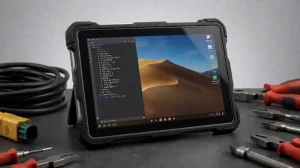
A school bus safety rugged tablet is a specialized mobile computing device engineered specifically for transportation fleet operations. Unlike consumer tablets, these devices combine industrial-grade durability with integrated telematics, camera management, and driver monitoring capabilities. They’re designed to withstand the demanding environment of school bus operations while providing real-time access to critical safety and operational data.
Modern school bus safety rugged tablet systems typically feature:
- Integrated telematics for real-time vehicle diagnostics
- Multi-camera management interfaces (360-degree views)
- Driver behavior monitoring and coaching tools
- GPS tracking and route optimization
- Automatic incident recording and documentation
- Integration with Automatic Emergency Braking systems
The Real Threat: Why Rugged Tablets Matter
The Data Everyone Should Know
From 2014 to 2023, school-transportation-related crashes claimed 209 school-age children’s lives—but only 38 were bus occupants. A full 171 were outside the bus, including those in other vehicles and pedestrians. Verizon Connect This critical statistic reveals why school bus safety rugged tablet systems must extend beyond the vehicle interior.
Illegal Passing: The #1 Identified Threat
According to the National Association of State Directors of Pupil Transportation Services (NASDPTS), “illegal passing of stopped school buses continues to be the greatest safety danger to children.” Illegal-passing incidents increased by 4% in the past year.
This is where school bus safety rugged tablet technology becomes essential. These devices monitor and document every instance of dangerous behavior around the bus, creating an accountability ecosystem.
Automatic Emergency Braking (AEB): The Primary Defense
Why AEB is Becoming Mandatory
The FMCSA and NHTSA have jointly required Automatic Emergency Braking systems on commercial motor vehicles, with unified rulemaking finalized in December 2024. School Bus Fleet AEB systems directly address the #1 threat to school bus safety: illegal passing and pedestrian collisions.
How AEB Works with Rugged Tablet Integration
Advanced school bus safety rugged tablet systems display real-time AEB system status and performance metrics:
- Forward collision warning activations
- Automatic braking events and severity levels
- Pedestrian detection alerts and responses
- System health and maintenance requirements
This integration allows fleet managers to:
- Monitor AEB system performance across entire fleets
- Identify high-risk locations and times
- Generate compliance documentation
- Trigger driver coaching after near-miss events
- Predict maintenance needs before system failure
Multi-Layered Protection Through Rugged Tablet Systems
Pedestrian Detection and 360-Degree Camera Integration
Modern school bus safety rugged tablet systems integrate multiple camera feeds and sensor data:
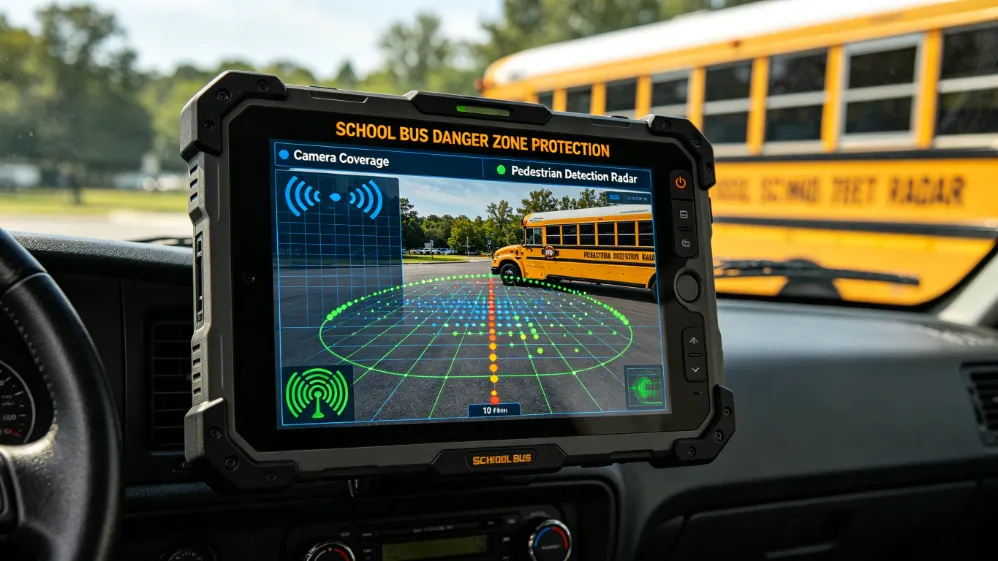
Saf-T-Zone Pedestrian Detection: Uses high-frequency radar to alert drivers of pedestrians near the bus’s front, back, and loading sides. The school bus safety rugged tablet displays real-time pedestrian proximity alerts and maintains historical logs.
NS PV360 Camera System: Provides drivers with a bird’s-eye view around the entire bus. A school bus safety rugged tablet consolidates these camera feeds into a single, intuitive interface that drivers can reference during loading/unloading operations.
Predictive Stop-Arm Systems: Radar-based systems detect vehicles approaching stopped buses. The school bus safety rugged tablet can alert drivers and, in advanced systems, transmit warnings to approaching vehicles through connected infrastructure.
| Safety Technology | Function | Rugged Tablet Integration |
|---|---|---|
| Automatic Emergency Braking | Detects collisions and applies brakes automatically | Real-time system status, event logging, compliance tracking |
| Pedestrian Detection (Saf-T-Zone) | Alerts drivers to pedestrians in danger zones | Proximity alerts, historical incident maps, high-risk location identification |
| 360-Degree Cameras (NS PV360) | Eliminates blind spots around entire bus | Unified multi-camera interface, incident recording, driver coaching |
| Predictive Stop-Arm Systems | Detects illegal passing attempts | Alert documentation, driver behavior analysis, accountability records |
| Telematics Monitoring | Tracks vehicle diagnostics and driver behavior | Real-time performance metrics, maintenance scheduling, driver coaching |
Real-Time Driver Monitoring and Behavior Coaching
The Human Element in School Bus Safety
While technology prevents many accidents, driver behavior remains critical. A school bus safety rugged tablet system monitors:
- Harsh Braking Events: Identifies sudden stops that may indicate driver error or emergency situations
- Rapid Acceleration: Detects aggressive driving patterns that endanger students
- Excessive Idling: Monitors fuel waste and engine strain
- Speed Violations: Tracks speeding in school zones and residential areas
- Cornering Performance: Identifies reckless turns that could cause rollovers
Geotab research demonstrates that school bus safety rugged tablet systems enable targeted, data-driven coaching that improves driver performance significantly.
Actionable Coaching Through Rugged Tablet Data
Fleet managers use school bus safety rugged tablet data to:
- Identify specific drivers requiring coaching
- Pinpoint locations with recurring safety issues
- Document coaching sessions with objective data
- Track improvement over time
- Recognize and reward safe driving behaviors
The Danger Zone: External Student Protection
Why the 10-Foot Perimeter Demands Technology
The area around a school bus—especially during loading and unloading—is where children face the greatest risk. This “danger zone” is where 171 of the 209 school-age fatalities occurred over the 2014-2023 period.
A school bus safety rugged tablet system provides:
Blind Spot Elimination: Multiple camera feeds eliminate the angles drivers cannot see naturally. The tablet consolidates these feeds into a clear, real-time display.
Incident Documentation: When accidents occur, the school bus safety rugged tablet automatically records video from multiple angles, providing irrefutable evidence for insurance claims and legal proceedings.
Stop-Arm Enforcement: Automated stop-arm camera systems integrated with school bus safety rugged tablet platforms document every vehicle that illegally passes a stopped bus. This creates accountability and can be shared with law enforcement.
Predictive Alerting: Advanced systems use radar and machine learning to predict dangerous situations before they occur, giving drivers additional reaction time.
Telematics and Fleet-Wide Intelligence
From Individual Buses to Fleet-Wide Insights
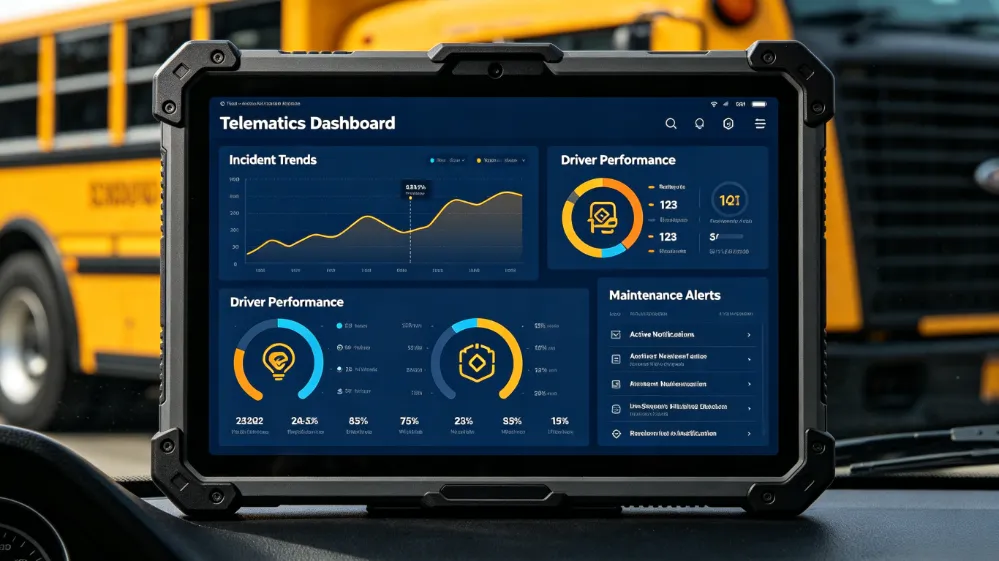
The true power of school bus safety rugged tablet systems emerges at the fleet level. Aggregating data from dozens or hundreds of buses reveals patterns:
High-Risk Route Identification: Which routes experience the most pedestrian near-misses or illegal-passing incidents?
Time-Based Patterns: Do certain times of day correlate with more incidents? (Morning rush vs. afternoon dismissal)
Driver Performance Benchmarking: How do individual drivers compare to fleet averages?
Maintenance Prediction: Which buses are experiencing early warning signs of mechanical failure?
Cost Analysis: Which safety investments deliver the highest return in incident prevention?
BusBoss emphasizes that school bus safety rugged tablet systems enable the transition from reactive to proactive safety culture. Instead of reviewing footage after incidents occur, districts use data to prevent them.
Regulatory Compliance and Documentation
NHTSA Standards Integration
The NHTSA has established Federal Motor Vehicle Safety Standards (FMVSS) requiring specific safety features. A school bus safety rugged tablet system documents compliance:
- FMVSS No. 222: School bus passenger seating and crash protection—the tablet logs interior camera footage proving proper seating
- FMVSS No. 131: Pedestrian safety devices—the tablet documents stop-arm deployment and effectiveness
- FMVSS No. 221: School bus body joint strength—the tablet integrates with vehicle diagnostic systems
Automated Reporting
Rather than manual documentation, school bus safety rugged tablet systems automatically generate:
- Daily safety reports
- Incident summaries with video evidence
- Driver performance scorecards
- Maintenance requirement notifications
- Compliance audit trails
Implementation Strategy for School Districts
Phase 1: Automatic Emergency Braking Foundation
Begin with AEB system installation on all buses. These systems are becoming federally mandated and provide the most critical protection against the #1 threat: illegal passing and pedestrian collisions.
Phase 2: Rugged Tablet Integration
Deploy school bus safety rugged tablet systems to monitor and optimize AEB performance. These devices provide drivers with real-time feedback and fleet managers with comprehensive data.
Phase 3: Comprehensive Camera and Sensor Integration
Add 360-degree cameras, pedestrian detection systems, and predictive stop-arm technology. The school bus safety rugged tablet consolidates all these data streams into a unified interface.
Phase 4: Driver Training and Culture Development
Use school bus safety rugged tablet data to implement targeted driver coaching programs. Build a safety culture where data drives continuous improvement.
Cost-Benefit Analysis
Investment in Rugged Tablet Systems Pays Dividends
- Accident Prevention: Even a single prevented serious accident justifies the investment
- Insurance Premium Reduction: Districts with comprehensive safety technology qualify for lower insurance rates
- Liability Protection: Documented safety measures and incident recordings protect districts legally
- Operational Efficiency: Route optimization and maintenance prediction reduce fuel costs and downtime
- Student and Parent Confidence: Transparent safety technology builds community trust
The Future of School Bus Safety
Emerging Technologies
As school bus safety rugged tablet systems evolve, expect integration with:
- Artificial Intelligence for predictive hazard identification
- 5G connectivity for real-time cloud integration
- Autonomous vehicle readiness features
- Enhanced driver assistance systems (ADAS) monitoring
- Integration with city infrastructure for coordinated safety
Key Sources:
- School Bus Fleet Magazine – 2025 Safety Trends
- NHTSA School Bus Regulations
- Verizon Connect – School Bus Safety Research
- BusBoss – School Bus Safety Technology Guide
- Geotab – Student Transportation Safety Program
To implement a complete school bus AEB + active safety system, we recommend the Waysion SYVR10R as the in-cabin intelligent terminal.
Specs: Rockchip RK3568 2.0GHz, Android 12/Linux, 10.1” high-brightness display, IP67 rated, integrated 4G + GPS/BeiDou, with CAN bus, RS232/485, GPIO, AHD video inputs, and RJ45. Directly interfaces with AEB controllers to enable brake-triggered recording and alarm upload. Built for long-term stability in school bus environments.
For specifications or project collaboration, please contact Waysion.
Tags: rugged Android tablet, School bus safety, School bus with rugged tablet mounted in driver area