⚡ The 2026 Paradox: Why Debian Reclaims the Industrial Edge
As we navigate 2026, the global industrial landscape is undergoing a pivotal shift. The era of “black‑box” proprietary OSes is fading, replaced by demand for full architectural transparency. In an age dominated by IIoT and real‑time analytics, the Debian Tablet PC has become the gold standard for engineers who refuse to compromise on security, stability, or software sovereignty.
The pain points of the past decade—forced updates, telemetry‑heavy kernels, planned obsolescence—have driven enterprise architects back to the “Universal Operating System.” Debian on a tablet delivers a stable, predictable platform where the user, not the vendor, controls the update cycle. Whether managing a decentralised power grid or coordinating autonomous logistics in a mega‑warehouse, the reliability of a Debian Linux tablet ensures the human‑machine interface remains unbroken.
Today’s digital transformation requires more than a touchscreen; it requires a mobile server. Modern Debian tablets leverage the Linux 6.x kernel, natively supporting Docker, Kubernetes, and ROS2. This enables “code‑to‑field” parity: the same environment used for development in the cloud is deployed directly to the rugged hardware held by a field technician.
🛡️ Engineering Excellence: Beyond the Glass
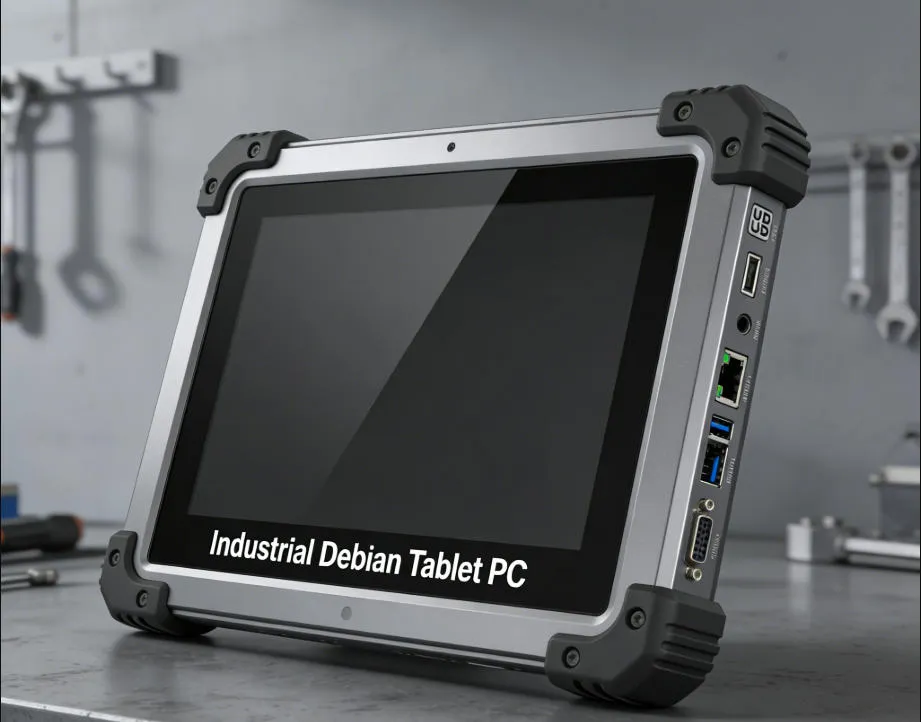
Building an industrial‑grade Debian tablet is an exercise in extreme engineering. The chassis is not plastic but a magnesium‑aluminium alloy that dissipates heat without vulnerable cooling fans.
IP68 Sealing & Ingress Protection
In the field, dust is as lethal as water. Our engineering uses double‑injection moulding and custom‑cured silicone gaskets to achieve IP68 certification: the tablet can be submerged in 1.5 m of water for 30 minutes and remains impervious to fine particulate matter found in mining and cement production.
MIL‑STD‑810H Test Protocols
Durability is not a marketing claim; it is a verified metric. Each unit undergoes MIL‑STD‑810H testing, including 26 drops from 4 ft onto plywood over concrete. We simulate high‑altitude transport, thermal shock (-20 °C to +60 °C), and sustained vibration to ensure internal NVMe and RAM modules remain seated and functional under mechanical stress.

🌐 Strategic Global Sourcing: The Shenzhen‑Global Nexus
To deliver cutting‑edge technology at scale, our supply chain leverages the unparalleled velocity of Shenzhen, China. Known as the “Silicon Valley of Hardware,” the Greater Bay Area provides the agile manufacturing infrastructure necessary to customise Debian tablets for specific industrial needs.
By sourcing components—such as 1000+ nit sunlight‑readable displays and specialised I/O (RS232/DB9)—directly from the heart of the tech supply chain, we reduce lead times by 40% compared to traditional Western‑only manufacturing, while maintaining strict Western compliance standards (CE, FCC, RoHS) through rigorous QC checkpoints.
📊 Technical Specifications & Comparison
Choosing the right architecture is critical for long‑term deployment. Below is a comparison of current industrial Debian tablet tiers.
| Feature | Standard Enterprise | Advanced Field Pro | Extreme Mission‑Critical |
|---|---|---|---|
| Processor | Intel Alder Lake‑N | Intel Core i5‑13th Gen | Intel Core i7 / ARM v9 Custom |
| RAM (ECC support) | 8GB LPDDR5 | 16GB LPDDR5 | 32GB – 64GB LPDDR5x |
| Protection rating | IP65 / 3ft drop | IP67 / 4ft drop | IP68 / 6ft drop / ATEX Zone 1 |
| OS optimisation | Debian 12 Bookworm | Debian 12 (real‑time kernel) | Custom Debian (hardened) |
📉 TCO & ROI Analysis: The Logic of Quality
While the initial acquisition cost of a rugged Debian tablet PC is approximately 2.5x higher than a consumer‑grade device, the Total Cost of Ownership (TCO) over a 5‑year cycle is significantly lower.
- Failure rate reduction: Consumer tablets see 15‑20% annual failure rate in industrial settings; ruggedised units drop to <2%.
- Software longevity: Debian LTS means you don’t need to rewrite field software every 24 months due to OS deprecation.
- Downtime costs: In manufacturing, one hour of downtime can cost $50,000+. A reliable tablet pays for itself in a single avoided incident.

❓ Frequently Asked Questions
Standard Debian can be installed on tablets with unlocked bootloaders or x86 architecture, but industrial‑grade tablets require specialised drivers for touch digitisers, GPS modules, and LTE modems – these are pre‑integrated in our builds.
Debian offers superior stability for complex networking, native support for full desktop applications, and a transparent security model without the telemetry and bloatware often found in Android ecosystems.
Modern Debian kernels utilise advanced TLP and PowerTOP optimisations, allowing our tablets to achieve 10‑12 hours of active field use on a single charge with hot‑swappable battery support.
Latest Content
- How to Optimize Crop Yields with Smart Agriculture
- MDT Metrorail: Deployment and Functions in Rail Systems like Miami-Dade Transit
- MDT Transit Bus Tracker: The Ultimate Guide to Real-Time Public Transport Tracking
- School Bus Rugged Tablet Success Case: Transforming Student Transportation with Intelligent Fleet Technology
- Comprehensive Guide to Mobile Data Terminals (MDT) for Specific Industries: Fire, Transit, Rail, and Beyond
Tags: debian linux tablet, debian on tablet, debian tablet, Debian Tablet PC