As vehicle digitalization accelerates, fleet and special-vehicle projects are becoming increasingly complex.
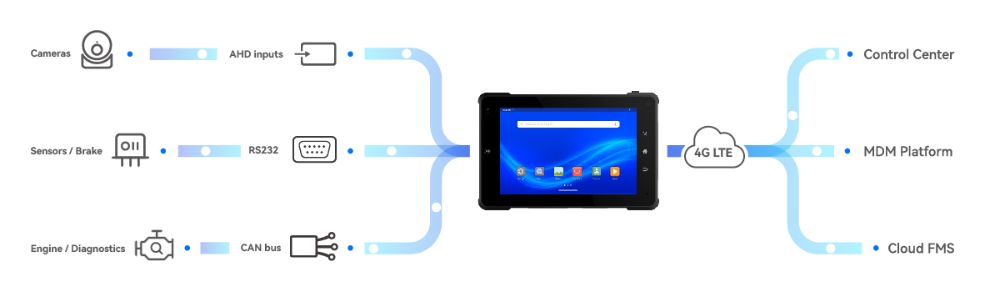
Modern solutions are no longer built around a single device, but around how data moves across the entire vehicle system—from sensors and cameras, to the driver, and finally to backend platforms.
Let’s take a closer look at a typical vehicle telematics architecture and explain the role of the WAYSION Q777 rugged vehicle tablet as the in-cab human–machine interface (HMI).
From Vehicle Data to Decisions: A System-Level View
In most fleet, logistics, and industrial vehicle deployments, the system can be divided into three logical layers:
1. Vehicle Data Capture Layer
2. In-Vehicle Interaction Layer
3. Backend Platform Layer
Each layer has different requirements—and failures in any one of them can compromise the entire solution.
1. Vehicle Data Capture: Where Everything Starts
Modern vehicles generate large volumes of data through:
- CAN bus and OBD interfaces
- Vehicle-mounted cameras (AHD / IP)
- GNSS positioning modules
- I/O signals such as door status, ignition, or auxiliary equipment
- External sensors connected via RS232 / RS485
This data is often collected and pre-processed by edge devices such as MDVRs or vehicle gateways.
However, raw data alone has limited value unless it can be presented and acted upon inside the vehicle.
This is where a reliable in-cab interface becomes critical.
2. The In-Vehicle HMI: Why the Tablet Matters
The human–machine interface is the point where:
- Drivers receive tasks and alerts
- Navigation and route updates are displayed
- Proof-of-delivery or inspection data is captured
- Driver feedback and confirmations are recorded
In many projects, consumer-grade tablets are initially considered—but quickly expose limitations:
- Unstable power under vehicle voltage fluctuation
- Poor vibration resistance
- Limited I/O and peripheral integration
- Short product lifecycles incompatible with long-term projects
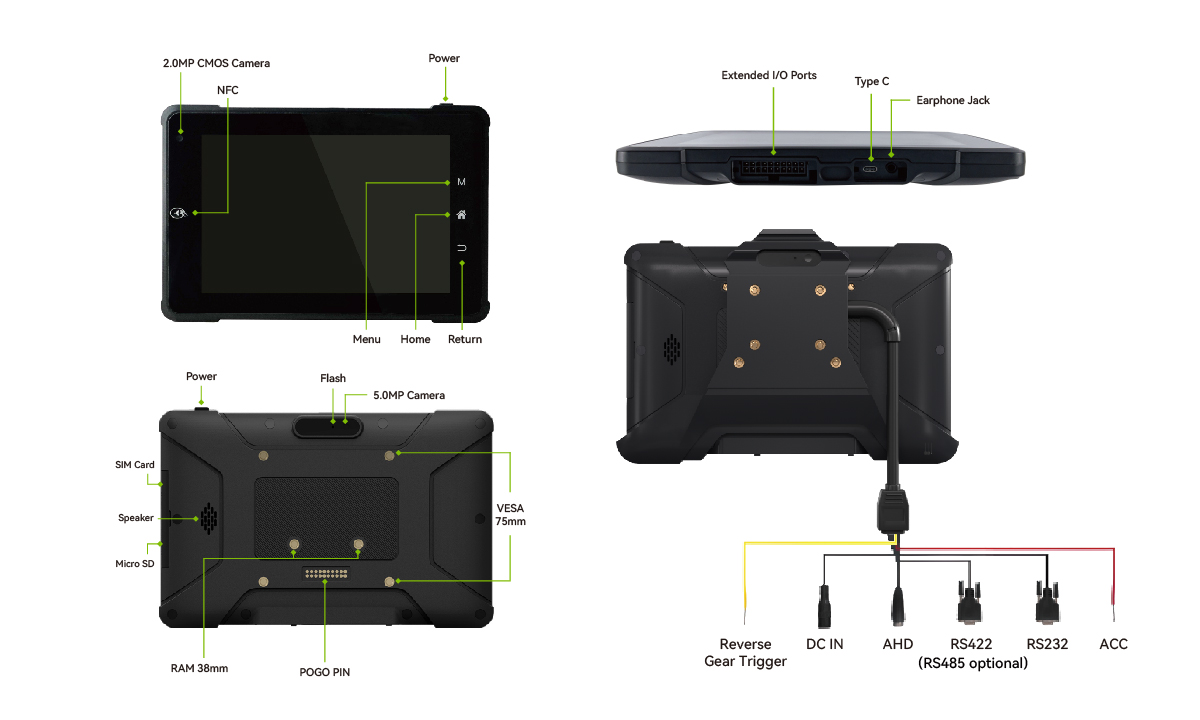
Q777 as the Central HMI in Vehicle Architectures
The WAYSION Q777 rugged vehicle tablet is designed specifically to operate at this intersection between vehicle hardware and fleet software.
Within the architecture, Q777 acts as:
- The primary in-cab display
- A driver interaction terminal
- A bridge between vehicle systems and cloud platforms
Key integration characteristics include:
Vehicle-grade power & ignition control via docking;
Stable pogo-pin connection for long-term mounting;
Support for cameras, GNSS, CAN, and external peripherals;
Consistent operation under vibration, temperature, and voltage changes.
Rather than forcing system integrators to redesign their architecture, Q777 is built to fit into existing vehicle ecosystems.
3. From Vehicle to Cloud: Reliable Data Transmission
Once data is processed and confirmed inside the vehicle, it must be transmitted reliably to backend platforms for dispatch and scheduling, real-time monitoring, compliance and reporting, and historical data analysis.
Q777 supports multiple connectivity options, including: 4G cellular, Wi-Fi offload at depots, and Multi-constellation GNSS for positioning continuity.
This ensures that data collected in the field becomes actionable insights, not isolated records.
Why System Integrators Choose a Dedicated HMI Platform
For system integrators and solution providers, hardware is not just a component—it is part of the system architecture.
Projects often require long-term hardware availability, predictable interfaces and behavior, compatibility across PoC, pilot, and mass deployment stages.
Q777 is developed with these realities in mind, providing: a stable Android platform, hardware designed for long lifecycle projects, flexibility to support different telematics and fleet software stacks.
A Platform That Supports, Not Complicates, Your Design
The real value of a rugged vehicle tablet is not measured by specs alone, but by how smoothly it integrates into a real vehicle system.
In modern fleet and vehicle telematics architectures, the role of the in-cab tablet is clear:
It connects drivers to systems;
It turns data into decisions;
It must remain reliable under real-world conditions.
The WAYSION Q777 is designed to be that stable HMI layer—supporting your system architecture instead of dictating it.
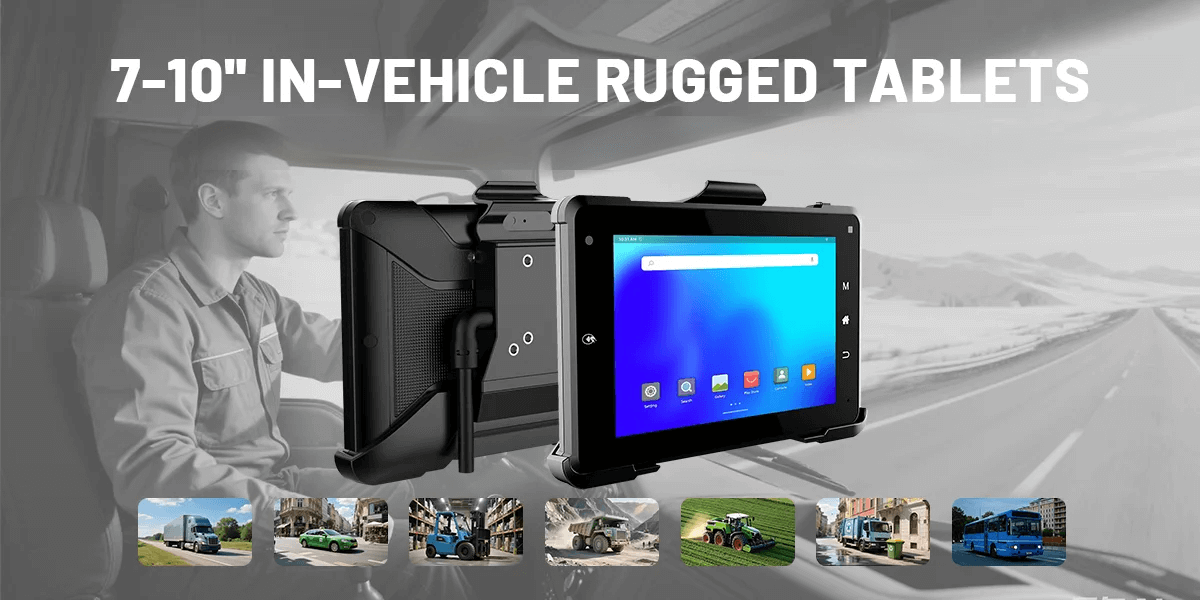
Typical Application Scenarios:
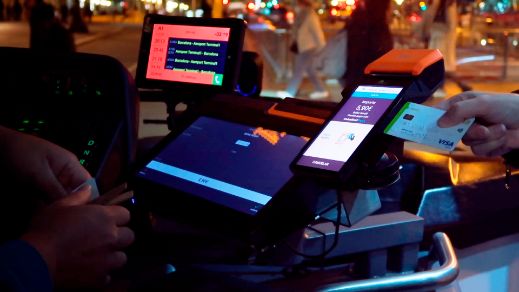
Public Transportation Systems;
Industrial & Special Vehicles.
Latest Content
- How to Optimize Crop Yields with Smart Agriculture
- Industrial Debian Tablet PC: The 2026 Guide to Open-Source Field Computing
- MDT Metrorail: Deployment and Functions in Rail Systems like Miami-Dade Transit
- Top 10 Rugged Tablet Manufacturers & Supplier Worldwide in 2026 (Updated 2026)
- School Bus Rugged Tablet Success Case: Transforming Student Transportation with Intelligent Fleet Technology
Tags: Q777, Q777 rugged vehicle tablet