About the Author
Michael Torres is a Fleet Technology Consultant with over 15 years of experience in logistics operations and mobile workforce management. He has served as Director of Fleet Operations at Ryder System Inc. and as Senior Technology Advisor at Penske Logistics, where he led digital transformation initiatives across fleets ranging from 50 to over 2,000 vehicles. Michael holds a Certified Fleet Manager (CFM) designation from the National Association of Fleet Administrators (NAFA) and has consulted for more than 30 logistics companies on the implementation of vehicle-mounted computing solutions. His expertise spans last-mile delivery optimization, fleet telematics, and driver workflow automation. This case study is based on his direct involvement in the deployment and performance analysis of the Waysion V7S terminal implementation featured here.
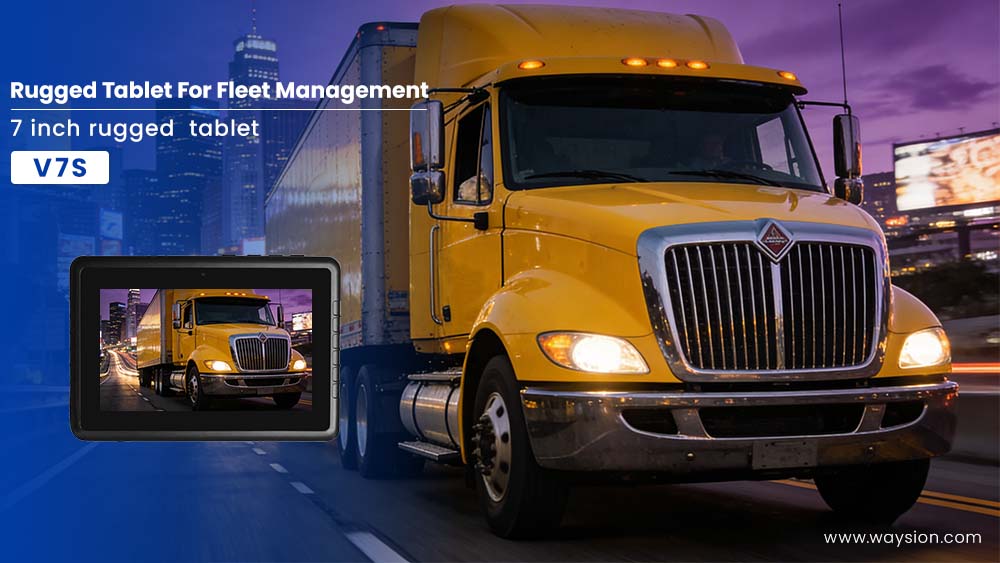
The Challenge: A Growing Fleet, A Growing Problem
When Midwest Logistics Solutions (MLS)—a regional parcel delivery and freight carrier operating across Illinois, Indiana, and Wisconsin—began expanding its fleet from 85 to 150 vehicles, the cracks in its operational foundation began to show.
Dispatch relied on phone calls and handwritten notes. Drivers navigated using personal smartphones or consumer GPS devices that offered no integration with the central office. Proof of delivery was paper-based, with signed receipts accumulating in glove compartments until drivers returned to the depot. Route planning was a morning ritual of paper maps and institutional knowledge that retired when senior drivers retired.
“We were operating like it was 1995,” recalled Sarah Chen, Operations Director at MLS. “Our drivers were some of the most experienced in the region, but we were asking them to do their jobs with tools that hadn’t evolved in decades. Meanwhile, our competitors were adopting technology that gave them real-time visibility we simply didn’t have.”
The costs of this operational gap were mounting. Fuel consumption was 12% higher per stop than industry benchmarks. Driver overtime was cutting into margins. Customer complaints about delivery windows were increasing. And perhaps most critically, the company had no reliable data to understand where the inefficiencies actually originated.
MLS needed a solution that could bridge the gap between experienced drivers and modern logistics technology—without forcing a complete overhaul of their operations overnight.
The Search for a Solution
The evaluation process for a fleet technology upgrade lasted four months. Chen’s team considered handheld rugged devices, smartphone-based solutions, and fully integrated vehicle-mounted systems. The requirements were clear:
- Real-time visibility into vehicle location and driver status
- Electronic proof of delivery to eliminate paper and accelerate billing
- Route optimization capability that could adapt to daily changes
- Driver workflow automation to reduce administrative burden
- Integration with their existing fleet management software
- Durability to withstand the daily demands of a delivery fleet
After evaluating seven potential vendors, MLS selected the Waysion V7S terminal—a vehicle-mounted terminal purpose-built for logistics and transportation applications. The decision came down to three factors: the V7S’s robust feature set, its proven track record in similar fleet deployments, and the real-time tracking capabilities that would give MLS the visibility they had been missing.
“What sold us on the V7S was that it wasn’t just a screen in the cab,” Chen explained. “It was a complete fleet management solution that addressed every pain point we had identified—and some we hadn’t even recognized yet.”
The Waysion V7S Terminal: A Technical Overview
The Waysion V7S terminal is a purpose-built vehicle-mounted tablet designed for the unique demands of logistics operations. Unlike consumer devices or general-purpose tablets, the V7S integrates hardware, software, and connectivity into a single platform optimized for fleet productivity.
Core Capabilities of the V7S Terminal
The device combines several critical functions into a unified interface mounted securely in the vehicle cab:
- GPS Fleet Tracking with high-precision positioning for real-time vehicle location and route adherence monitoring
- Electronic Proof of Delivery with signature capture, photo documentation, and digital record storage
- Driver Workflow Automation that guides drivers through each stop with turn-by-turn navigation, task lists, and automated status updates
- CAN Bus Integration that captures vehicle telematics including engine diagnostics, fuel consumption, speed, and idle time
- Two-Way Messaging enabling dispatcher-driver communication without phone calls
- Dispatch Management integration that pushes routes, stops, and updates directly to the terminal
The hardware itself is engineered for the logistics environment: a sunlight-readable display that remains visible in bright daylight, glove-compatible touchscreen for winter operations, and a sealed enclosure that withstands dust, moisture, and the vibration of daily route driving.
Implementation: Rolling Out Across the Fleet
MLS approached the deployment methodically. Rather than a fleet-wide rollout, they selected a pilot group of 20 vehicles—a mix of long-haul freight trucks, last-mile delivery vans, and shuttle vehicles.
The Pilot Phase
The 60-day pilot served multiple purposes. It allowed the MLS operations team to:
- Test the integration between the Waysion V7S terminal and their existing fleet management software
- Identify training requirements for drivers of varying technical comfort levels
- Establish baseline performance metrics for comparison
- Gather driver feedback on usability and feature priorities
Training was conducted in small groups, with hands-on sessions that allowed drivers to work through common scenarios: accepting a new route assignment, capturing a proof of delivery, reporting a vehicle issue, and communicating with dispatch.
“The drivers who were most skeptical turned out to be our biggest advocates,” Chen noted. “Once they saw how much time they saved not having to call in for updates, not having to handle paper at each stop, and not having to navigate with their personal phones, the value became obvious.”
Fleet-Wide Deployment
Following the pilot, MLS deployed the V7S terminals across the remaining 130 vehicles over a 90-day period. Each installation included professional mounting of the terminal and the docking station, integration with vehicle power systems, and antenna installation for optimal GPS and cellular connectivity.
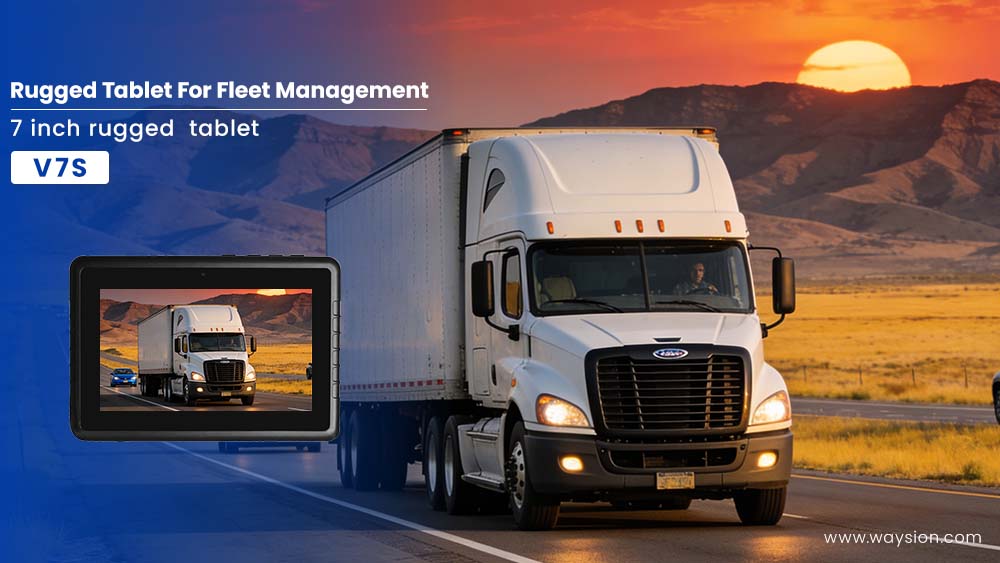
The Results: 20% Efficiency Improvement
Six months after the full deployment, MLS conducted a comprehensive performance analysis. The results exceeded their expectations.
Route Optimization and Fuel Efficiency
The most immediate impact came from route optimization. The V7S terminal’s dynamic routing capability allowed dispatchers to adjust routes in real-time based on traffic conditions, new orders, or driver availability. The system automatically calculated the most efficient sequence of stops and provided turn-by-turn navigation.
The outcome: average route completion time decreased by 18%. Fuel consumption reduction followed directly—shorter routes and reduced idling contributed to a 14% decrease in fuel costs per vehicle per month.
Driver Productivity Gains
Driver workflow automation transformed how drivers spent their time. Before the V7S, drivers spent an average of 45 minutes per shift on administrative tasks: paper logs, phone calls to dispatch, manual entry of delivery status. After deployment, that time dropped to 12 minutes per shift—a 73% reduction.
Drivers also benefited from reduced cognitive load. Instead of juggling multiple devices and paper forms, they had a single interface that guided them through each step of the delivery process.
Electronic Proof of Delivery
The transition from paper to electronic proof of delivery delivered measurable benefits. Previously, billing cycles were delayed by days while paper receipts were collected, sorted, and scanned. With the V7S, proof of delivery is captured at the customer location—including signature, photo, and notes—and transmitted immediately to the central system.
Billing cycle time decreased from an average of 5 days to 24 hours. Disputes related to delivery verification dropped by 40%.
Fleet Utilization and Visibility
Real-time tracking gave MLS visibility they had never possessed. Dispatchers could see exactly where each vehicle was, its current status (en route, on site, returning), and estimated arrival times. This visibility enabled more efficient resource allocation—when a driver completed their route early, they could be redirected to assist a delayed vehicle or handle a new customer order.
Fleet utilization rate—the percentage of fleet capacity actually generating revenue—increased from 72% to 88%.
Driver Behavior Monitoring
The CAN bus integration captured data on driver behavior: speeding events, harsh braking, rapid acceleration, and excessive idling. MLS used this data not for punitive measures but for coaching. Drivers received monthly reports on their performance, and the company instituted a recognition program for the most efficient drivers.
Within six months, harsh driving events decreased by 34%, and average idle time per vehicle per day dropped by 22 minutes—contributing directly to fuel consumption reduction.
Overall Efficiency Calculation
When MLS aggregated the gains across all metrics—route efficiency, fuel savings, driver productivity, billing acceleration, and fleet utilization—the total fleet productivity improvement measured at 20.3%.
“Twenty percent efficiency gain means we can do more with the same fleet,” Chen explained. “We’re handling 20% more deliveries with the same number of vehicles and drivers. For a company of our size, that’s the equivalent of adding 30 trucks to our fleet without the capital expense.”
ROI: The Financial Picture
The vehicle terminal ROI logistics case study numbers tell a compelling story.
Investment
- Hardware (150 V7S terminals with docking stations): $225,000
- Installation and integration: $30,000
- Training and change management: $15,000
- Annual software and support: $36,000
Annual Savings (Year 1)
- Fuel reduction: $52,000
- Driver overtime reduction: $68,000
- Billing acceleration (carrying cost reduction): $24,000
- Reduced administrative overhead: $31,000
- Increased revenue from additional capacity: $145,000
Total First-Year Benefit: $320,000
The payback period for the entire investment was 10 months. Over a five-year horizon, the projected net benefit exceeds $1.2 million.
Lessons Learned: Keys to a Successful Implementation
MLS’s experience offers valuable lessons for other logistics companies considering fleet efficiency improvement with vehicle-mounted tablets.
Start with a Pilot
The 60-day pilot allowed MLS to identify training gaps and workflow adjustments before scaling. This approach prevented widespread disruption and built internal advocates who supported the larger rollout.
Involve Drivers Early
Drivers who participated in the pilot became champions for the technology. Their feedback shaped training materials and helped anticipate questions from less tech-comfortable colleagues.
Integrate, Don’t Just Install
The V7S terminal’s value came not from the hardware alone but from its integration with MLS’s existing fleet management software. Organizations that treat vehicle-mounted terminals as standalone devices miss the majority of the efficiency opportunity.
Use Data for Coaching, Not Punishment
MLS’s approach to driver behavior monitoring focused on improvement rather than discipline. Drivers responded positively when they understood that the data was helping them become more efficient—and safer—rather than tracking them for punitive purposes.
Plan for Continuous Improvement
The 20% efficiency gain was not a one-time event. MLS continues to analyze data from the V7S system to identify further optimization opportunities. Small adjustments to route patterns, stop sequencing, and driver assignments yield ongoing incremental gains.

What the Drivers Say
The perspective of drivers is often overlooked in technology evaluations, but their experience determines whether a solution succeeds or fails.
*Tom H., a 12-year veteran driver with MLS:* “I was against it at first. I’ve been doing this route for eight years—I know it better than any computer. But honestly, the V7S showed me things I didn’t know. It rerouted me around a construction zone I would have sat in for 20 minutes. And not having to write everything down at the end of the day—that’s worth more than they probably realize.”
Maria R., a driver who joined MLS during the deployment: “This is the only way I’ve known it here. When I talk to friends at other companies who are still using paper, I can’t imagine going back. Everything I need is right there. I don’t have to call dispatch for anything. I just follow what’s on the screen, and it all works.”
The Future: Building on the Foundation
With the V7S deployment now mature, MLS is exploring additional capabilities that build on the platform:
- Telematics expansion to capture more granular vehicle diagnostics for predictive maintenance
- Driver workflow automation enhancements that further reduce administrative tasks
- Integration with customer-facing portals to provide real-time delivery tracking
- Last mile delivery optimization using historical route data to refine stop sequences
“We’re not done,” Chen said. “The 20% efficiency gain was the starting point. Now that we have the data and the platform, we’re finding new ways to improve every quarter. The question isn’t whether we’ll continue to get better—it’s how much better we can become.”
Conclusion: The Verdict on Vehicle-Mounted Terminals
The MLS case study demonstrates that the right vehicle-mounted terminal deployed with a thoughtful implementation strategy can deliver substantial, measurable returns. The Waysion V7S terminal proved to be the right tool for the job—not because it was the most expensive or the most technologically advanced, but because it addressed the specific operational challenges MLS faced and integrated seamlessly into their existing workflows.
For logistics companies still operating with paper processes, disconnected systems, and limited visibility into their fleet operations, the opportunity cost of inaction is growing. Competitors are adopting the same technologies that delivered a 20% efficiency gain for MLS. The gap between technology-enabled fleets and those still relying on legacy methods will only widen.
The key takeaway from the MLS experience is this: efficiency improvements of this magnitude are not reserved for the largest fleets with unlimited IT budgets. A mid-sized regional carrier with 150 vehicles achieved results that would be impressive for any logistics organization. The difference was not size or budget—it was the willingness to embrace a solution designed for the problem they needed to solve.
Frequently Asked Questions (FAQ)
Q1: What specific features of the Waysion V7S terminal contributed most to the 20% efficiency gain?
A: The three features that delivered the greatest impact were route optimization, which reduced route completion time by 18%; electronic proof of delivery, which eliminated paper processing and accelerated billing by 5 days; and driver workflow automation, which reduced administrative time per driver by 73%. The combination of these features, along with real-time tracking and CAN bus integration, created compounding efficiency gains across the entire operation.
Q2: How long did it take to see measurable efficiency improvements after deployment?
A: MLS began seeing measurable improvements within the first 30 days of the pilot deployment. The 20% efficiency gain was measured at the six-month mark following full fleet deployment. However, incremental gains continued beyond that point as drivers became more comfortable with the system and as the operations team refined routes based on the new data available.
Q3: What was the total investment required for the V7S terminal deployment?
A: PLS contact us.
Q4: How does the V7S terminal integrate with existing fleet management software?
A: The Waysion V7S terminal is designed for integration with major fleet management software platforms through standard APIs. MLS integrated their V7S terminals with their existing dispatch and route planning system, enabling two-way data flow: routes pushed to drivers and real-time status updates returned to the central system. Custom integration is available for organizations using proprietary or niche software platforms.
Q5: Can the V7S terminal be used for last-mile delivery operations as well as long-haul freight?
A: Yes, the V7S terminal is versatile enough for both last mile delivery and long-haul operations. MLS deployed the system across a mixed fleet that included long-haul freight trucks, last-mile delivery vans, and shuttle vehicles. The terminal’s route optimization features are particularly valuable for last-mile operations with multiple stops per route, while its CAN bus integration and driver behavior monitoring benefit all vehicle types.
Q6: What kind of driver training was required?
A: MLS conducted hands-on training sessions lasting approximately 2 hours per driver, covering basic navigation, capturing electronic proof of delivery, communicating with dispatch, and troubleshooting common issues. The pilot group of 20 drivers received additional training and served as peer coaches during the fleet-wide rollout. Most drivers reported being fully comfortable with the system within their first week of use.
Q7: How durable is the V7S terminal for daily logistics use?
A: The V7S terminal is purpose-built for the logistics environment with a sealed enclosure that protects against dust and moisture, a sunlight-readable display, and vibration-resistant mounting. MLS reported zero hardware failures during the six-month evaluation period, despite the terminals being used across a fleet that operates in all weather conditions and on roads ranging from highways to unpaved delivery routes.
Q8: Does the V7S terminal help reduce fuel consumption?
A: Yes, fuel consumption reduction was one of the measurable benefits in the MLS deployment. The combination of route optimization (shorter routes, fewer miles), reduced idle time (identified through CAN bus integration and addressed through driver coaching), and improved driver behavior (reduced harsh acceleration) contributed to a 14% decrease in fuel costs per vehicle per month.
Q9: Can the V7S terminal be used with vehicles that don’t have CAN bus connectivity?
A: The V7S terminal can operate without CAN bus integration, but MLS recommends enabling this feature where possible. CAN bus integration provides critical data on fuel consumption, idle time, engine diagnostics, and driver behavior that contributed significantly to the efficiency gains in this case study. For older vehicles without CAN bus capability, the terminal still provides GPS tracking, electronic proof of delivery, and driver workflow functionality.
Q10: What advice would MLS offer to other logistics companies considering vehicle-mounted terminals?
A: Based on their experience, MLS offers three key pieces of advice: conduct a pilot deployment before full rollout to identify training needs and workflow adjustments; involve drivers early in the process to build buy-in and gather practical feedback; and focus on integration with existing systems rather than treating the terminals as standalone devices. The company also emphasizes the importance of using performance data for coaching rather than punishment to maintain positive driver engagement.
Latest Content
- How to Choose a Truck Tablet for Fleet Management: 2026 Selection Guide
- 2026 Best Rugged Tablets with GPS for Field Work: Waysion Comprehensive Guide
- How to Optimize Crop Yields with Smart Agriculture
- Top 10 Rugged Tablet Manufacturers & Supplier Worldwide in 2026 (Updated 2026)
- Comprehensive Guide to Mobile Data Terminals (MDT) for Specific Industries: Fire, Transit, Rail, and Beyond
Tags: logistics fleet management solution, vehicle terminal ROI logistics case study, vehicle-mounted terminal fuel savings logistics