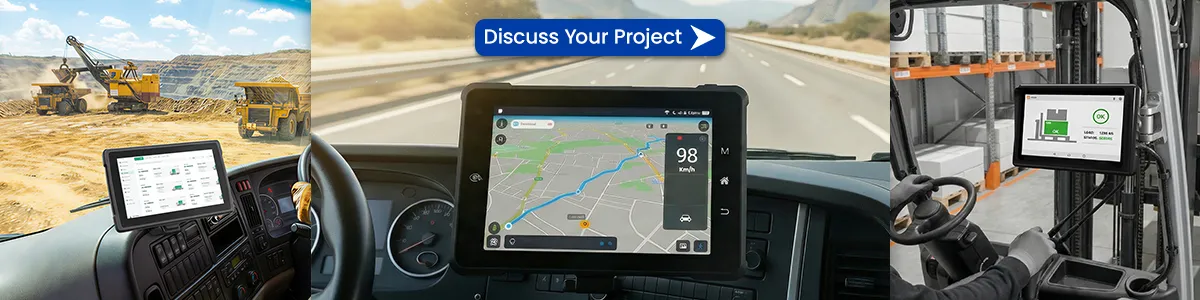
Severe vibration, silica dust, and explosive gases in mining environments destroy standard industrial tablets. Mining rugged tablets must feature IP65/68 dust/waterproofing, MIL-STD-810H vibration certification, ATEX/IECEx Zone 2 explosion-proof compliance, and 1000+ nits sunlight-readable displays with glove/wet-touch capability. Utilizing floating PCB structures and pressure-fit seals ensures zero-downtime operation in open-pit trucks and underground mines.
From Open-Pit Trucks to Underground Mines: Unpacking Shockproof, Explosion-Proof, and IP68 Standards for Mining Rugged Tablets
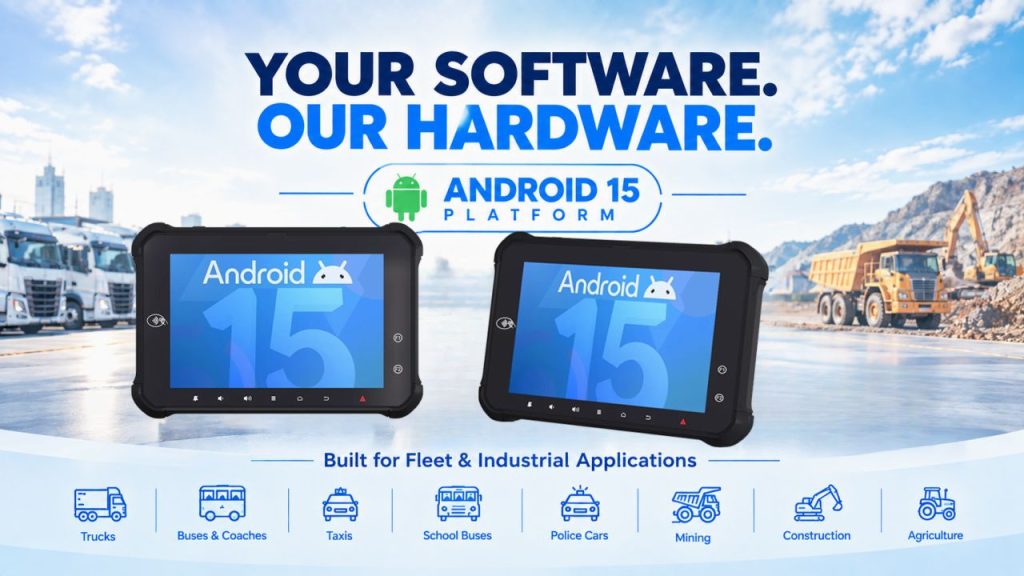
Why Standard Industrial Tablets Fail Within 6 Months in Mining Operations
In both open-pit mining and deep underground mining environments, electronic devices are constantly subjected to extreme physical stress and environmental hazards. In the early stages of digital transformation, many mining operators deploy standard industrial-grade tablets to reduce initial hardware expenditure. However, field data indicates that the Mean Time Between Failures (MTBF) for these standard devices is extremely short, with an average lifespan rarely exceeding six months.
The rapid breakdown of standard industrial tablets stems from three primary environmental “killers”:
- Infiltration of Ultra-fine Silica Dust & Mineral Powder: Drilling, blasting, shoveling, and haulage generate massive quantities of fine silica dust with particles smaller than 5 microns. Standard industrial tablets lack sealed housing around heat dissipation vents, speaker meshes, and standard USB/RJ45 ports. Fine dust easily penetrates internal components during thermal cycling or fan operation, leading to board short-circuiting, stuck buttons, and port degradation.
- Composite High-Frequency and Low-Frequency Vibration: Terminals mounted inside the cabins of 100-ton haul trucks, hydraulic excavators, or drill rigs must endure continuous high-frequency engine vibration combined with low-frequency, high-amplitude shocks from unpaved haul roads. Ribbon cables, battery mountings, and display glass in standard tablets suffer rapid fatigue, disconnection, or cracking.
- Explosion Hazards in Underground Atmospheres: In underground coal mines or facilities containing flammable gases (e.g., methane, hydrogen sulfide) and combustible dust, tiny electrical sparks from internal switching, battery overheating, or electrostatic discharge (ESD) in standard tablets can trigger catastrophic ignition events.
The 3 Essential Durability Standards for Mining-Grade Rugged Tablets
To maintain 24/7 continuous operation in harsh mine sites, mining rugged tablets must be engineered from the ground up to comply with stringent physical protection and electrical safety benchmarks.
MIL-STD-810H / 810G Certification: Resisting Violent Shocks and Drops
The US Military Standard MIL-STD-810H serves as the definitive benchmark for environmental engineering considerations. Mining rugged tablets must pass the following critical test procedures:
- Method 514.8 (Category 4 – Vehicle Vibration): Simulates equipment mounted on heavy haul trucks or tracked machinery. The tablet undergoes tens of hours of three-axis random vibration testing across frequencies from 10Hz to 500Hz, ensuring that internal PCBs, surface-mount components, and fasteners remain completely secure.
- Method 516.8 (Shock & Transit Drop): The device must survive free-fall drops from 1.2 to 1.5 meters onto a hard concrete surface (typically 26 drops across various angles, edges, and faces) with zero chassis cracking, zero screen breakage, and full functional booting post-test.
ATEX Zone 1/2 & IECEx Anti-Explosion Certification: Underground Safety Compliance
In mining zones exposed to explosive gas or dust hazards, rugged tablets require Intrinsic Safety (IS) engineering:
- ATEX Zone 2 / IECEx Ex-ic Compliance: Designed for locations where an explosive atmosphere is not likely to occur during normal operation, or if it does, will exist for a short period only. The tablet employs non-sparking circuitry with energy-limiting protection on all capacitors and inductors, ensuring that no single fault can generate sufficient thermal or electrical energy to ignite gas or dust mixtures.
- Anti-Static Enclosure & Sealed Encapsulation: Chassis built from anti-static engineering polymers (e.g., Polycarbonate + ABS) or elastomer-overmolded magnesium alloys maintain surface resistance below critical safety thresholds to prevent static spark generation caused by friction.
IP65 vs IP68: Resisting High-Pressure Washdowns
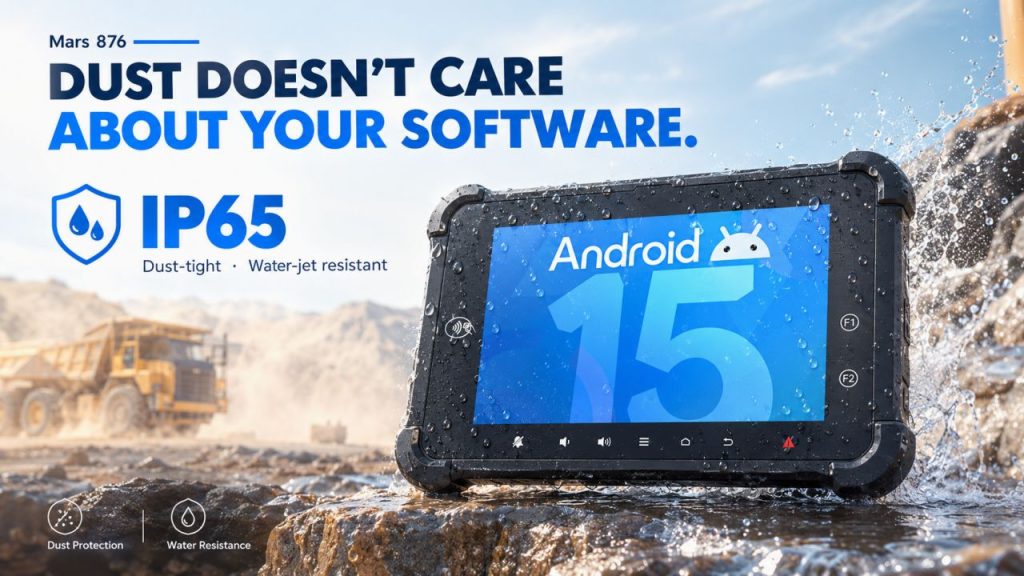
While IP65 is often considered sufficient for generic industrial use, mining fleet maintenance imposes far higher water resistance demands. At the end of a shift, haul trucks are washed down using commercial high-pressure water cannons.
- Limitations of IP65: Rated only against low-pressure water jets (6.3mm nozzle at 12.5 L/min). Water vapor and high-pressure jets easily breach button gaps and port covers.
- The IP68 Requirement: Devices must be 100% dust-tight (8 hours under negative pressure dust testing) and capable of continuous immersion in water exceeding 1.5 meters for over 30 minutes. Ports must utilize heavy-duty dust plugs or latch-reinforced sealing caps.
Display Ergonomics: Overcoming Glare, Mud, and Heavy Gloves
The touchscreen serves as the primary interface for miners interacting with Fleet Management Systems (FMS) or digital inspection checklists. It is also the component most vulnerable to environmental failure.
- Sunlight Readability: Direct sunlight in open-pit mines can exceed 100,000 lux. Standard screens (300–400 nits) become washed out and unreadable. Mining rugged tablets require 1000+ nits ultra-bright LCD panels combined with Optical Bonding technology. Optical bonding fills the air gap between the cover glass and the display panel, reducing internal reflectivity to below 0.5% while incorporating an Anti-Glare (AG) coating.
- Heavy Glove and Wet-Touch Operation: Miners routinely wear thick anti-impact gloves, heavy leather gloves, or rubber gloves covered in mud and water. Standard capacitive touchscreens suffer from false touches or total unresponsiveness under wet conditions. Rugged tablets integrate specialized touch controller ICs (e.g., Synaptics/Cypress) running advanced algorithms that support precise touch inputs even when operating with 3mm thick heavy gloves or under heavy water drops.
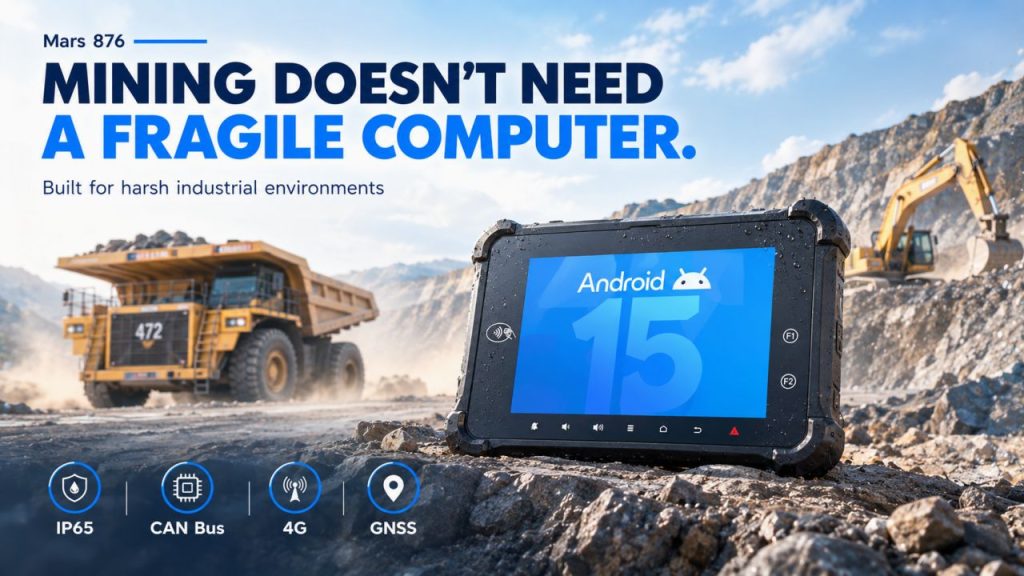
High-Quality Actionable Solution: Hardware Architecture Reference Standard
To address these extreme mining challenges, we outline a fully actionable, field-proven hardware specification architecture for mining rugged tablets:
Structural Shock Absorption & IP68 Sealed Enclosure Architecture
- Chassis Construction: High-strength die-cast magnesium-aluminum alloy internal frame wrapped in a TPU (Thermoplastic Polyurethane) dual-injection shock-absorbing rubber bumper system, delivering a “hard-core frame with soft-touch armor” protection.
- Floating Internal Mounts: The mainboard and battery assembly use silicon-damper suspension mounts. Critical internal ribbon connectors feature screw-locked retention plates, passing all MIL-STD-810H vehicle vibration tests.
- Port Sealing Mechanism: Replaces traditional flat rubber plugs with latch-secured, pressure-fit sealing covers or M12 industrial aviation connectors fitted with dual-lip silicone gaskets to guarantee IP68 integrity.
Intrinsically Safe Anti-Explosion Circuitry
- Energy-Limiting PMIC Design: The Power Management IC incorporates redundant current and voltage limiting circuits to restrict capacitive and inductive energy storage, fully conforming to ATEX Zone 2 / IECEx standards (Ex ic IIC T4 Gc).
- Static Dissipative Enclosure: Outer surface impedance is maintained below $10^9 \Omega$ to eliminate static buildup. All buttons and display margins feature ESD protection rated to 15kV air discharge and 8kV contact discharge.
High-Brightness Optical Bonding Display Assembly
- Display Specifications: 10.1-inch WUXGA (1920×1200) IPS display delivering up to 1200 nits peak brightness.
- Full Optical Bonding Process: Liquid Optical Clear Adhesive (LOCA) full bonding eliminates internal air gaps and withstands thermal stress from -20°C to 60°C without delamination or bubbling.
- Multi-Touch Operating Modes: Offers one-touch switching via a physical hotkey between “Finger Mode,” “Glove Mode (up to 3mm),” and “Rain/Wet-Touch Mode,” accompanied by a heavy-duty passive/active stylus.
If you would like to learn more about solutions for mining tablets, please Contact us.
Tags: Explosion Proof Tablet ATEX, IP68 Industrial Rugged Tablet, MIL-STD-810H Vehicle Vibration, Mining Rugged Tablet, Sunlight Readable Glove Touch Screen