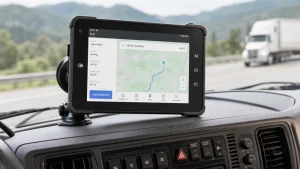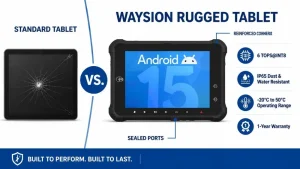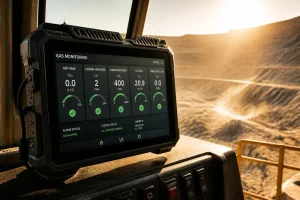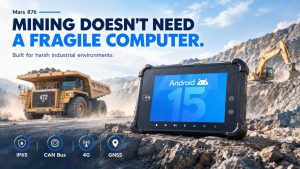
Deploying consumer-grade tablets in demanding industrial, logistics, or field-service environments is a false economy that typically results in 3–4× higher total cost of ownership (TCO) within 24 months. Wholesale rugged tablets represent a fundamentally different value proposition: purpose-built devices engineered for sustained operation in dust, moisture, vibration, and temperature extremes, backed by enterprise lifecycle commitments that stabilize long-term IT budgets. For procurement teams evaluating bulk purchases in 2026, the decision hinges on verified durability standards (MIL-STD-810H, IP68), platform longevity (minimum 5-year security patch guarantees), and vendor service-level agreements that minimize operational downtime. This guide provides actionable specifications, real-world performance data, vendor comparisons, and a vetting checklist to ensure your wholesale investment delivers measurable returns rather than recurring replacement costs.
The True Cost of Consumer vs. Rugged Tablets in Field Operations
The sticker price of a consumer tablet is deceptive. Industry benchmark data consistently shows that non-ruggedized devices deployed in field environments experience annual failure rates between 18% and 28%, compared to 2%–4% for certified rugged alternatives. These failures aren’t merely hardware replacements; each incident triggers an average of 4.2 hours of lost productivity per technician, including troubleshooting, data re-entry, travel to retrieve a spare, and IT support overhead. At a blended labor rate of $45/hour, a single device failure costs approximately $189 in lost output before accounting for the replacement unit itself.
Consider a documented case from a mid-sized last-mile delivery operator that initially deployed 200 consumer tablets for route navigation and proof-of-delivery capture. Within 14 months, they had replaced 67 units (33.5% failure rate), primarily due to screen cracks from drops, charging port failures from repeated cable insertion, and water damage during rain exposure. The cumulative cost—including hardware, labor, and missed delivery SLAs—exceeded $127,000. After migrating to a wholesale purchase of Zebra ET45 rugged tablets with integrated barcode scanners and hot-swap batteries, their Year 2 device-related incidents dropped to 6 units (3%), and driver satisfaction scores increased 22% due to reduced frustration with malfunctioning equipment.
This pattern repeats across manufacturing, utilities, construction, and public safety. The break-even point for rugged tablet wholesale investment typically occurs between Month 14 and Month 18 post-deployment, after which TCO diverges dramatically in favor of purpose-built hardware.
Critical Specifications That Actually Matter in 2026
Marketing materials often lead with IP ratings and drop-test claims, but experienced buyers know these are baseline thresholds, not differentiators. Here’s what separates adequate from exceptional in current-generation rugged tablets:
MIL-STD-810H Verification Over Claims: Many vendors advertise “MIL-STD-810 tested” without specifying which methods were applied or whether testing was conducted internally or by an independent lab. Insist on test reports covering Method 516.8 (Shock), 514.8 (Vibration), 501.7/502.7 (Temperature), and 510.7 (Sand/Dust). Third-party validation from labs like Intertek or UL carries significantly more weight than manufacturer self-certification.
Display Usability in Real Conditions: Brightness specs alone are insufficient. Evaluate wet-touch and glove-touch performance using standardized test protocols, as capacitive tuning varies widely. For outdoor work, prioritize displays rated ≥800 nits with optical bonding to eliminate internal reflections. Anti-glare treatments should be matte-finished, not glossy-coated, to prevent specular reflection under direct sunlight.
Connectivity Future-Proofing: With private 5G and CBRS deployments accelerating in warehouses, ports, and campuses, verify that wholesale units support relevant Band 48/n48 frequencies alongside standard carrier bands. Wi-Fi 6E is now table stakes for high-density environments; Wi-Fi 7 support is emerging in premium models and worth considering for deployments intended to last beyond 2029. Bluetooth 5.3+ ensures reliable peripheral connectivity for scanners, printers, and headsets.
Battery Architecture for Multi-Shift Operations: Sealed batteries are a liability in 24/7 operations. Prioritize hot-swappable designs that allow battery exchange without powering down, eliminating workflow interruptions. Verify that spare batteries are available through wholesale channels at negotiated rates and that charging docks support fleet-scale management with individual battery health reporting.
Top Rugged Tablet Platforms Compared (2026 Buyer’s Matrix)
| Feature | Samsung Galaxy Tab Active5 Pro | Zebra ET45 | Panasonic Toughbook FZ-G2 | Getac F110 G7 |
|---|---|---|---|---|
| OS / Updates | Android 15 / 5yr security | Android 14 / 7yr commitment | Win 11 IoT / 10yr lifecycle | Win 11 / 6yr support |
| Display | 10.1″ 800 nits, glove/wet touch | 10″ 800 nits, Wavellight™ | 10.1″ 1000 nits, anti-reflective | 11.6″ 1000 nits, LumiBond® |
| Durability | IP68, MIL-STD-810H, 1.5m drop | IP68, MIL-STD-810H, 1.5m drop | IP65, MIL-STD-810H, 1.8m drop | IP65, MIL-STD-810H, 1.8m drop |
| Scanning | Optional SE4710 imager | Integrated SE4710/SE55 | Optional barcode module | Optional HF RFID + barcode |
| Battery | 5,050mAh, no hot-swap | 6,300mAh, hot-swap capable | Dual batt, hot-swap standard | Dual batt, hot-swap standard |
| Wholesale Price Range | $580–$680 | $720–$850 | $1,900–$2,400 | $2,100–$2,700 |
| Best For | Light field service, retail | Warehouse, logistics, transport | Extreme industrial, defense | Public safety, heavy industry |
Samsung offers the lowest entry cost and strongest consumer-app compatibility but lacks hot-swap capability and has shorter lifecycle support. Zebra dominates logistics with purpose-built scanning integration and industry-leading Android update commitments. Panasonic and Getac command premium pricing justified by superior mechanical robustness, dual-battery architectures, and decade-long availability guarantees suited for regulated or mission-critical sectors.
Wholesale Procurement Strategy & Vendor Vetting Checklist
Negotiating wholesale rugged tablet purchases requires preparation beyond volume discounts. Use this checklist to evaluate suppliers systematically:
✅ Lifecycle Guarantee Documentation: Obtain written confirmation of OS update duration, security patch cadence, and spare parts availability window. Verbal assurances are unenforceable.
✅ Advanced Replacement Terms: Standard depot repair takes 10–15 business days. Negotiate advanced replacement pools (e.g., 5% buffer stock shipped immediately upon RMA initiation) to maintain fleet uptime.
✅ Pre-Deployment Services: Confirm availability of asset tagging, MDM enrollment, BIOS/firmware configuration, and accessory kitting before shipment. In-house staging reduces IT labor burden by 60–80%.
✅ Reference Validation: Request 2–3 customer references in your vertical who purchased ≥100 units in the past 18 months. Ask specifically about post-sale support responsiveness and warranty claim resolution time.
✅ Total Acquisition Cost Modeling: Include accessories (docks, straps, styli), MDM licensing, training, and projected Year 2–3 battery replacements in your RFQ comparison. Lowest unit price rarely equals lowest TCO.
✅ Return & Restocking Policy: Clarify terms for DOA units, specification mismatches, and order changes. Favorable restocking windows protect against over-provisioning during pilot phases.
Pilot deployments of 10–25 units across representative use cases are non-negotiable before committing to full wholesale orders. Document failure modes, user feedback, and integration friction points during the 60–90 day evaluation period to inform final configuration and quantity decisions.
Frequently Asked Questions
Q1: What is the realistic lifespan of a wholesale rugged tablet deployment?
Most enterprise-grade rugged tablets are designed for 5–7 years of active field service, with premium Windows platforms extending to 10 years. Actual lifespan depends on usage intensity, environmental severity, and maintenance practices. Budget for battery replacements at Year 3 and plan technology refresh cycles around OS end-of-support dates rather than hardware failure.
Q2: Can we mix Android and Windows rugged tablets in the same MDM environment?
Yes, but with caveats. Modern UEM platforms (Microsoft Intune, VMware Workspace ONE, SOTI MobiControl) support cross-platform management, though policy granularity differs. Android devices offer deeper kiosk-mode control and app-locking capabilities. Standardize on one OS family unless distinct use cases justify platform divergence, as dual-platform support increases IT overhead by 30–40%.
Q3: How do we validate supplier claims about drop-test ratings?
Request third-party test certificates specifying MIL-STD-810H Method 516.8 parameters: number of drops, height, surface type, temperature conditions, and functional verification criteria post-test. Internal test summaries lacking methodology detail are insufficient. Consider commissioning independent drop-testing for high-volume procurements where vendor claims seem inconsistent with field reports.
Q4: What trade-in or refresh programs exist for bulk rugged tablet upgrades?
Major OEMs and authorized resellers offer structured refresh programs providing guaranteed buyback values (typically 15–30% of original wholesale price at Year 3) when upgrading to next-generation models. These programs reduce net acquisition cost for fleet renewals and include certified data destruction. Negotiate refresh terms during initial wholesale purchase to lock in future value.
Tags: enterprise Android tablet wholesale vendor comparison, hot-swap battery rugged tablet fleet deployment, MIL-STD-810H certified tablet bulk pricing, rugged tablet total cost of ownership calculator, wholesale rugged tablets for logistics companies