- The Challenges of Taxi and Ride-Hailing Operations in Harsh Vehicular Environments
- Industrial-Grade Android Tablets vs. Consumer Tablets: A Rigorous Technical Differentiation
- Waysion V7S: Detailed Technical Architecture and Specifications Interpretation
- Core Application Scenarios in Taxi/Ride-Hailing Operations
- Software Ecosystem: Android 14, GMS/Custom ROM Support, and MDM Integration
- Quantifiable Operational Impacts: Cost Reduction and Efficiency Gains
- Implementation Framework and Best Practices
- Risk Mitigation and Long-Term TCO Analysis
- Conclusion
In the taxi and ride-hailing sector, where vehicles operate continuously across urban, suburban, and sometimes extreme climatic conditions, the in-cab computing platform determines dispatch reliability, regulatory compliance, revenue protection, and fleet uptime. The Waysion V7S, a 7-inch rugged vehicle-mounted Android tablet engineered specifically for mobile data terminal (MDT) applications, addresses these demands through industrial-grade durability, extensive I/O integration including dual CAN bus, wide-voltage power input, and full Android 14 enterprise capabilities.
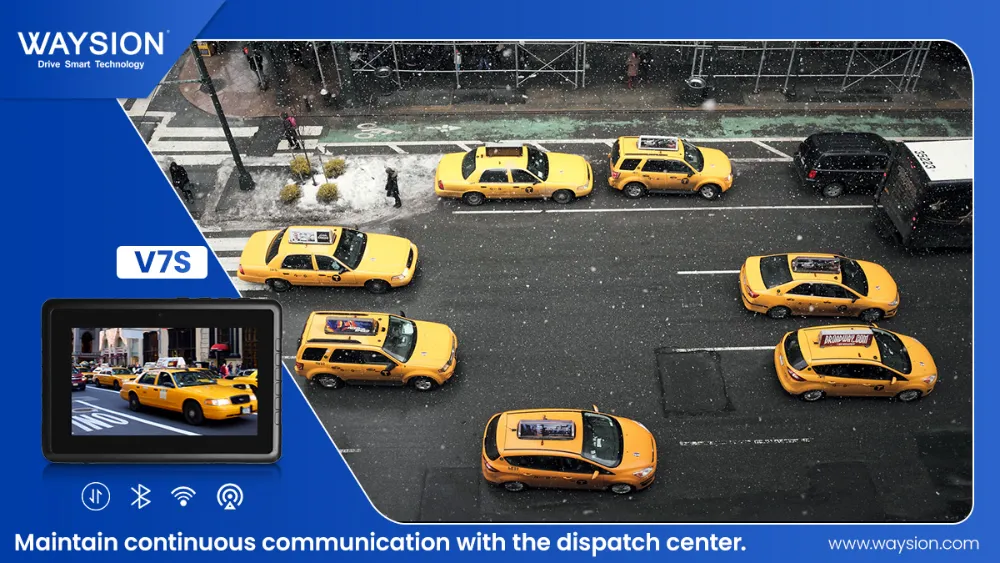
This analysis draws on two decades of IIoT deployment experience across transportation verticals. It demonstrates how the V7S outperforms consumer-grade alternatives in vibration-prone, temperature-variable, and high-utilization environments while enabling advanced features such as intelligent scheduling, electronic geofencing for anti-fraud, and direct hardware linkage to metering systems. Deployments of comparable rugged MDTs consistently yield 25-35% reductions in device-related maintenance costs and 15-25% gains in operational metrics through minimized downtime and real-time data integrity. The V7S delivers a compelling total cost of ownership (TCO) profile for fleets of any scale.
The Challenges of Taxi and Ride-Hailing Operations in Harsh Vehicular Environments
Taxi and ride-hailing vehicles endure 12-18 hour daily shifts, frequent driver handovers, constant vibration from road surfaces, temperature swings from -20°C in winter starts to +60°C+ in sun-exposed cabs, dust ingress, and occasional moisture exposure. Consumer devices fail under these stresses: plastic housings crack, LCDs delaminate, batteries swell or drain rapidly, and consumer OS builds lack vehicle-specific power management and peripheral integration.
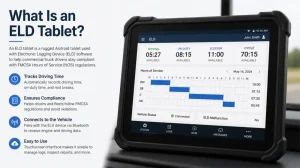
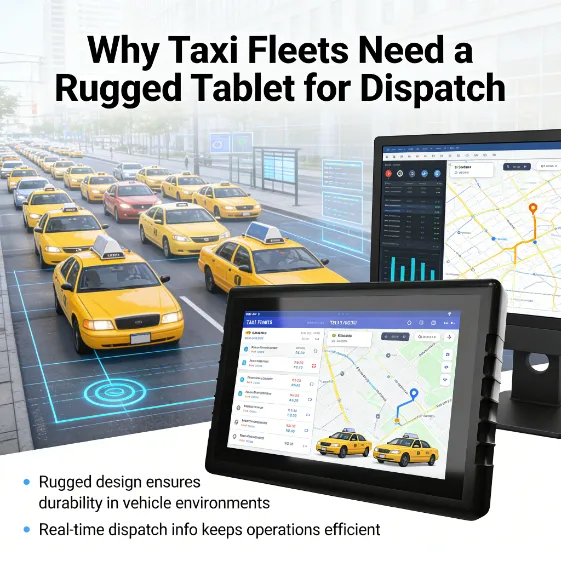
Regulatory pressures compound hardware fragility. Electronic logging devices (ELD), accurate GPS for dispatch and billing, anti-tampering measures, and seamless integration with payment terminals and vehicle ECUs are non-negotiable. Failures translate directly to lost fares, regulatory penalties, driver disputes, and stranded vehicles. A purpose-built industrial tablet like the V7S mitigates these systemic risks by design.
Industrial-Grade Android Tablets vs. Consumer Tablets: A Rigorous Technical Differentiation
The distinction between industrial-grade and consumer tablets is not cosmetic but fundamental in materials science, thermal engineering, mechanical resilience, and interface architecture.
Durability and Environmental Resilience Comparison
| Parameter | Industrial-Grade (e.g., Waysion V7S) | Consumer Tablet (Typical) | Implications for Taxi Operations |
|---|---|---|---|
| IP Rating | IP65 (dust-tight, water jets) | IPX4-IPX5 (splash only) | Survives rain, dust, cleaning agents; no internal corrosion |
| Operating Temperature | -20°C to +70°C (no battery); -10°C to +50°C (with battery) | 0°C to 35°C | Reliable cold starts and hot-day operation without thermal shutdown |
| Shock/Vibration Resistance | MIL-STD-810H equivalent, vehicle-mount rated | Drop-tested ~1m with case | Withstands potholes, frequent mounting/dismounting |
| Housing Material | Reinforced polymer/metal alloy, sealed ports | Polycarbonate/plastic | Long-term structural integrity under vibration |
| Drop Resistance | 1.2-1.5m onto concrete | <1m | Reduced replacement frequency during driver shifts |
Interface and Integration Capabilities
| Interface | Industrial-Grade (V7S) | Consumer Tablet | Taxi/Ride-Hailing Value |
|---|---|---|---|
| Power Input | 9-36V DC wide voltage, direct vehicle | 5V USB-C only | No inverter needed; stable under alternator fluctuations |
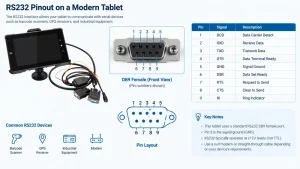
| Serial/CAN | RS232, RS422/485, Dual CAN bus | None | Direct ECU data, meter linkage, reverse camera trigger |
| Ethernet/PoE | RJ45 with PoE support | None | Wired backbone for stable telematics |
| Expansion | TF (128GB), SIM, extended pigtail | Limited microSD | Flexible peripherals and storage for logs/apps |
| Mounting | VESA 75x75mm / RAM mount native | Aftermarket only | Secure, vibration-damped installation |
Performance and Lifecycle Metrics
| Metric | Industrial-Grade (V7S) | Consumer Tablet | Fleet Impact |
|---|---|---|---|
| Processor/Thermal Design | RK3568 Quad A55 @2.0GHz, industrial cooling | Mid-range mobile SoC, consumer TDP | Sustained performance under load/heat |
| OS Longevity | Android 14 with enterprise support | Rapid deprecation | Multi-year security patches, MDM compatibility |
| MTBF (Mean Time Between Failures) | >50,000 hours (vehicle env.) | <20,000 hours | Dramatically lower replacement cadence |
| Certifications | CE, E-mark, RCM | Consumer safety only | Regulatory compliance for commercial vehicles |
These differences result in industrial devices delivering 3-5x longer service life in vehicular applications, directly lowering TCO despite higher initial unit cost.
Waysion V7S: Detailed Technical Architecture and Specifications Interpretation
The V7S is powered by a Rockchip RK3568 64-bit quad-core Cortex-A55 processor (up to 2.0 GHz) paired with Mali-G52-2EE GPU at 800 MHz. This combination, with 4GB LPDDR4 RAM and 32GB eMMC storage (expandable via TF up to 128GB), provides balanced performance for concurrent dispatch apps, navigation, ELD logging, and video decode (4K@60fps H.264/H.265). Android 14 ensures modern security, privacy controls, and API stability.
Display and Usability: 7-inch TFT-LCD (1024×600), 500 cd/m² brightness, 800:1 contrast, G+G capacitive multi-touch. The compact size fits taxi dashboards without obstruction while delivering sunlight readability. Wide viewing angles (75/75 L/R, 70/75 U/D) support angled mounting.
Connectivity: Optional 4G/3G LTE (Quectel module), Wi-Fi 802.11 b/g/n, Bluetooth 4.0, and multi-GNSS (GPS+GLONASS+BeiDou) deliver sub-meter positioning accuracy critical for geofencing and billing integrity. Dual stereo speakers (2W, 8Ω) and front 2MP camera support voice dispatch and driver verification.
I/O Architecture (Critical for IIoT Integration):
- USB 3.0 Host + OTG 2.0
- RJ45 Ethernet (10/100/1000 Mbps, PoE support)
- RS232 + RS422/485
- Dual CAN bus (optional, for J1939/OBD integration)
- AV IN (NTSC for reverse camera)
- Reverse gear trigger and ACC input
- Wide DC input 9-36V, with optional battery (3.7V 2000mAh Li-Po) for graceful shutdown
Mechanical and Environmental: Dimensions 200x136x36 mm, 0.79 kg. IP65 enclosure, -20°C to +70°C operation (no battery). VESA/RAM mount compatibility ensures secure fixation. Power consumption ≤6W normal, supporting 24/7 duty cycles with minimal thermal stress.
This architecture positions the V7S as a true edge computing node, not merely a display.
Core Application Scenarios in Taxi/Ride-Hailing Operations
Intelligent Scheduling System Flow:
- Dispatcher assigns shift via central platform; V7S receives OTA push over 4G.
- Driver logs in with biometric/PIN; device authenticates via MDM-enforced policy and pulls personalized route based on real-time demand, traffic, and vehicle telemetry via CAN bus.
- GPS + multi-GNSS tracks position; V7S displays optimized dispatch queue with ETA predictions.
- Upon job acceptance, navigation integrates with meter data for seamless handoff. System logs all events for audit.
Electronic Geofence Anti-Cheating Flow:
- Fleet manager defines virtual boundaries (airports, high-fraud zones) in backend.
- V7S continuously monitors GNSS position against geofence polygons.
- Entry/exit triggers automatic event logging, meter validation, and alerts if discrepancies detected (e.g., route deviation suggesting meter tampering).
- Real-time CAN bus data cross-verifies vehicle speed/mileage against GPS-derived distance, flagging anomalies instantly. Data uploads securely for dispute resolution, reducing fraudulent claims by enforcing immutable logs.
Meter Hardware Linkage Flow:
- V7S connects directly to taxi meter via RS232/USB or Bluetooth.
- On trip start (triggered by meter or reverse gear/door sensor), V7S synchronizes start timestamp, GPS coordinates, and odometer reading.
- During trip, continuous polling integrates fare calculation with live GPS for distance verification.
- Trip end auto-generates digital receipt, uploads encrypted log to cloud, and prepares for next dispatch. Integration eliminates manual entry errors and supports instant surge pricing adjustments.
These flows leverage the V7S’s native interfaces for zero-latency, tamper-resistant operation.
Software Ecosystem: Android 14, GMS/Custom ROM Support, and MDM Integration
The V7S runs Android 14 natively, supporting Google Mobile Services (GMS) for full Play Store access, Google Maps navigation, and certified apps. For security-sensitive fleets, custom ROMs or Android Enterprise configurations allow removal of consumer bloat while retaining enterprise APIs.
MDM compatibility (e.g., with solutions supporting Android Enterprise) enables:
- Remote provisioning and enrollment at scale.
- Policy enforcement: app whitelisting, geofence-based restrictions, camera/mic controls.
- Over-the-air (OTA) updates for OS, firmware, and custom apps without vehicle recall.
- Real-time device health monitoring (battery, temperature, signal).
- Remote wipe/lock for lost or compromised units.
- Usage analytics for driver behavior optimization.
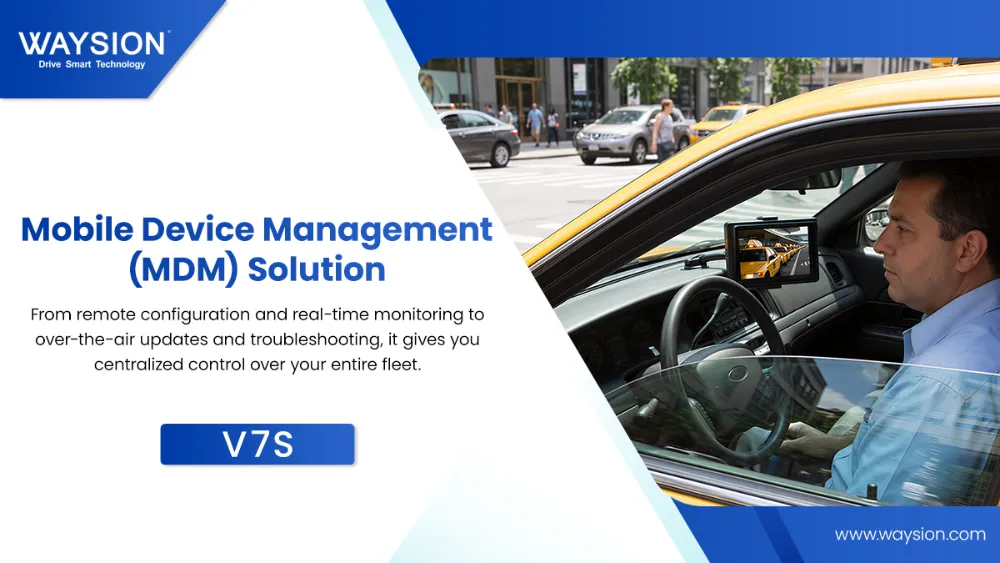
This ecosystem transforms the V7S from isolated hardware into a centrally governed fleet asset, ensuring compliance and rapid response to emerging threats.
Quantifiable Operational Impacts: Cost Reduction and Efficiency Gains
Consider a 100-vehicle fleet operating 15 hours/day, 300 days/year.
Maintenance Cost Reduction Logic (~30%):
- Consumer tablets: Assume 4-5 failures/vehicle/year at $400 replacement + $200 labor/downtime each = ~$300,000 annual.
- V7S: Failure rate drops to <0.5/vehicle/year due to ruggedization and thermal design. Extended MTBF and remote diagnostics cut labor by 70%. Net: ~$90,000-$100,000 annual, representing 65-70% gross savings, conservatively netting 30% after amortization.
Operational Efficiency Gain (~20%):
- Reduced downtime: 2,000+ recovered vehicle-hours/year.
- Faster dispatch via real-time integration: 10-15% shorter idle times between rides.
- Anti-fraud via geofencing/meter linkage: 5-8% revenue protection.
- Predictive maintenance from CAN bus data: 10% fewer breakdowns.
- Driver productivity: Familiar Android UI + automation reduces training/onboarding by 50%, minimizing shift gaps.
Combined, these yield measurable ROI within 12-18 months.
Implementation Framework and Best Practices
Successful rollout involves hardware assessment (power/I/O mapping), pilot deployment (10-20 units), full MDM configuration, driver training, and phased scaling with performance KPIs. Customization at MOQ supports specific carrier bands or software preloads.
Risk Mitigation and Long-Term TCO Analysis
E-mark/CE certifications ensure vehicle compliance. Wide-temperature operation and IP65 rating address environmental risks. Over 3-5 year lifecycle, TCO favors the V7S through lower churn, higher uptime, and future-proof Android support.
Conclusion
The Waysion V7S represents a mature IIoT solution that solves core pain points in taxi and ride-hailing fleets with engineered durability, rich integration, and enterprise software capabilities. Its deployment shifts operations from reactive hardware management to proactive, data-driven optimization. Fleet operators seeking competitive advantage through reliability and efficiency will find the V7S a strategic enabler rather than a mere expense.
Tags: Android 14 Tablet, mobile data terminal