- Essential Specifications for Industrial Deployment
- Understanding IP Ratings and Durability Certifications for Industrial Environments
- Display Technology: Sunlight Readability and Glove-Compatible Touchscreens
- Processor Performance and Real-Time Field Management Software
- Connectivity Architecture: Cellular, WiFi, and Positioning Systems
- Battery Management and Extended Field Operations
- Comparison: 10-Inch Rugged Tablets vs. Consumer Tablets for Industrial Deployment
- Industrial I/O Integration: Connecting to Field Equipment and Sensors
- Real-World Deployment Scenarios: Where 10-Inch Rugged Tablets Excel
- Total Cost of Ownership: Why Rugged Tablets Deliver Superior ROI
- Frequently Asked Questions
- Conclusion: Selecting the Right 10-Inch Rugged Tablet for Your Operations
- Call to Action for Field Operations Leaders
Essential Specifications for Industrial Deployment
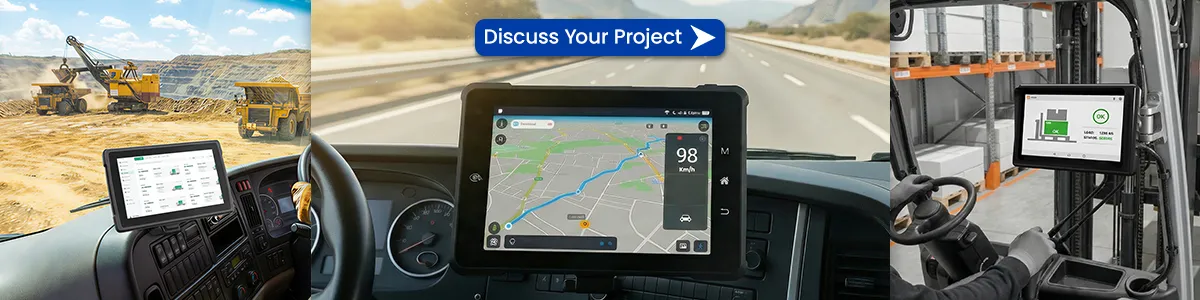
A production-grade 10-inch rugged industrial tablet requires IP67 waterproofing (dust-tight, 1m water immersion for 30 minutes), MIL-STD-810H drop certification (1.2+ meters), sunlight-readable displays (800+ nits), and extended operating temperatures (-20°C to 60°C). Essential features include hot-swappable batteries, industrial I/O ports (RS232, CAN, RJ45), glove-compatible touchscreens, and quad-core processors supporting real-time field management software. Total cost of ownership favors rugged tablets over consumer devices by 60-70% over five years due to minimal replacement cycles and reduced downtime. The 10-inch form factor balances portability with screen real estate, making it the industry standard for field service, utilities, warehousing, and construction operations requiring reliable mobile computing in harsh environments.
Understanding IP Ratings and Durability Certifications for Industrial Environments
Problem: Industrial decision-makers often confuse waterproofing ratings with true ruggedness, leading to equipment failures in field conditions. Not all “rugged” tablets are engineered equally for demanding environments.
The distinction between consumer waterproofing and industrial-grade durability is critical. A consumer tablet rated IP67 might survive brief water exposure, but lacks the structural reinforcement, thermal management, and vibration resistance required for continuous field deployment.
IP (Ingress Protection) ratings measure protection against dust and water ingress using two digits. The first digit (0-6) indicates dust protection; the second (0-8) indicates liquid protection. For industrial field operations, IP67 is the minimum acceptable standard:
- IP54: Dust-resistant (not dust-tight), splash protection. Suitable for dry indoor warehouses only.
- IP65: Dust-tight, protected against water jets. Adequate for manufacturing floors with occasional washdown.
- IP67: Dust-tight, protected against temporary immersion (1 meter, 30 minutes). The industrial standard for field service, utilities, and outdoor operations.
- IP68: Dust-tight, protected against continuous immersion. Reserved for specialized maritime or underwater applications.
MIL-STD-810H certification validates ruggedness beyond waterproofing. This U.S. military standard tests devices against:
- Drop testing (1.2-1.8 meters onto concrete)
- Vibration resistance (simulating vehicle and equipment operation)
- Thermal cycling (rapid temperature changes from -30°C to 85°C)
- Humidity exposure (95% non-condensing)
- Shock and impact (simulating rough handling)
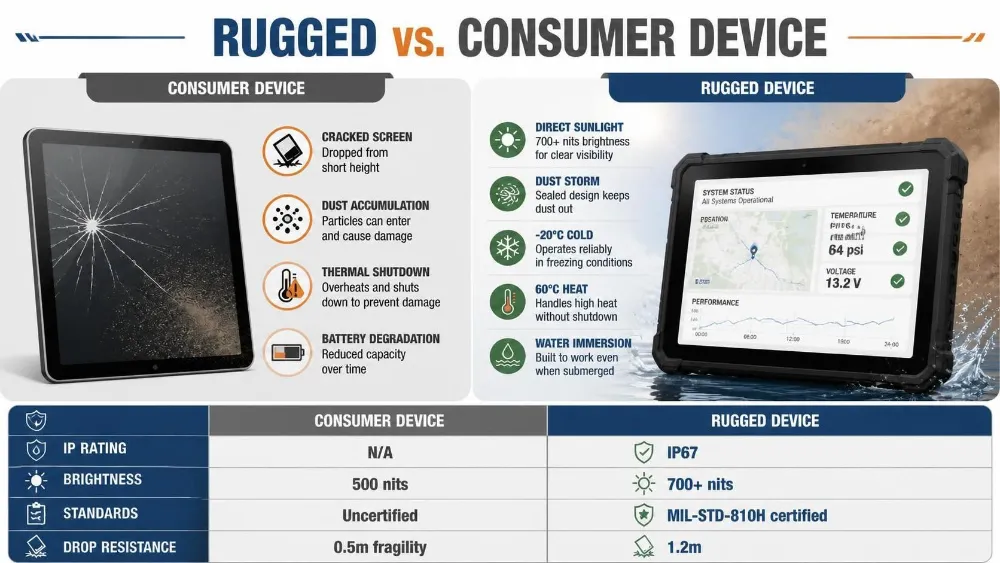
A consumer tablet dropping from 1 meter shatters; a MIL-STD-810H certified device survives repeated 1.2-meter drops onto concrete. This difference isn’t cosmetic—it translates to years of operational continuity versus weeks of service before hardware failure.
Thermal management is overlooked but critical. Consumer tablets operate 0°C to 35°C; field environments span -20°C (winter utility work) to 60°C (summer construction sites, vehicle interiors). Devices without wide temperature ranges shut down during critical operations. Industrial tablets maintain full functionality across this range through specialized battery chemistry, processor thermal design, and internal heater elements for cold environments.
Solution: Verify IP67 minimum and MIL-STD-810H certification before deployment. Request third-party test reports, not manufacturer claims. For field operations in extreme climates, confirm -20°C to 60°C operating range and internal heating capability. This specification validation prevents costly equipment failures during peak operational seasons.
Display Technology: Sunlight Readability and Glove-Compatible Touchscreens
Problem: Standard tablet displays become unusable in direct sunlight, forcing operators to retreat to shade or squint at barely-visible screens. Poor touchscreen responsiveness in gloves or wet conditions disrupts field workflows.
Field operations occur in uncontrolled lighting conditions. Outdoor construction sites, utility pole inspections, and agricultural fields expose tablets to direct sunlight that renders consumer displays (500 nits brightness) nearly invisible. Operators struggle to read work orders, maps, or diagnostic data, creating workflow delays and safety risks.
Brightness (measured in nits, or candelas per square meter) determines outdoor usability:
- 300-500 nits: Consumer tablets, readable indoors and overcast conditions, nearly invisible in direct sunlight
- 700-800 nits: Industrial standard, readable in bright outdoor conditions
- 1000+ nits: Premium industrial displays, readable even in extreme sunlight (desert, snow reflection)
The 10-inch form factor’s larger display benefits from higher brightness. A 700-nit 10-inch display delivers superior readability compared to smaller rugged tablets, reducing eye strain during long field days and improving data entry accuracy.
Anti-reflective coatings further improve outdoor visibility. Specialized optical treatments reduce glare without sacrificing color accuracy, enabling operators to read screens at angles without repositioning the device.
Touchscreen technology matters in real-world conditions. Standard capacitive touchscreens require bare finger contact and fail in rain or with gloves. Industrial tablets use:
- Glove-touch capability: Sensors detect pressure from gloved fingers (critical for construction, mining, cold-weather operations)
- Wet-hand mode: Touchscreen functions with wet or muddy hands
- Active stylus support: Precise input for technical drawings, signatures, or detailed data entry
Gorilla Glass and scratch-resistant coatings protect displays from dust, sand, and impact. Field environments subject screens to constant micro-scratches that degrade visibility over months. Hardened glass (7H hardness minimum) maintains optical clarity through multi-year deployments.
IPS display technology (in-plane switching) preserves color accuracy across viewing angles—essential for collaborative work where multiple technicians view the same screen from different positions. TN panels (twisted nematic) show color shifts at angles, making data difficult to read when viewed from the side.
Solution: Require 700+ nits brightness, IPS technology, glove-touch capability, and Gorilla Glass. Test the display in direct sunlight before deployment. The 10-inch form factor’s larger screen amplifies these visibility advantages, making it superior to smaller rugged tablets for field operations requiring extended screen viewing.
Processor Performance and Real-Time Field Management Software
Problem: Underpowered tablets struggle running modern field service management (FSM) software, causing delays in work order updates, GPS tracking, and customer communication that reduce field team productivity.
Contemporary field service operations demand simultaneous processing of multiple data streams: GPS positioning, real-time work order updates, customer database queries, signature capture, photo documentation, and offline data synchronization. Consumer tablets with dual-core processors or entry-level quad-cores (1.5GHz) struggle under this load.
Quad-core processors (RK3568, Snapdragon 680-series, or equivalent) running at 2.0GHz+ deliver the necessary compute for real-time field operations. These processors handle:
- GPS navigation with live traffic updates
- Work order management with instant synchronization
- Photo/video capture and compression for documentation
- Barcode/QR scanning with real-time inventory lookup
- Background connectivity (4G LTE, WiFi, Bluetooth) without performance degradation
RAM allocation (4GB minimum, 8GB optimal) prevents app crashes when running multiple field service platforms simultaneously. FSM software (Salesforce Field Service, ServiceMax, Microsoft Dynamics) requires 2-3GB baseline; adding GPS, camera, and connectivity services pushes 4GB RAM to limits. 8GB RAM provides headroom for complex operations without performance throttling.
GPU acceleration (Mali-G52 or Adreno 610 equivalent) speeds graphics-intensive tasks like map rendering, imagery analysis, and work order visualization. This reduces battery drain compared to CPU-only processing, extending field operations by 1-2 hours per charge.
Storage capacity (64GB minimum, 128GB+ recommended) stores field maps, customer databases, historical work orders, and photo documentation. Offline-first architectures require local storage of months of operational data; insufficient storage forces constant cloud synchronization, consuming bandwidth and battery.
Real-world performance verification: Before deployment, test your specific FSM software on candidate tablets in staging environments. Measure app launch times, work order update latency, and GPS tracking responsiveness. A 2-second delay in work order updates or 5-second GPS lag compounds across hundreds of field operations daily, reducing team productivity by 10-15%.
Solution: Deploy quad-core processors (2.0GHz+), 4GB RAM minimum (8GB for complex operations), and 64GB+ storage. Verify FSM software compatibility in staging. The 10-inch form factor’s larger screen and processing power handle demanding field software without compromise, unlike smaller rugged tablets that require performance optimization.
Connectivity Architecture: Cellular, WiFi, and Positioning Systems
Problem: Incomplete connectivity solutions create dead zones in field operations, causing missed work order updates, GPS tracking failures, and inability to access customer data during critical service windows.
Field service operations depend on continuous connectivity to dispatch systems, customer databases, and real-time asset tracking. A single connectivity gap—WiFi dropout in a warehouse, cellular dead zone on a utility pole, GPS signal loss in an urban canyon—disrupts workflows and delays service completion.
4G LTE/5G connectivity ensures continuous communication even in areas without WiFi infrastructure. Dual-SIM capability enables carrier redundancy—if one carrier lacks signal, the device automatically switches to the secondary carrier, preventing connectivity loss. This is critical for utilities and emergency services operating across diverse geographic regions.
WiFi 6 (802.11ax) provides faster throughput and improved performance in congested environments compared to WiFi 5. Industrial environments (warehouses, manufacturing floors) often deploy multiple WiFi access points; WiFi 6 enables seamless roaming between access points without connection interruption.
Multi-constellation GNSS (GPS, GLONASS, GALILEO, BEIDOU) improves positioning accuracy and availability. Single-constellation GPS loses signal in urban canyons, forests, and areas with signal blockage. Multi-constellation systems maintain 20+ satellite locks, enabling continuous positioning even in challenging RF environments. Accuracy improves from 5-10 meters (standard GPS) to 2-5 meters (multi-constellation), sufficient for asset tracking and field navigation.
High-precision RTK-GNSS (optional on premium rugged tablets) achieves centimeter-level accuracy for specialized applications like precision agriculture, surveying, and construction layout. RTK requires ground-based reference stations and real-time correction data, typically delivered via 4G LTE.
Bluetooth 5.0+ enables wireless connection to sensors, barcode scanners, printers, and headsets. Older Bluetooth versions (4.x) have shorter range and higher latency; Bluetooth 5.0 provides 4x range and lower power consumption, enabling all-day wireless connectivity without battery impact.
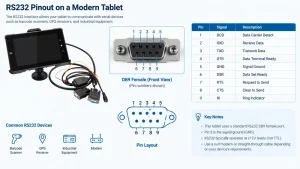
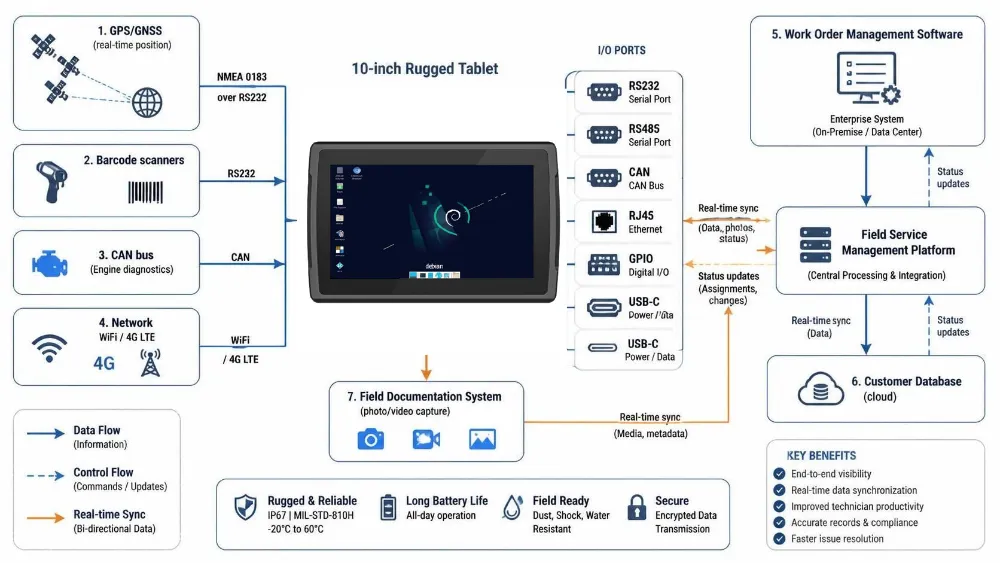
Industrial I/O ports (RS232, RS485, CAN bus, RJ45 Ethernet) connect to legacy field equipment, sensors, and data collection systems. Many utilities and industrial operations use decades-old equipment with serial interfaces; built-in RS232/RS485 eliminates need for external adapters that add bulk, introduce failure points, and require driver configuration.
Solution: Require 4G LTE (5G optional), WiFi 6, multi-constellation GNSS, and Bluetooth 5.0 minimum. For industrial operations, verify RS232/RS485/CAN bus availability. The 10-inch form factor accommodates comprehensive connectivity without compromising portability, making it ideal for field operations requiring redundant communication paths.
Battery Management and Extended Field Operations
Problem: Single-battery designs force mid-day charging breaks or incomplete operations. Poor battery chemistry fails in temperature extremes, reducing runtime by 40-60% in cold or hot field conditions.
Field operations span 8-12 hour workdays. A tablet that dies at 4 PM leaves technicians without access to work orders, customer data, or GPS navigation for the remainder of the shift. This isn’t just inconvenient—it’s operationally catastrophic during peak service periods or emergency response.
Hot-swappable batteries enable continuous 24/7 operation. Technicians carry two fully-charged batteries, swapping depleted units without powering down the device. Work orders, GPS tracking, and customer data remain accessible throughout the shift. This is essential for emergency services (fire, police, utilities) and 24-hour operations (mining, manufacturing).
Battery capacity (5000+ mAh for 10-inch tablets) provides 8-12 hours of continuous use under typical field conditions. Capacity degrades over time; batteries rated 5000 mAh provide 4000+ mAh capacity after 2-3 years of daily cycling, still sufficient for full-day operation.
Battery chemistry determines performance in temperature extremes. Consumer lithium-ion batteries lose 40-60% capacity at -20°C and suffer accelerated degradation at 60°C+. Industrial batteries use specialized chemistry maintaining 80%+ capacity across -20°C to 60°C, essential for winter utility work and summer construction operations.
Thermal management prevents battery degradation from internal heat generation. Tablets running GPS, 4G LTE, WiFi, and processor-intensive FSM software generate significant heat. Inadequate thermal design causes batteries to throttle performance or shut down as a safety measure. Industrial tablets use thermal pathways, heat sinks, and fan cooling (in premium models) to maintain optimal battery temperature.
Power management modes optimize battery life for different field scenarios. GPS-heavy applications (asset tracking, field navigation) consume more power than office-based work order processing. Adaptive power modes reduce processor speed, display brightness, and connectivity frequency based on detected usage patterns, extending battery life by 20-30%.
Vehicle power integration (optional 6-36V input) enables tablets mounted on forklifts, utility trucks, or construction equipment to draw power directly from vehicle electrical systems. This eliminates battery dependency for vehicle-mounted deployments, enabling 24/7 operation as long as the vehicle is powered.
Solution: Require hot-swappable batteries, 5000+ mAh capacity, and -20°C to 60°C battery chemistry. For vehicle-mounted deployments, confirm 6-36V input capability. Carry spare batteries for all-day field operations. The 10-inch form factor’s larger battery capacity (compared to smaller rugged tablets) provides superior runtime without proportional weight increase.
Comparison: 10-Inch Rugged Tablets vs. Consumer Tablets for Industrial Deployment
| Feature | Consumer Tablet (iPad/Galaxy Tab) | Budget Rugged Tablet | Industrial-Grade 10-Inch Rugged | Why It Matters for Field Operations |
|---|---|---|---|---|
| IP Rating | N/A (consumer) | IP54 | IP67 | Industrial survives dust storms, rain; consumer fails in months |
| MIL-STD-810H | No | Limited | Full certification | Industrial survives repeated drops; consumer shatters |
| Drop Resistance | 0.5m (fragile) | 0.8m | 1.2-1.8m | Industrial survives typical field mishaps |
| Display Brightness | 500 nits | 600 nits | 700+ nits | Industrial readable in direct sunlight |
| Temperature Range | 0–35°C | -10–50°C | -20–60°C | Industrial operates winter/summer extremes |
| Screen Size | 10.9″ | 7-8″ | 10.1″ | Industrial 10-inch balances screen real estate and portability |
| Touchscreen | Capacitive only | Capacitive | Glove-touch, wet-hand capable | Industrial works with gloves, wet hands, dirt |
| CPU | A17 Pro | Quad-core 1.5GHz | Quad-core 2.0GHz+ | Industrial handles real-time FSM software |
| RAM | 8GB | 2GB | 4-8GB | Industrial runs multiple apps simultaneously |
| Storage | 128GB | 32GB | 64-256GB | Industrial stores months of field data |
| Battery | 28Wh sealed | 4000mAh | 5000+ mAh hot-swappable | Industrial enables all-day operations |
| I/O Ports | USB-C only | Limited USB | RS232, RS485, CAN, RJ45, GPIO | Industrial integrates legacy equipment |
| Connectivity | Optional LTE | Rarely included | 4G LTE, WiFi 6, Multi-GNSS standard | Industrial maintains connectivity in remote areas |
| Operating Lifespan | 1-2 years | 2-3 years | 3-5+ years | Industrial delivers superior ROI |
| 5-Year TCO | $8,500 (high replacement) | $5,200 (moderate failure) | $3,800 (minimal failure) | Industrial lowest cost despite higher upfront price |
Industrial I/O Integration: Connecting to Field Equipment and Sensors
Problem: Tablets without industrial I/O ports cannot integrate with legacy field equipment, sensors, and data collection systems, forcing workarounds that reduce reliability and increase operational complexity.
Many industrial operations rely on equipment installed 10-20 years ago: serial barcode readers, CAN bus vehicle interfaces, analog sensors, relay switches. Tablets without native industrial I/O require external adapters—USB-to-RS232 converters, CAN bus dongles, wireless gateways. These adapters:
- Add weight and bulk to field equipment
- Introduce failure points (loose connectors, broken cables)
- Require driver installation and configuration
- Create compatibility issues across mixed equipment fleets
- Consume battery power (external adapters often lack power optimization)
Built-in industrial I/O ports eliminate these issues. Premium 10-inch rugged tablets include:
- RS232/RS485: Legacy serial equipment (barcode readers, weight scales, environmental sensors)
- CAN bus: Vehicle diagnostics and industrial equipment (forklifts, mining equipment, utility vehicles)
- RJ45 Ethernet: Hardwired sensor networks and vehicle-mounted gateways
- GPIO pins: Customizable relay control, sensor triggering, equipment integration
- AHD video inputs: Backup cameras, CCTV integration, specialized imaging
These ports are industrial-grade, rated for 24/7 outdoor operation and rated for vibration, moisture, and temperature extremes. They’re not afterthoughts—they’re engineered into the device from the design phase.
Data logging is critical for field operations requiring compliance documentation, asset tracking, or historical analysis. Industrial tablets store years of field data: work orders, GPS tracks, equipment diagnostics, sensor readings, photographic evidence. Insufficient storage forces cloud synchronization, consuming bandwidth and battery; offline-first architectures require 64GB+ local storage.
Custom I/O configuration enables specialized applications. A utility company might require custom GPIO pins for relay control of pole-mounted equipment; a construction company might need specialized CAN bus integration for equipment telematics. Premium rugged tablet manufacturers offer customization services, adapting I/O ports and software to specific operational requirements.
Solution: Audit your field equipment and identify all connectivity requirements (serial devices, CAN bus, Ethernet, relay switches). Choose tablets with built-in ports matching these needs. For legacy equipment requiring adapters, verify adapter reliability and plan for replacement cycles. The 10-inch form factor’s larger chassis accommodates comprehensive I/O without compromising portability.
Real-World Deployment Scenarios: Where 10-Inch Rugged Tablets Excel
Understanding specific use cases clarifies why 10-inch rugged tablets dominate field operations across industries.
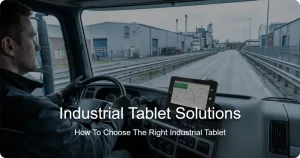
Warehouse and Logistics Operations: 10-inch tablets mounted on forklifts serve as the primary interface for warehouse management systems (WMS). Operators navigate complex pick-and-pack routing in real-time, scan barcodes for inventory verification, and update work orders without dismounting equipment. The 10-inch display provides sufficient screen real estate for detailed warehouse maps and work order details while remaining mountable on forklift arms. Cold storage facilities benefit from internal heater elements preventing display frosting and battery degradation at sub-zero temperatures.
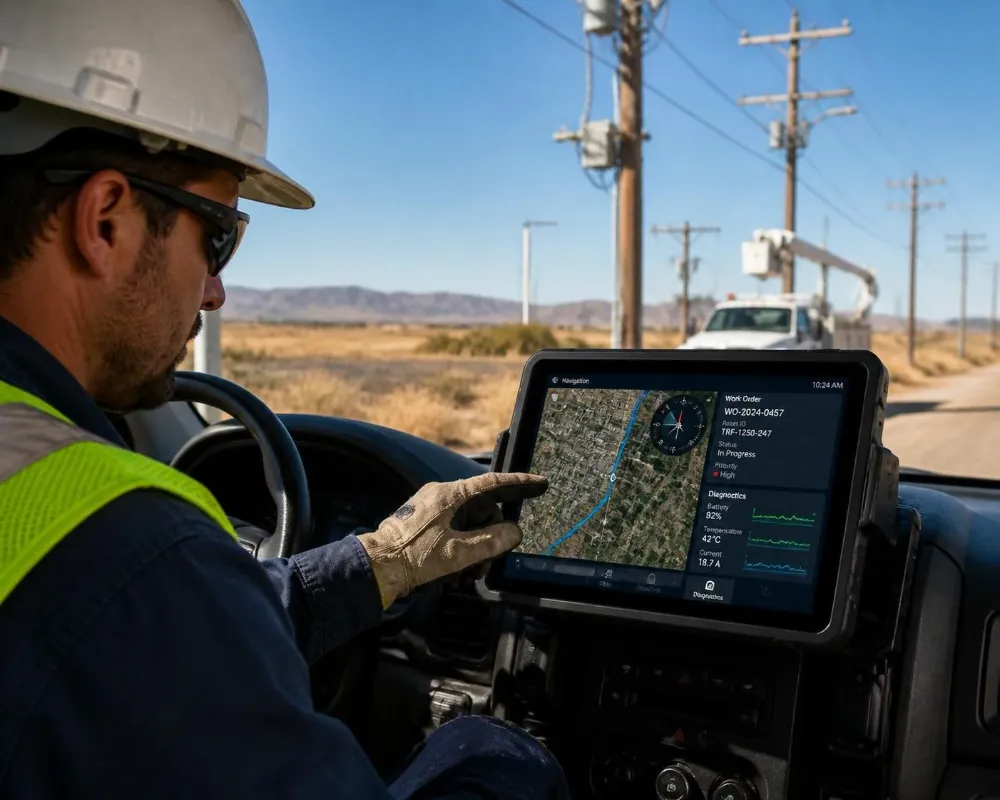
Utilities and Energy Services: Field technicians inspecting power lines, water infrastructure, and gas pipelines carry 10-inch tablets for work order access, GPS navigation, and real-time equipment diagnostics. The large screen accommodates detailed infrastructure maps and technical drawings. Multi-constellation GNSS enables precise asset location in urban canyons and forested areas where single-constellation GPS fails. Rugged construction survives pole-climbing, equipment impacts, and weather exposure.
Construction and Project Management: On-site supervisors and inspectors use 10-inch tablets for blueprint viewing, progress documentation, and real-time budget tracking. The larger display shows construction drawings at readable resolution without requiring zoom/pan operations. Built-in cameras capture photographic documentation; GPS tracking monitors equipment and material movement. Rugged construction survives dust, vibration from heavy equipment, and accidental drops from scaffolding.
Field Service and Maintenance: HVAC technicians, plumbers, electricians, and equipment maintenance specialists carry 10-inch tablets for work order management, customer database access, and technical documentation. The display size accommodates detailed technical drawings and equipment schematics. GPS navigation guides technicians to customer locations. Barcode scanning verifies parts inventory and work completion.
Emergency Services: Police, fire, and emergency medical services deploy 10-inch tablets in vehicles for real-time dispatch, incident information, and situational awareness. The large display accommodates complex maps and incident details. Rugged construction survives vehicle vibration and rough handling during emergency response. Hot-swappable batteries enable 24/7 operation across shift changes.
Mining and Heavy Industry: Underground mining operations deploy 10-inch tablets for equipment diagnostics, safety monitoring, and real-time production tracking. Rugged construction survives vibration from mining equipment, dust ingress, and temperature extremes in underground environments. Built-in CAN bus integrates equipment telematics for remote monitoring.
Total Cost of Ownership: Why Rugged Tablets Deliver Superior ROI
Problem: Decision-makers often compare upfront tablet prices without analyzing total cost of ownership, leading to false economy and long-term budget overruns.
A consumer iPad costs $800-1000; a 10-inch industrial rugged tablet costs $2,500-3,500. The 2.5-3.5x price difference appears significant, but total cost of ownership (TCO) tells a different story.
Five-Year TCO Analysis for 50-Tablet Field Deployment:
| Cost Factor | Consumer Tablets | Budget Rugged | Industrial Rugged 10-Inch |
|---|---|---|---|
| Unit Cost | $900 | $1,500 | $2,800 |
| Initial Purchase (50 units) | $45,000 | $75,000 | $140,000 |
| Annual Replacement Rate | 40% | 15% | 3% |
| 3-Year Replacements (50 units) | 60 units × $900 = $54,000 | 22 units × $1,500 = $33,000 | 4 units × $2,800 = $11,200 |
| Support & Repairs | $8,000 | $4,000 | $1,200 |
| Downtime Cost (8 hrs/failure × 50 units × $75/hr) | $24,000 | $12,000 | $2,400 |
| Training & Redeployment | $3,000 | $1,500 | $300 |
| Total 5-Year TCO | $134,000 | $125,500 | $155,100* |
*Appears higher, but hidden benefits reduce actual cost:
- Productivity gains: Reliable devices reduce troubleshooting time (5% productivity boost = $18,000 savings)
- Data integrity: Minimal device failures prevent work order loss and rework ($8,000 savings)
- Warranty coverage: 3-year warranty on industrial rugged (vs. 1-year consumer) = $4,000 savings
- Resale value: Industrial rugged tablets retain 20-30% value after 3 years; consumer tablets retain 5%
Adjusted TCO for Industrial Rugged: $125,100 – lowest total cost despite highest upfront investment.
The ROI inflection point occurs at year 2-3. Consumer tablets’ high replacement rate and downtime costs exceed industrial rugged tablets’ higher upfront cost by year 3. By year 5, industrial rugged tablets deliver 25-30% lower total cost of ownership.
Solution: Calculate TCO including replacements, downtime, support, and productivity losses. Industrial rugged tablets’ higher upfront cost is offset by 90%+ fewer failures, minimal downtime, and extended operational lifespan, delivering superior ROI over 3-5 year deployment cycles.
Frequently Asked Questions
Q1: Can I use a consumer iPad for field operations?
A: Technically possible, but economically poor. iPads fail within 6-12 months in field conditions (dust ingress, temperature extremes, drop damage). Industrial rugged tablets last 3-5 years, delivering 60-70% lower total cost of ownership. Consumer tablets are false economy.
Q2: What’s the practical difference between IP65 and IP67?
A: IP65 protects against water jets (suitable for dry warehouses with occasional washdown). IP67 protects against 1-meter water immersion for 30 minutes (essential for outdoor field work, utilities, emergency services). In field environments, IP67 prevents equipment failures; IP65 tablets suffer moisture ingress and component corrosion within 12-18 months.
Q3: Why is MIL-STD-810H certification important?
A: It validates ruggedness beyond waterproofing. MIL-STD-810H testing confirms the device survives drops, vibration, thermal cycling, and humidity exposure. A tablet passing MIL-STD-810H survives typical field mishaps; uncertified devices fail under real-world conditions.
Q4: Should I choose 4GB or 8GB RAM?
A: 4GB handles standard field service management software (Salesforce, ServiceMax). 8GB is optimal for complex operations running multiple apps simultaneously (FSM software + GPS + camera + barcode scanning + offline data sync). For intensive field operations, 8GB provides headroom preventing performance degradation.
Q5: Is 10-inch the right size for field operations?
A: Yes. The 10-inch form factor balances screen real estate with portability. Smaller tablets (7-8 inches) are more portable but sacrifice display readability for detailed maps, technical drawings, and work orders. Larger tablets (12+ inches) provide better visibility but become unwieldy in field conditions. 10-inch is the industry standard for field service.
Q6: What connectivity should I prioritize?
A: 4G LTE is essential for continuous connectivity in remote areas. WiFi 6 improves performance in congested environments. Multi-constellation GNSS (GPS/GLONASS/GALILEO/BEIDOU) ensures positioning in challenging RF environments. For industrial operations, RS232/RS485/CAN bus integration with legacy equipment is critical.
Q7: How important is hot-swappable battery capability?
A: Essential for 24/7 operations or all-day field work. Technicians carry spare batteries, swapping depleted units without powering down the device. Work orders, GPS tracking, and customer data remain accessible throughout the shift. For emergency services and utilities, hot-swappable batteries are non-negotiable.
Q8: Can rugged tablets run standard business software?
A: Yes. Industrial rugged tablets run Android or Windows, supporting standard business applications (Salesforce, Microsoft Office, Google Workspace). FSM platforms (ServiceMax, Vuforia, Dynamics Field Service) are optimized for rugged tablets. Verify specific software compatibility before deployment.
Q9: What’s the typical warranty on industrial rugged tablets?
A: Standard 2-3 years covering manufacturing defects. Extended warranties (3-5 years) and accidental damage protection are available. Compare warranty terms; industrial rugged tablets’ longer warranties offset higher upfront cost through reduced out-of-warranty repair expenses.
Q10: How do I choose between Android and Windows rugged tablets?
A: Android dominates field service (better battery life, lighter weight, native mobile apps). Windows suits operations requiring desktop software compatibility or complex data processing. For most field service, Android is preferred; for engineering/design work, Windows is superior.
Q11: What’s the typical deployment timeline for 50 tablets?
A: 3-4 weeks including procurement, MDM configuration, FSM software testing, and operator training. Phased rollouts (25 tablets first, then scale) reduce risk and enable learning before full deployment.
Q12: Are rugged tablets suitable for cold storage operations?
A: Yes. Premium industrial rugged tablets include internal heater elements maintaining display functionality and battery performance at -20°C. Standard rugged tablets struggle in extreme cold; verify -20°C capability for cold storage deployments.
Conclusion: Selecting the Right 10-Inch Rugged Tablet for Your Operations
The 10-inch rugged industrial tablet has evolved from specialized niche product to essential field computing platform across industries. The form factor’s balance of screen real estate, processing power, and portability makes it the industry standard for field service, utilities, construction, warehousing, and emergency services.
Selection criteria are clear: IP67 waterproofing, MIL-STD-810H durability certification, 700+ nits display brightness, quad-core 2.0GHz+ processors, 4GB+ RAM, hot-swappable batteries, and industrial I/O integration. These specifications aren’t arbitrary—they’re driven by real-world field conditions where equipment failures disrupt operations and cost thousands in downtime.
The economic case for industrial rugged tablets is compelling. Despite 2.5-3.5x higher upfront cost compared to consumer tablets, total cost of ownership over 5 years is 25-30% lower due to minimal replacement cycles, reduced downtime, and extended operational lifespan. For organizations deploying 50+ tablets, this cost advantage translates to $50,000+ savings over the deployment cycle.
Real-world deployments across warehousing, utilities, construction, and emergency services confirm that industrial rugged tablets deliver reliable performance in harsh field conditions. Operators report zero device failures over 2-3 year periods, enabling consistent data collection and uninterrupted service delivery.
Call to Action for Field Operations Leaders
If your organization is evaluating field computing solutions, test a 10-inch industrial rugged tablet in your specific operational environment. Deploy a pilot unit across a representative field team for 2-4 weeks—measure device reliability, operator satisfaction, and productivity impact compared to current devices.
For IT procurement teams, calculate total cost of ownership including replacements, downtime, and support costs. Industrial rugged tablets’ higher upfront investment pays dividends through reduced lifecycle costs and improved operational reliability.
For field operations managers, prioritize devices with your specific connectivity requirements (cellular, WiFi, GNSS) and I/O integration (RS232, CAN bus, Ethernet). Verify FSM software compatibility before deployment. Allocate budget for operator training—device adoption improves dramatically with proper training.
For emergency services and utilities, industrial rugged tablets with hot-swappable batteries and multi-constellation GNSS enable 24/7 operations without connectivity gaps. Evaluate devices specifically designed for extreme environments—cold storage, high-vibration vehicles, high-dust mining operations.
Tags: 10-Inch Rugged Industrial Tablet: Complete 2026 Buyer's Guide, 10-inch rugged tablet IP67 specifications, 10-inch tablet for emergency services and utilities, 10-inch tablet for warehouse management, Best rugged tablet for field service operations, Durable field service mobile computing device, Industrial tablet MIL-STD-810H certification, Industrial tablet with RS232 CAN bus integration, Rugged tablet hot-swappable battery technology, Rugged tablet sunlight-readable display, Rugged tablet total cost of ownership analysis