Picture this: a construction foreman drops his tablet off a scaffold on Monday. It cracks on Wednesday. By Friday, it’s dead — along with every inspection photo, work order, and signature stored on it.
Or a warehouse manager whose consumer tablet stops responding after six months of dust, forklift vibrations, and temperature swings.
These aren’t edge cases. They’re the exact reason rugged tablets exist — and why businesses that buy them once stop buying replacement tablets four times a year.
This guide covers everything you need to know: what a rugged tablet actually is, how to read those confusing protection ratings, whether the higher price is really worth it, and which type fits your work environment.

What Is a Rugged Tablet?
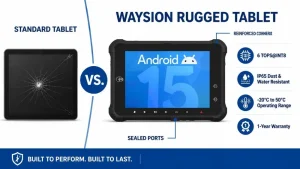
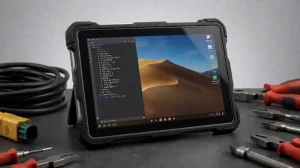
A rugged tablet is a tablet computer engineered to survive harsh environments — drops, water, dust, extreme temperatures, and constant vibration — that would destroy a normal consumer tablet.
But here’s the part most people miss: “rugged” isn’t a marketing word. It’s a set of measurable, certified standards. Two of them matter most, and once you understand them, comparing tablets becomes dramatically easier.
IP Rating: What Those Numbers Actually Mean
Every serious rugged tablet carries an IP rating (Ingress Protection) — two digits that tell you exactly what the device can keep out.
| Rating | Dust Protection | Water Protection | Real-World Meaning |
|---|---|---|---|
| IP54 | Dust-protected | Splash-resistant | Survives a worksite, not a rainstorm |
| IP65 | Fully dust-tight | Withstands water jets | Fine in rain, hose-down cleaning |
| IP67 | Fully dust-tight | Survives 30 min underwater (1m) | Dropped in a puddle? Pick it up, keep working |
| IP68 | Fully dust-tight | Continuous underwater (depth varies) | The toughest common rating |
Quick way to remember it:
- First digit = solids (dust, sand, dirt). 6 is the max.
- Second digit = liquids. 7 means submersible; 8 means more submersible.
So when a spec sheet says IP65 tablet, it means fully dust-proof and rain-proof — ideal for construction sites and outdoor logistics. An IP68 tablet goes further and handles full submersion.
One honest caveat: manufacturers test under lab conditions. An IP67 rating means 1 meter of still, fresh water for 30 minutes — not ocean waves, not chlorinated pools, not repeated dunks.
MIL-STD-810G: The Military Drop-Test Standard
The second certification you’ll see everywhere is MIL-STD-810G — a U.S. military testing standard covering everything from drop impact to thermal shock to vibration.
Here’s the consumer-friendly translation:
- A regular tablet expects to be handled carefully.
- A MIL-STD-810G tablet expects to be dropped on concrete.
Most rugged tablets certified under this standard survive drops of 4 to 6 feet (1.2–1.8 meters) onto concrete — roughly the height of a workbench or a forklift seat. Many are also tested across operating ranges like -4°F to 140°F (-20°C to 60°C), which is why they keep working in freezers and on summer rooftops where consumer tablets shut down or throttle.
A practical warning: “MIL-STD-810G tested” is not the same as “MIL-STD-810G certified.” Some brands run one internal test and slap the label on. Reputable manufacturers publish the specific test methods (like Method 516.6 for drops). If a spec sheet doesn’t list which methods were used, ask.
Rugged Tablet vs. Consumer Tablet: The Real Comparison
This is the question every buyer asks: Why pay three times more when an iPad costs less?
Fair question. Here’s the honest answer, in numbers.
| Factor | Consumer Tablet | Rugged Tablet |
|---|---|---|
| Upfront price | 300–900 | 800–3,000+ |
| Drop survival | ~4 ft with a case, still a gamble | 4–6 ft bare, certified |
| Water/dust | None (unless cased) | IP65–IP68 standard |
| Operating temp | 32°F–95°F typical | -4°F to 140°F |
| Battery life | 8–10 hrs | 10–14+ hrs, hot-swappable on many models |
| Typical lifespan in field | 1.5–2 years | 4–5+ years |
| Accessories | Consumer cases | Vehicle docks, hand straps, barcode scanners, holsters |
The Counterintuitive Math: Total Cost of Ownership
Here’s where rugged tablets quietly win.
Say a crew of 10 field workers needs tablets:
- Consumer route: 10 iPads × 5,000. In a dusty, high-vibration environment, expect 2–3 failures per year. Over three years, you’ve replaced 6–9 units, plus downtime while data gets recovered and reinstalled. Realistic 3-year cost: 8,000–12,000.
- Rugged route: 10 rugged tablets × 14,000 upfront. But with a 4–5 year field lifespan, most units never need replacing. Realistic 3-year cost: ~$14,000 — with near-zero downtime.
The rugged option is more expensive on paper and often cheaper in practice — especially once you count the cost of a worker standing idle because their device died mid-shift.
When a consumer tablet is genuinely fine: indoor office work, light retail, any environment without dust, drops, or weather. Don’t overbuy.
Industrial Tablet vs. Commercial Rugged Tablet: A Second Layer Most Buyers Miss
Once you start shopping, you’ll notice the market splits again. Not all rugged tablets are the same tier, and choosing the wrong tier is the most expensive mistake in this category.
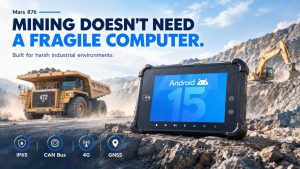
Commercial rugged tablets (sometimes called “semi-rugged” or “business rugged”) are built for logistics, retail, field service, and healthcare. Think warehouse scanning, delivery routes, hotel maintenance. They carry solid IP ratings and drop protection, run standard Android or Windows, and cost roughly 800–2,000.
Industrial tablets push further: extended temperature ranges, hazard-location certifications (like Class I Div 2 for oil and gas), sunlight-readable 1000-nit screens, expansion modules for specialized sensors, and 5+ year product lifecycles so your fleet stays consistent. Expect 2,000–4,000+.
The rule of thumb: buy for your actual worst day, not your theoretical worst day.
- A delivery driver in a city? Commercial rugged.
- A technician inside a refinery? Industrial, with the certifications to prove it.
- A warehouse freezer environment (-20°C)? Industrial or high-end commercial with a verified cold-rating — many “rugged” tablets fail here despite good IP scores.
Best Rugged Tablets for Business, by Scenario
Instead of a generic top-10 list, here’s how the market actually breaks down by use case.
For Warehouses and Logistics
Look at: Zebra ET4x series, Honeywell RT10
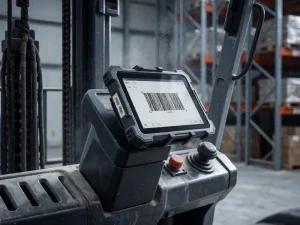
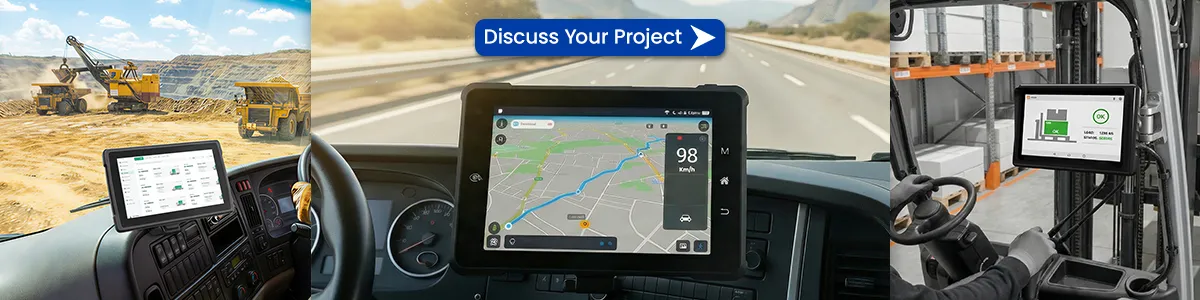
Warehouse work revolves around scanning. These models integrate barcode/RFID options, pair with vehicle docks for forklifts, and offer hot-swappable batteries so a shift never stops for charging. This is the classic outdoor tablet for warehouse operations that also move between dock and yard.
Why this category: the ecosystem matters more than the tablet — docks, mounts, scanners, and software support are where these brands earn their price.
For Construction and Field Services
Look at: Getac UX10 / F110, Trimble tablets
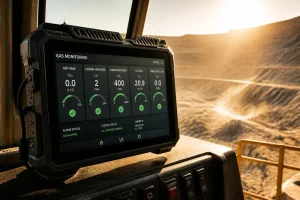
Construction demands the full package: MIL-STD-810G drop ratings, high-brightness screens readable in direct sun, wide temperature tolerance, and GNSS support for site surveying. Getac and Trimble dominate here because they’ve been hardened specifically for job sites, not adapted to them.
Why this category: sunlight readability is the spec everyone forgets until day one on site. A 400-nit screen is invisible at noon; these machines push 1,000+ nits.

Rugged Tablet Price Guide: What You Should Expect to Pay
Prices vary by region and configuration, but the market falls into clear tiers:
| Tier | Price Range | What You Get | Best For |
|---|---|---|---|
| Entry rugged | 400–800 | IP67, basic drop protection, Android | Light field work, small teams |
| Mid-range commercial | 800–2,000 | MIL-STD-810G, IP65–68, accessory ecosystem, Windows or Android | Logistics, retail, field service |
| High-end industrial | 2,000–4,000+ | Extreme temps, sunlight-readable 1000+ nit screens, hazard certifications, long lifecycles | Construction, energy, public safety |
Three buying notes:
- Accessories add up. A vehicle dock, spare batteries, and hand straps can add 20–30% to the total. Price the kit, not the tablet.
- Warranty matters more here than anywhere. Many industrial brands offer 3–5 year warranties with accidental-damage options. On a $2,500 unit, an extended warranty is usually worth it.
- Ask about lifecycle commitments. Industrial vendors often guarantee the same model stays purchasable for 3–5 years — critical when you’re standardizing a 50-unit fleet and one dies in year three.
FAQ
Q: Can a rugged tablet get wet — actually wet?
Check the second IP digit. IP65 handles rain and water jets. IP67 survives full submersion in up to 1 meter of water for 30 minutes. IP68 goes deeper. But no rating covers saltwater, pressurized hot water, or repeated dunks — treat the rating as a safety margin, not a license.
Q: Is MIL-STD-810G the same as being “military grade”?
Not exactly. MIL-STD-810G is a testing methodology, not a pass/fail guarantee. It defines how to test; the manufacturer decides which methods to run. A tablet that passed only the vibration test can still claim MIL-STD-810G. Always ask which specific methods (drop, thermal, humidity) were tested.
Q: Can I just put a rugged case on a consumer tablet instead?
Sometimes. A $50 case improves drop survival meaningfully for indoor-adjacent work. But it adds no true IP rating, no temperature tolerance, no certified drop height, and it makes the tablet bulky anyway. For genuinely harsh environments, cases are a stopgap, not a solution.
Q: Do rugged tablets run normal apps?
Yes — most run standard Android or Windows, so your inventory software, CRM, and forms apps work as-is. The exception is some fully industrial units with locked-down custom builds. If app compatibility matters (it always does), verify before buying.
Q: Are used or refurbished rugged tablets worth it?
More so than consumer tablets, actually. Because these devices are built for 4–5 year lives, a 2-year-old refurbished unit from a reputable seller often has years of service left at half price. Check battery health and warranty transferability first.
The Bottom Line
A rugged tablet isn’t an expensive tablet — it’s a cheaper tablet measured over five years instead of five months.
Your decision tree in three lines:
- Clean indoor environment? → Consumer tablet. Save your money.
- Dust, drops, weather, or vehicles in the picture? → Commercial rugged, IP65+ and MIL-STD-810G.
- Extreme cold, hazard zones, or mission-critical uptime? → Industrial tier, certifications verified.
Match the device to your worst real day, price the total cost of ownership, and the “expensive” rugged tablet almost always turns out to be the economical one.
Tags: benefits of rugged tablets, best rugged tablet for business, industrial tablet vs commercial tablet, IP rating tablet meaning, MIL-STD-810G tablet, outdoor tablet for warehouse/construction, rugged tablet price/cost comparison, rugged tablet vs consumer tablet, What is a rugged tablet